

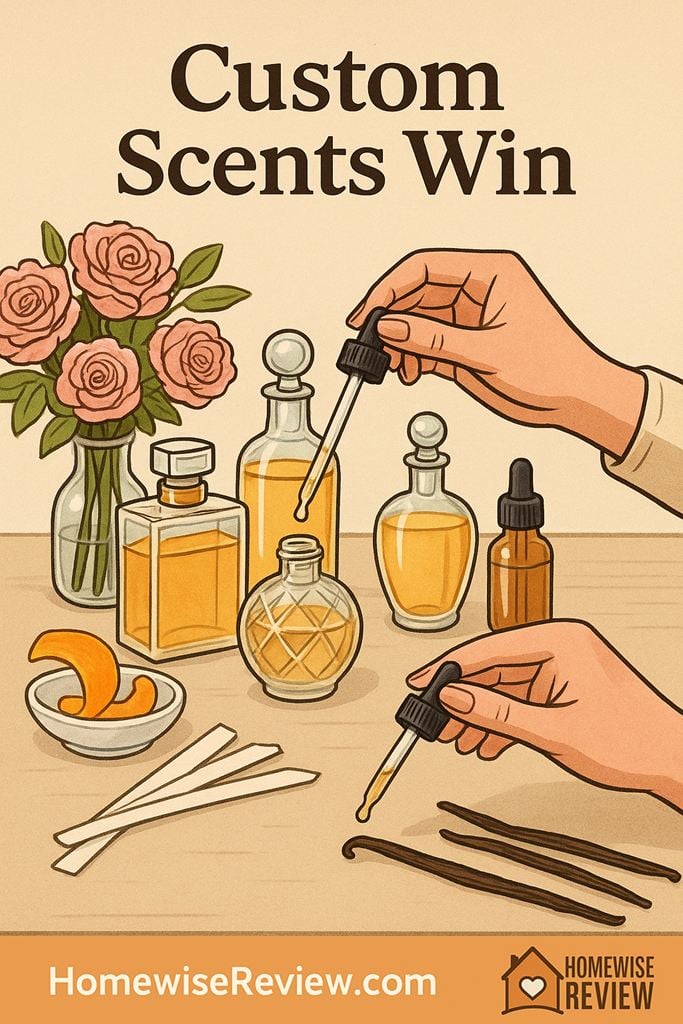
Custom fragrance is worth considering when the process helps you find and refine a scent you will actually wear, not merely when a quiz calls a standard bottle “made for you.” The term can describe a recommendation algorithm, a layering kit, a modified house base, or a perfumer developing a formula through several trials. Those services have very different costs, creative control, and reorder value. Before paying a premium, ask what is truly customized, how many revisions and samples are included, whether the formula is kept for reorders, who owns it, what happens if materials change, and whether you can test the final scent on skin before committing to a full bottle.
First, find out what “custom” actually means
| Service type | What changes | Best for | Key limitation |
|---|---|---|---|
| Recommendation quiz | The products shown to you | Narrowing a large ready-made catalog | The fragrance itself is not custom |
| Layering system | The ratio of existing scents you combine | Experimenting at home with reversible combinations | Results depend on repeatable application |
| Semi-custom blend | Notes or accords within a fixed base or menu | Guided choice without a long development process | Other customers may build something similar |
| Bespoke formula | A perfumer develops a formula through briefs and trials | A specific creative goal and long-term signature | Highest cost, longest process, and possible material changes |
A personalized path can be valuable even when the bottle is ready-made. A good questionnaire may reduce choice overload and direct you toward useful samples. The problem begins when marketing blurs selection with formulation. Ask the provider to name the level plainly.
Write a fragrance brief based on real wear
“Fresh but unique” is too vague. Build the brief around situations, contrasts, and limits. Describe where you will wear it, how far you want it to project, how long you need it to remain noticeable, and which familiar scents or materials you enjoy or dislike. Separate the emotional reference from a literal ingredient request: “a quiet coastal morning” gives a perfumer room to interpret, while “must contain five marine notes” may force a formula you do not enjoy.
- Primary use: office, everyday, evening, event, or gift.
- Desired presence: skin-close, noticeable at conversation distance, or more projecting.
- Climate and season: hot/humid, cold/dry, or year-round indoor wear.
- Preferences: three fragrances you enjoy and the exact part of each you like.
- Limits: notes, effects, or materials that cause dislike or symptoms.
- Practical target: budget, bottle size, deadline, and likely reorder frequency.
Sample the dry-down, not just the opening
A blotter is useful for comparing several trials without overloading your skin, but it cannot answer the final wear question. Test finalists on clean skin on separate days, using the same number of sprays and no strongly scented lotion. Record the opening, one-hour development, later dry-down, comfort, projection, and whether you still want to smell it after several hours.
Skin temperature, application, other products, environment, and perception can all change the experience. That does not mean a service can calculate a scientifically unique “skin chemistry formula” from a short quiz. Treat skin testing as product evaluation, not proof of a mystical match.
Ask the questions that determine long-term value
- Trials: How many mods, samples, and consultation rounds are included?
- Approval: Do you approve a skin-worn sample before the full bottle is made?
- Formula record: Will the provider retain the exact formula and batch notes?
- Ownership: Do you own the formula, receive it, or only receive the finished fragrance?
- Reorders: Is there a minimum size, setup fee, or expiration period?
- Material changes: How are substitutions handled if an ingredient becomes unavailable or restricted?
- Corrections: What happens when the approved full bottle differs materially from the sample?
- Gift orders: Can the recipient revise the scent, or is the buyer approving it for them?
The formula-ownership answer is especially important. A bespoke experience can still leave you dependent on one studio for every reorder. That may be acceptable, but it should be part of the price decision rather than a surprise years later.
Do not confuse customization with safety
A natural, artisan, personalized, or expensive fragrance can still contain substances that irritate or sensitize some people. The FDA explains that fragrance formulas can contain many natural and synthetic ingredients and may be listed simply as “Fragrance” under U.S. labeling rules. The agency also notes that some people can be allergic or sensitive to fragrance ingredients.
Ask for the finished product’s ingredient label and any allergen information the provider supplies. If you have a known fragrance allergy, asthma, or previous reaction, discuss it before development and follow medical guidance; a preference quiz is not an allergy assessment. Stop using the product and seek appropriate care if you develop a concerning reaction. In shared or fragrance-free spaces, a custom formula does not override another person’s need for clean air.
The International Fragrance Association says its standards ban, restrict, or set conditions for certain fragrance ingredients and are compulsory for members. Ask whether the manufacturer follows the current applicable IFRA standards, but do not treat that answer as a guarantee that an individual cannot react.
Use a simple value test
A custom service is a strong fit when you have a clear brief, enjoy the development process, receive meaningful trials, can approve the dry-down, understand formula and reorder terms, and value the result enough to wear it often. It is a weak fit when you mainly want a surprise, expect guaranteed compliments, cannot test before full-bottle purchase, or would be equally happy with a ready-made sample you already love.
Compare the total project price with a discovery set and a month of deliberate sampling. If the ready-made route produces a scent you love, custom formulation may add story rather than practical fit. If repeated sampling reveals a precise gap (too sweet, too loud, missing a particular texture), that is a much better bespoke brief.
For readers who want individuality with less commitment, our capsule perfume wardrobe guide shows how a small rotation can cover different situations without commissioning a formula.
Frequently Asked Questions
Is a fragrance quiz the same as custom perfume?
No. A quiz usually personalizes recommendations from an existing catalog. It can still be useful, but the formula is not made for you.
Is bespoke perfume guaranteed to smell unique?
A formula may be developed for your brief, but common materials and scent structures can still feel familiar. Ask what exclusivity and formula ownership actually mean in the contract.
Should I buy a custom fragrance as a surprise gift?
Only if the recipient can participate in sampling and revisions. Fragrance preference is difficult to predict, and the development experience is much of the value.
Can a custom fragrance avoid all allergens?
No service can promise that every person will tolerate a formula. Disclose known allergies, review available ingredient information, follow professional medical advice, and stop after a reaction.
Sources and evidence limits
For safety context, see the FDA’s fragrance and cosmetic-allergen guidance and IFRA’s public standards overview.
As an Amazon Associate, we earn from qualifying purchases made through links on our site.