

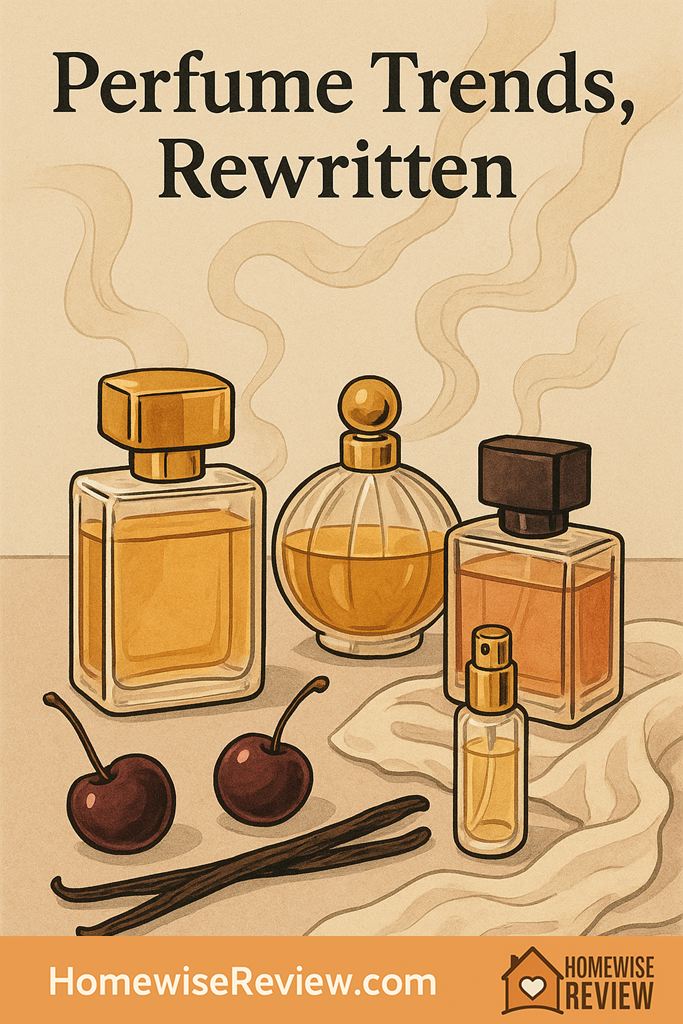
A useful fragrance wardrobe is built around situations, not hype. One close-wearing scent, one more expressive option, and samples for experimentation may cover more ground than a shelf of trend purchases.
You do not need to buy every popular note or replace a signature scent. Five widely discussed fragrance directions can instead act as decision tools: textured gourmand, quiet skin scent, dark fruit, gender-neutral note-first shopping, and small-format experimentation. Each solves a different problem. Gourmand adds warmth and comfort; a skin scent suits close settings; dark fruit provides contrast; gender-neutral shopping expands the search beyond the label; and travel sizes or discovery sets reduce the cost of learning. The limitation is important: these are style descriptions, not evidence that a perfume is high quality, long-lasting, or right for your skin. Test the exact fragrance through its drydown.
Choose wardrobe roles before note families
| Wardrobe role | Useful direction | Main question | When unnecessary |
|---|---|---|---|
| Comforting or evening scent | Textured gourmand | Do you enjoy sweetness after several hours? | You consistently tire of vanilla, cocoa, caramel, or edible accords |
| Office or close-contact scent | Skin scent or soft musk | Is subtle projection a benefit in your setting? | You need fragrance-free space or prefer a more noticeable trail |
| Distinctive accent | Dark fruit such as cherry with woods, spice, leather, or almond | Do the supporting notes prevent a syrupy effect? | You dislike fruit or the almond-like character some cherry accords create |
| Broader discovery | Shop by notes and mood rather than gender shelf | Would you wear the profile if the label were hidden? | You already know the exact category that works for you |
| Low-risk experimentation | Sample, discovery set, travel spray, or decant from an authorized source | Can you test enough full wears before committing? | You are replacing a finished bottle you already know well |
1. Use gourmand as a texture choice
Gourmand describes a fragrance with edible associations such as vanilla, cocoa, coffee, caramel, nuts, marshmallow, or baked notes. The useful distinction is not “sweet or not.” Look at what surrounds the sweetness. Dry woods, smoke, salt, spice, musk, amber-style accords, or citrus can make two vanilla fragrances behave very differently.
Choose a textured gourmand when you want warmth and an easy-to-understand scent identity. Choose another direction if sweet fragrances become tiring, if you work in a scent-sensitive environment, or if the intended use is hot outdoor weather. Test the late drydown: the bright opening may disappear while the sweet base remains.
2. Treat a skin scent as a projection decision
“Skin scent” is used loosely for fragrances designed or perceived to stay close, often using soft musks, light woods, ambrette-style effects, powder, iris, or transparent amber. The term does not guarantee low projection, and “musk” does not identify one standardized smell. It is a cue to test reach at a normal dose.
This role fits offices, travel, quiet social settings, or people who want occasional private whiffs rather than a room-filling trail. Its chief drawback is also the point: a close scent may feel poor value to someone who wants obvious projection. Ask another person whether it is noticeable at conversational distance before assuming it vanished.
3. Use dark fruit for contrast, not novelty
Cherry and other dark-fruit ideas can sit in several families. Paired with almond, vanilla, or liqueur-like accords, cherry can read gourmand. With leather, smoke, woods, rose, or spice, it can feel darker and less dessert-like. A note name alone therefore cannot tell you whether a fragrance will smell like candy, syrup, fruit skin, or an abstract floral-fruit accord.
Choose dark fruit when your wardrobe lacks a bold accent between sweet and woody styles. Avoid blind buying if medicinal, almond-like, or syrupy effects bother you. Test on skin and compare the first ten minutes with the two-hour drydown.
4. Shop note-first instead of gender-first
A gender label is marketing context, not a wearability rule. Citrus, woods, florals, vanilla, leather, tea, musk, and spice can be worn by anyone who enjoys the finished composition. Shopping note-first expands the options and makes comparison more precise: you can ask whether you prefer dry or sweet woods, airy or dense florals, and clean or warm musk.
This does not mean every fragrance is interchangeable or that cultural associations disappear. It means your skin test and comfort matter more than the shelf sign. If a gift is involved, ask about the recipient’s existing favorites rather than guessing from gender alone.
5. Make format part of the buying decision
Discovery sets, manufacturer samples, travel sprays, and smaller bottles can reduce blind-buy risk and help you learn across weather and settings. Compare cost per milliliter only after deciding whether you can realistically finish the larger bottle. The lowest unit price is not a saving if the fragrance goes unused.
Check whether a set includes redeemable credit, whether a travel spray is refillable, and whether the exact concentration matches the bottle you plan to buy. An eau de parfum, eau de toilette, mist, oil, and flanker with the same family name may have different formulas. Buy samples and decants from sources you trust, because authenticity and storage history matter.
A three-slot wardrobe that covers most situations
- Close and versatile: a soft scent for work, errands, and shared indoor space.
- Expressive: a gourmand, dark fruit, floral, leather, or other profile you enjoy for evenings and occasions.
- Experimental: samples or a travel format for notes outside your established preferences.
One bottle may cover both close and expressive roles by changing dose. If you already have a fragrance for each real use case, the “gap” may be marketing rather than need.
A repeatable sampling scorecard
- Opening: What do you smell after ten minutes, without reading the note list?
- Drydown: What remains after two hours and near the end of the wear?
- Comfort: Does any sweetness, powder, smoke, or sharpness become tiring?
- Reach: Is it private, conversational, or obvious farther away?
- Role: Which actual setting would make you choose it over a bottle you own?
- Redundancy: Does it add a new function or merely duplicate a favorite?
Use at least two full wears before a full bottle, unless a reaction or strong dislike ends the test. Keep fragrance away from flame and heat until dry, avoid the eyes, and stop using a product that causes irritation.
Related HomeWise guides
Use the signature scent finder to identify your strongest preferences, compare travel-size perfume options, or read how to build a perfume wardrobe on a budget.
Frequently Asked Questions
Do I need more than one perfume?
No. A single fragrance is enough if it suits your settings and you still enjoy it. A wardrobe is useful only when different roles create real value.
Is a skin scent the same as weak perfume?
Not necessarily. It describes a close-wearing effect, but the term is not standardized. Test projection on your skin and ask someone at conversational distance.
Are unisex fragrances formulated differently?
There is no single unisex formula. The label usually signals broad positioning. Judge the complete note profile and wear rather than assuming a technical category.
Are discovery sets always cheaper?
No. They lower commitment, but cost per milliliter may be high. Their value comes from preventing a poor full-bottle purchase and enabling several proper wear tests.