
Transitioning from Relaxed to Natural Hair: A Step-by-Step Guide
A clear, month by month plan to transition from relaxed to natural hair. Detangling, trims, protein and moisture, protective styles, and heat tips to prevent breakage.

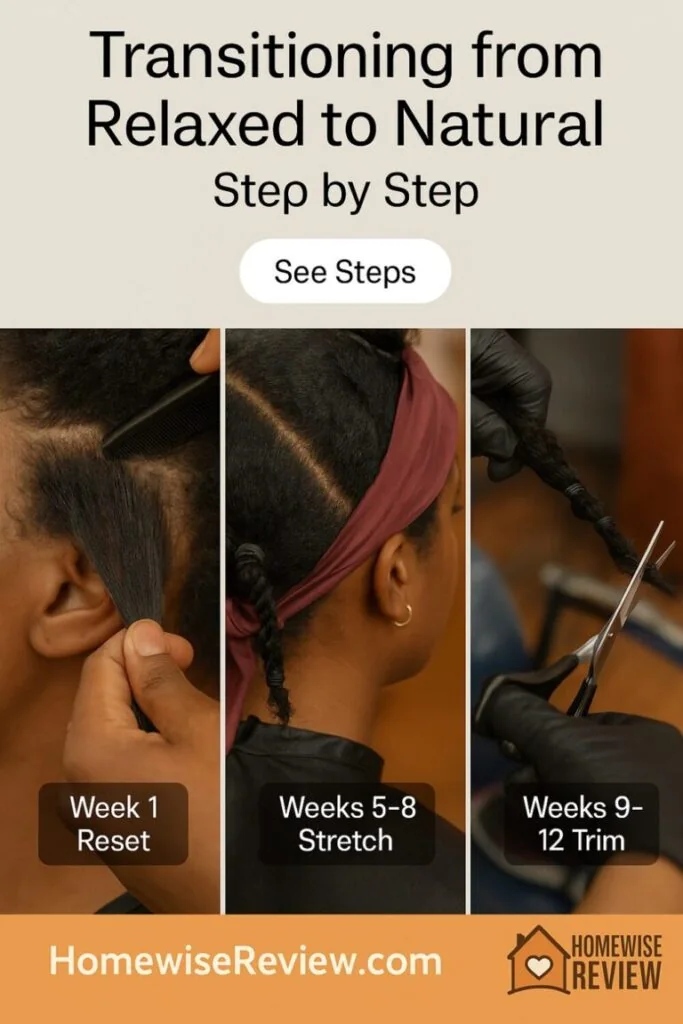
Decide how much length to keep, use a gentle sectioned wash routine, and remove damaged ends when they stop serving your plan.
On this page
- Big chop or gradual transition?
- Stop overlapping relaxer on the lengths you are keeping
- A sectioned transition wash day
- Choose products by a visible job
- Styles that make two textures easier to manage
- Heat is optional, not automatically forbidden or safe
- Trim based on damage and your end goal
- When breakage needs more than a routine change
Transitioning from relaxed to natural hair means caring for new growth and permanently straightened lengths at the same time. The point where the two textures meet can be vulnerable to repeated pulling and breakage, but it does not need a rigid 90-day program. Choose either a gradual transition or a big chop, simplify wash day, detangle with patience, and trim relaxed ends at a pace that suits your length and styling goals.
Big chop or gradual transition?
| Decision | Advantages | Tradeoffs | Better fit when |
|---|---|---|---|
| Big chop | Removes the relaxed lengths at once and leaves one texture to learn | Immediate loss of length and a shorter-style adjustment | You want a clean reset or the relaxed ends are badly damaged |
| Gradual transition | Keeps more length while natural hair grows | Two textures can tangle differently and take longer to style | Length retention matters more than simplifying immediately |
| Staged cuts | Removes weak ends in larger planned steps | Length and shape change several times | You want a middle route with visible progress |
There is no standard number of months a transition should last. Growth rate, starting length, breakage, styling preferences, and comfort with shorter hair all change the timeline. Pick a review point, such as after each wash or trim, rather than committing to an arbitrary finish date.
Stop overlapping relaxer on the lengths you are keeping
If the goal is to grow out your natural texture, applying relaxer to new growth continues the chemical process rather than the transition. Applying relaxer over previously relaxed hair also increases the chance of overprocessing. The American Academy of Dermatology advises that relaxer touch-ups should be limited to new growth and performed cautiously; if you are stopping relaxers, do not use edge touch-ups as a workaround.
Do not apply a relaxer to an irritated or injured scalp. Burning, sores, or significant shedding needs professional assessment, not another chemical service.
A sectioned transition wash day
- Inspect before washing. Note where tangles, split ends, or snapping are concentrated. This helps you decide whether the next step is gentler handling or a trim.
- Divide the hair into manageable sections. The number depends on density and length. Secure each section loosely so the roots are not pulled.
- Clean the scalp and rinse the lengths. Choose a cleanser that removes the actual buildup without leaving the scalp irritated. Do not scrub the relaxed ends together.
- Condition every section. Coat the older ends especially well because they have experienced the longest chemical and mechanical history.
- Detangle from the ends upward. Keep the hair damp and conditioned, support the section above the working area, and use fingers or a wide-tooth comb before a brush.
- Rinse and choose a low-tension style. Apply only the styling products needed for that method and let the hair dry before taking down a set.
The 4C brush guide compares flexible detangling and stretching tools. No brush makes force safe, so stop when a tool catches instead of pulling it through the texture change.
Choose products by a visible job
- Cleanser: removes scalp and styling buildup without requiring repeated harsh washing.
- Rinse-out conditioner: provides enough slip for the two textures to be separated without force.
- Leave-in: optional when it improves manageability after rinsing.
- Hold product: selected for the twist, braid, roller set, or other style rather than added automatically.
- Protein treatment: not a diagnosis for hair that feels “mushy.” Use only a product appropriate for your hair and follow its label; more protein is not a guaranteed breakage fix.
For cleanser formats, compare the sulfate-free shampoo guide. Sulfate-free is not proof that a formula will be gentle enough or cleansing enough for you.
Styles that make two textures easier to manage
A useful transition style blends the textures without demanding painful tension, heavy extensions, or daily heat. Options include loose braid-outs, twist-outs, roller sets, banding, and medium twists that can be undone without cutting through tangles.
- Banding: stretches sections without a flat iron, but bands should not pull at the roots or compress the same points repeatedly. See the heat-free banding guide.
- Braid-out or twist-out: can visually blend the textures, provided the hair dries fully and the installation is comfortable.
- Roller set: can create a consistent finish with less direct heat, but the hair still needs gentle tension and complete drying.
- Wig or extensions: do not protect hair automatically. A tight base, heavy added hair, adhesives, or inaccessible scalp can create new problems.
Heat is optional, not automatically forbidden or safe
Excessive heat can damage any hair type, and transitioning lengths may already be fragile. If you use a dryer or flat iron, apply a product specifically labeled for heat protection, keep the tool at the lowest effective setting, and reduce the number of passes and heated sessions. Flat-iron only fully dry hair.
A hooded dryer is not automatically harmless; it is still heat. What matters is temperature, exposure, distance, frequency, and the condition of the hair. Stop if a method causes new snapping, scorching, or a burnt smell.
Trim based on damage and your end goal
There is no evidence-based rule that every transition needs a quarter-inch or half-inch trim every six to eight weeks. Trim when split, thin, or repeatedly tangling ends are interfering with the plan. A stylist can help create an even shape, but you can also choose staged cuts that remove a clear portion of relaxed hair at planned intervals.
- Trim sooner: when ends are splitting, knotting around one another, or breaking faster than length is useful.
- Keep more length: when the ends remain manageable and you accept the extra detangling and styling time.
- Choose the final chop: when maintaining two textures costs more time or breakage than the retained length is worth to you.
When breakage needs more than a routine change
Hair can break from chemical processing, heat, tension, rough handling, and other causes. If you see scalp sores, sudden shedding, bald patches, pain, or progressive hairline loss, consult a board-certified dermatologist. Do not try to diagnose the cause by alternating protein and moisture masks.
Frequently Asked Questions
How long should I transition before a big chop?
There is no required timeline. Decide based on the natural length you want, the condition of the relaxed ends, and how much two-texture maintenance you are willing to do.
Do I need protein every few weeks?
No fixed protein schedule fits every product and head of hair. If you choose a protein-containing treatment, use it as labeled and judge the result rather than increasing frequency based on a texture slogan.
Can I relax only my edges during a transition?
That continues chemical straightening in one of the most visible and tension-prone areas. If the goal is fully natural hair, use a comfortable style that does not require chemically straightened edges.
Affiliate Disclosure
If you purchase through links on our site, we may earn a small commission at no extra cost to you.