

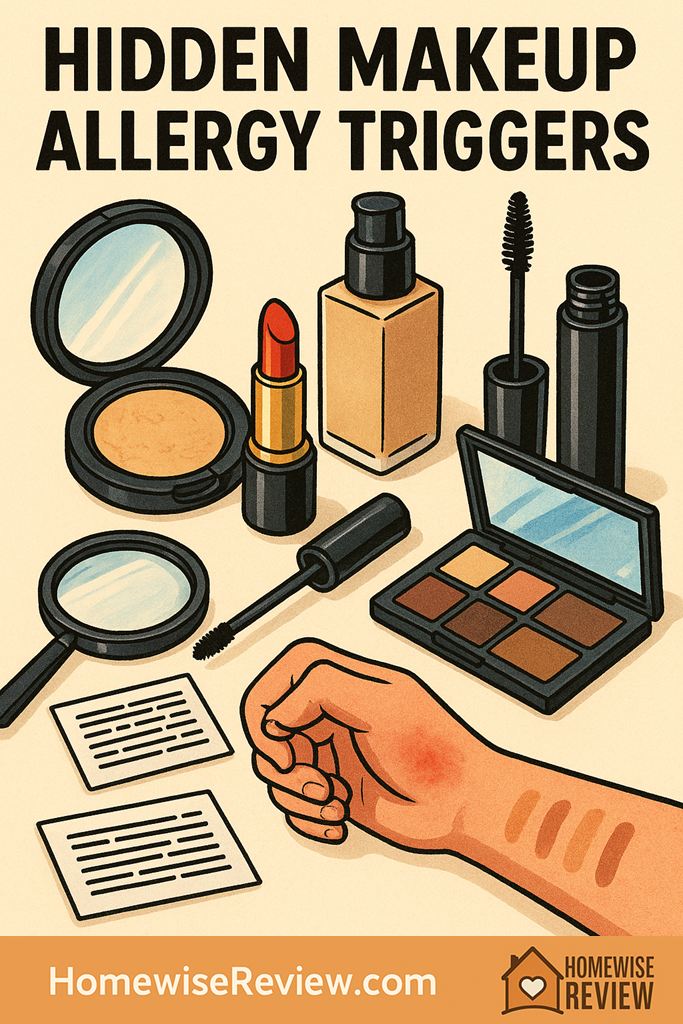
An itchy eyelid, flaky lip border, or recurring facial rash may be contact dermatitis. The fastest route to an answer is a product-and-label investigation, not a universal blacklist.
Makeup reactions commonly involve fragrance, preservatives, dyes, metals, natural rubber latex, or an adhesive used around the eyes or nails. That does not mean these ingredients are unsafe for everyone, and a label cannot diagnose an allergy. It does give you a practical starting point: stop products touching the irritated area, record every cosmetic and applicator involved, compare ingredient lists, and seek medical patch testing when the rash persists or returns. Get urgent medical help for trouble breathing or swallowing, faintness, rapidly increasing facial swelling, or other signs of a severe allergic reaction.
Allergy and irritation are not the same problem
Allergic contact dermatitis is an immune reaction that can develop after repeated exposure to a substance you previously tolerated. It often itches and may cause redness, swelling, flaking, or small blisters. Irritant contact dermatitis does not require an allergy; a harsh product, excessive cleansing, friction, or repeated solvent exposure can damage anyone’s skin barrier. It more often burns or stings, although the two can look similar.
The location is a clue, not proof. Eyelid skin is thin and commonly develops contact dermatitis. The trigger may be eye makeup, remover, fragrance, an eyelash curler, metal transferred from the hands, nail products transferred when you rub your eyes, or lash adhesive. Lip reactions can involve color cosmetics, flavor, fragrance, dental products, or a product applied elsewhere and transferred.
Five FDA-listed cosmetic allergen classes
The U.S. Food and Drug Administration groups common cosmetic allergens into five broad classes: natural rubber, fragrances, preservatives, dyes, and metals. These are useful label categories, not a ranked top-five list.
1. Fragrance and flavor
A U.S. cosmetic label may list a fragrance mixture simply as fragrance or perfume, so every component may not be visible. The FDA also identifies individual fragrance allergens such as limonene, linalool, eugenol, citronellol, geraniol, citral, coumarin, and several benzyl compounds. Lip products may use flavor mixtures.
If fragrance is a suspected trigger, save the full ingredient panel and ask the manufacturer for more information. Do not rely on front-label language alone. The FDA notes that terms such as hypoallergenic, fragrance-free, and for sensitive skin do not have a federal standard that guarantees a product will not cause a reaction.
2. Preservatives
Water-containing cosmetics need a preservation system to control microbial growth. A sensitized person can still react to a particular preservative. The FDA’s examples include methylisothiazolinone (MIT), methylchloroisothiazolinone (CMIT), formaldehyde, and formaldehyde-releasing ingredients such as DMDM hydantoin, diazolidinyl urea, imidazolidinyl urea, bronopol, sodium hydroxymethylglycinate, and quaternium-15.
Do not search for a preservative-free liquid makeup as a universal solution; inadequate preservation creates a different safety problem. Instead, identify the exact allergen through clinical evaluation and choose a properly preserved product that omits that substance. Never add water or saliva to mascara, share cosmetics, or keep a product that has changed odor, color, or texture.
Color cosmetics contain approved color additives, and reactions can involve a dye or another chemical associated with color products. The FDA highlights p-phenylenediamine (PPD) and coal-tar ingredients in its allergen overview, particularly in the wider category of cosmetic dyes. PPD is much more relevant to permanent hair dye and black henna than to ordinary powder eye shadow, so avoid assuming every colorful product contains it.
If only one shade causes trouble, compare its ingredient list with tolerated shades from the same range. Color additives can differ by shade, often in a separate “may contain” section.
4. Metals
The FDA lists nickel and gold among cosmetic allergen concerns. Metal exposure near the eyes may also come from tools such as tweezers or an eyelash curler, or from invisible transfer after handling keys, jewelry, or nail products. A known jewelry allergy makes this history especially important, but it does not prove that a particular pigment is responsible.
When eyelid dermatitis persists after stopping eye makeup, include tools, jewelry, and hand-to-eye transfer in the inventory. A dermatologist can decide which metals and cosmetic series belong in patch testing.
5. Natural rubber latex
Natural rubber latex can occur in beauty adhesives and applicators. The FDA has received allergy reports involving products that may contain latex, including eyelash adhesives, eyeliner, face or body paint, and hair-bonding adhesives. Reactions can range from a local rash to respiratory symptoms and, rarely, anaphylaxis.
Read the ingredient list and contact the manufacturer if latex status is unclear. Someone with a known latex allergy should not test an uncertain adhesive on the eyelid at home.
Do not overlook acrylate and adhesive exposure
Lash glues, artificial nail systems, press-on adhesives, and some long-wear beauty products add another exposure path. An eyelid rash can come from lash adhesive directly or from nail chemicals transferred by the fingertips. This category is not interchangeable with natural rubber latex; a “latex-free” glue can still contain another ingredient that causes allergy or irritation.
If the rash appeared after a manicure, lash service, brow service, or home kit, record the product names and do not repeat the exposure just to prove the connection. Bring labels or ingredient photos to the appointment.
A safer product-elimination plan
- Stop products on the affected area. Remove makeup gently and avoid scrubs, acids, retinoids, fragrance, and new remedies until the skin settles.
- List direct and indirect contact. Include makeup, skincare, remover, sunscreen, brushes, sponges, eye tools, lash glue, nail products, hair products, and anything transferred by your hands.
- Save exact labels. Photograph the ingredient panel, shade, batch information, and purchase source. Formulas can change.
- Use a bland routine. A gentle cleanser and a tolerated fragrance-free moisturizer reduce variables. Do not apply topical antibiotics or essential oils unless advised.
- Do not re-challenge severe reactions. Home reintroduction is inappropriate after facial swelling, breathing symptoms, widespread hives, or a blistering reaction.
- Reintroduce cautiously only after recovery. Add one product at a time several days apart. Stop at the first recurrence.
- Ask about medical patch testing. Persistent or recurrent dermatitis often needs dermatologist-directed testing. Patch testing takes multiple visits and may need cosmetic, fragrance, preservative, metal, rubber, or acrylate series based on the history.
How to shop after an allergen is confirmed
Use the exact allergen name and its synonyms, not a broad claim such as clean or natural. Keep a personal safe-product list, recheck labels at every purchase, and contact manufacturers when a fragrance mixture or adhesive composition is unclear. A product marketed as hypoallergenic can still contain your allergen because the term does not promise universal tolerability.
Fewer products can make troubleshooting easier, but multi-use makeup is not automatically safer: using one allergenic stick on lips, cheeks, and eyes can spread the same exposure. Choose based on the ingredient list and confirmed allergy, not the number of steps.
Frequently Asked Questions
Can makeup allergy start after years of using the same product?
Yes. Allergic contact dermatitis can develop after repeated exposure. A formula change or a new product used elsewhere can also explain a new reaction, so keep current labels.
Does hypoallergenic makeup prevent reactions?
No label can guarantee that. The FDA says there is no federal standard defining hypoallergenic for cosmetics. Avoid the specific ingredient confirmed or suspected in your case.
Can nail products cause an eyelid rash?
Yes. Chemicals can transfer from the nails or fingertips when you touch the eye area. Tell the dermatologist about recent gel, acrylic, press-on, and adhesive use.
When is patch testing appropriate?
Ask a dermatologist when a rash persists, returns after products are restarted, or has no obvious cause. Medical patch testing is different from testing a new cosmetic on a small area at home.
Sources and medical boundary
- FDA: Allergens in Cosmetics supports the five allergen classes, label limitations, symptoms, testing overview, and emergency boundary.
- American Academy of Dermatology: Contact dermatitis signs and symptoms supports the eyelid and fragrance-contact guidance.
- American Academy of Dermatology: Itchy rash could be contact dermatitis supports evaluating makeup, tools, metals, and nail-to-eye transfer.
- American Academy of Dermatology: Patch testing explains clinician-directed diagnosis for recurrent dermatitis.
This guide cannot identify an individual’s allergen or distinguish every allergy from irritation, infection, eczema, or another skin condition. Seek a healthcare professional for diagnosis and treatment.