

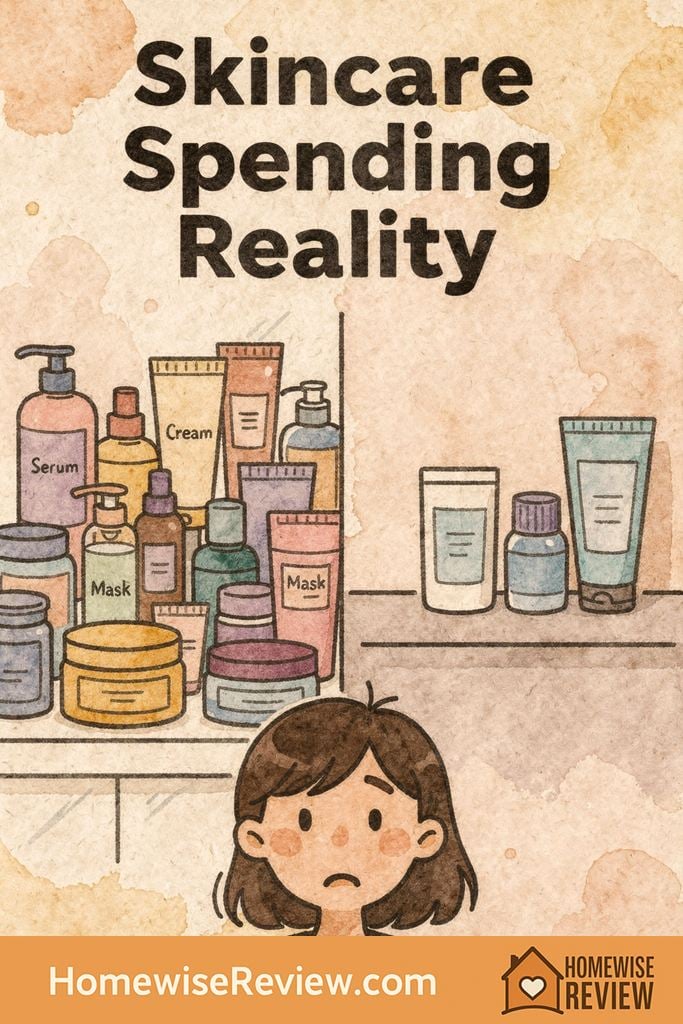
Skincare feels like small purchases, until you do the math on how fast products are meant to be used up. The biggest surprise is not luxury serums, it is the everyday basics you replace again and again.
- Daily face-and-neck sunscreen use can require about 9 standard 50 mL bottles per year, costing roughly $108 to $360 annually depending on price tier.
- A minimal three-step routine (cleanser, moisturizer, sunscreen) models to about $263 to $955 per year once repurchase frequency is accounted for.
- A five-product anti-aging routine (add vitamin C and retinoid) models to about $418 to $1,695 per year, driven more by repurchase cadence than one-time “splurges.”
- Common add-ons (exfoliant, eye cream, monthly masks) can push modeled annual totals to roughly $664 to $2,785, even before in-office services.
If you apply facial sunscreen the way dermatologists typically recommend, a standard 50 mL bottle can be gone in about six weeks. That turns a “$12 here, $20 there” habit into roughly nine bottles a year, before you even count cleanser, moisturizer, or the serum you swear you will finish this time.
This report breaks down the real annual cost of skincare using a simple idea: repurchase cadence. When you translate daily use into how many bottles you actually need per year, the total gets surprisingly concrete.
Key numbers at a glance
- Face sunscreen alone: about 9 typical 50 mL bottles per year if used daily at roughly 1/4 teaspoon for face and neck.
- “Just the basics” (cleanser, moisturizer, sunscreen): roughly $263 to $955 per year depending on price tier.
- A classic 5-product routine (add vitamin C + retinoid): roughly $418 to $1,695 per year.
- Common add-ons (exfoliant, eye cream, masks): can push totals to $664 to $2,785 per year.
Finding 1: Sunscreen is the quiet budget breaker
Sunscreen is often treated like an optional last step, but it is the product most likely to be used in the largest amount, most consistently, and repurchased the most frequently. For annual cost, that trio matters more than whether the label says “drugstore” or “luxury.”
Here is the math many routines never do:
- Usage assumption: about 1/4 teaspoon (roughly 1.2 mL) for face and neck per day.
- Typical bottle size: 50 mL.
- Days per bottle: about 41.
- Bottles per year: about 9.
Multiply that by price tier and you get a wide, real-world spread: around $108 per year at $12 per bottle, about $180 at $20 per bottle, and about $360 at $40 per bottle. If you rotate multiple sunscreens (tinted, untinted, mineral, water resistant), the number climbs fast, even when each purchase feels “reasonable.”
Finding 2: Repurchase speed matters more than the “fancy” label
The biggest drivers of annual spend are (1) how much you use, (2) how often you use it, and (3) the container size you keep buying. A $60 moisturizer sounds splurgy, but if it is a 50 mL jar you finish every 7 weeks, it becomes a recurring expense that behaves more like a bill.
Using conservative, easy-to-visualize assumptions (for example, a 50 mL moisturizer used morning and night), moisturizer alone often lands around 7 jars per year. That is approximately $105 annually at $15 per jar, and about $420 at $60 per jar.
This is why routines with “a few nice staples” can quietly cost more than routines with lots of inexpensive extras. If a premium product is used daily, it is not just expensive once. It is expensive repeatedly.
Finding 3: The “three-step routine” is rarely three steps in practice
Most people do not buy skincare like a laboratory protocol. They buy skincare like a household. That means duplicates (a backup cleanser), season swaps (rich winter cream plus gel summer moisturizer), and “maybe this will fix it” experiments when skin changes.
Even if the daily lineup looks simple, the cabinet often contains:
- Parallel versions of the same step (two cleansers, two moisturizers).
- Skin-mood purchases (calming serum, barrier balm, spot patches).
- Trend-driven add-ons that get used sporadically (essences, ampoules, masks).
From a cost standpoint, these “not technically part of my routine” items are where budgets often leak. They also create waste, because many active products have best-use windows after opening, and people routinely abandon a product before finishing the bottle.
Finding 4: Add-ons are where annual totals go from hundreds to thousands
If you only buy cleanser, moisturizer, and sunscreen, the annual cost can stay in the hundreds. Once you add a few common extras, you enter a different spending bracket.
Consider three very normal add-ons:
- Exfoliant (AHA/BHA): often used a few times per week, but still repurchased one to two times per year.
- Eye cream: small packages mean surprisingly frequent repurchases if used daily.
- Masks: sheet masks, wash-off masks, or overnight masks can become a steady monthly buy.
When you model those three add-ons with typical sizes and usage patterns, they can add roughly $246 (budget) to $1,090 (prestige) per year on top of a five-product routine. This is the moment many people realize they are not “spending a little on skincare,” they are effectively maintaining a subscription.
What women are really spending: four annual budgets (modeled)
The table below uses typical product sizes and simple usage assumptions to estimate how many units are needed per year. Prices are representative tiers rather than a single retailer, because the goal is to show the scale of the math, not pick winners.
| Routine type | What’s included | Estimated annual total (Budget) | Estimated annual total (Mid) | Estimated annual total (Prestige) |
|---|---|---|---|---|
| Minimal | Cleanser + moisturizer + daily face sunscreen | $263 | $466 | $955 |
| Core anti-aging | Minimal + vitamin C serum + retinoid | $418 | $826 | $1,695 |
| Layered routine | Core + exfoliant + eye cream + monthly masks | $664 | $1,326 | $2,785 |
| Treatment-heavy | Layered routine + periodic in-office services | +$400 to $2,000+ | +$400 to $2,000+ | +$400 to $2,000+ |
Two notes that change the total quickly: First, many women use more than one sunscreen (for example, a tinted option plus a sport option). Second, many actives are not used year-round, but the money is still spent upfront, and partially used bottles still count as spend.
Where the money usually goes (and why it feels invisible)
When you convert routines into annual totals, spending tends to concentrate in the same places:
- Daily, high-volume products: sunscreen and moisturizer often dominate because they are used generously and consistently.
- Small-bottle “hero” steps: serums feel small, but 30 mL bottles repurchased 3 to 4 times per year add up.
- Optional extras purchased often: masks, eye products, and “rescue” balms can create steady monthly spend that never shows up as a single big purchase.
This also explains the common experience of feeling like you “barely buy skincare” while still seeing a constant trickle of receipts. The spend is fragmented, and fragmentation is exactly what makes it hard to track.
Methodology: how these annual costs were modeled
Methodology source: West Skincare Basket Index (WSBI). The WSBI models annual skincare spending by combining (1) typical product sizes (for example, 50 mL sunscreen, 50 mL moisturizer, 150 mL cleanser, 30 mL serums), (2) simple usage assumptions based on common dermatology guidance for sunscreen and typical daily-use habits for other products, and (3) repurchase frequency calculated from size divided by estimated daily use.
Price tiers are representative examples to show how the same routine behaves at different unit costs: Budget (mass market), Mid (upper mass), and Prestige (department store and specialty). The estimates focus on out-of-pocket product spending and do not assume coupons, gifts, or subscription discounts, which can lower the cost but often increase the number of items purchased.
A quick self-audit: estimate your annual skincare spend in five minutes
- List your repeat buys from the last 2 to 3 months (cleanser, moisturizer, sunscreen, serums, actives, masks).
- Write the size on each bottle (mL or oz) and your approximate frequency of use (daily, weekly).
- Estimate how long it lasts in weeks. If you are unsure, note when you last opened it and how full it is now.
- Convert to yearly units: 52 divided by weeks-per-bottle.
- Multiply by price and add everything up, including the “only sometimes” products.
The most useful outcome is not a perfect number, it is identifying which step behaves like a recurring bill. For most routines, that is sunscreen and moisturizer first, then daily serums.
So what is the true cost of beauty, in plain terms?
For skincare specifically, the annual total depends less on one viral product and more on a simple pattern: how many daily steps you have that come in small containers. A minimal routine can be a few hundred dollars a year. A consistent, multi-active routine can be comfortably four figures. And a layered routine with frequent add-ons can approach the cost of a modest vacation, even without a single “crazy” purchase.
If that feels surprising, it is because skincare is marketed as a sequence of small decisions. Repurchase math turns it into what it really is: a long-running financial commitment.
Buying Guides Based on This Data
If you are trying to keep results high and waste low, start by comparing your routine to a curated list of best beauty buys on Amazon that focus on value and longevity. If devices are part of your spend, see our review of the Foreo Luna 4 to understand the one-time cost versus ongoing product repurchases. If your budget gets hit hardest by duplicates and “just in case” purchases, multipurpose beauty products for travel and gym bags can help you consolidate without going without.
Frequently Asked Questions ▾
Are these numbers what women actually spend, or what a routine costs if followed consistently?
They are modeled costs of maintaining a routine consistently for a full year, based on typical product sizes, estimated usage rates, and repurchase frequency. Actual spending can be lower (discounts, fewer steps) or higher (more experimentation, duplicates, services).
Why assume so much sunscreen?
Sunscreen is where the “recommended amount” differs most from how people think they use it. When you model daily use at commonly cited face-and-neck amounts, the repurchase rate increases sharply.
Does this include makeup, haircare, or fragrance?
No. This is skincare-only modeling. National spending surveys often group skincare with broader personal care categories, which can make it hard to isolate skincare without a basket-style model.
What is the easiest way to lower annual spend without sacrificing results?
Reduce the number of daily, small-bottle steps. Keeping sunscreen consistent while simplifying overlapping serums and rotating fewer “extras” typically makes the biggest difference.
As an Amazon Associate, we earn from qualifying purchases made through links on our site.