
Modern Haircare Explained: Scalp Care, Repair Claims, and Routine Design
Modern haircare offers more targeted options for scalp buildup, breakage, texture, and heat damage. Use this framework to choose what earns a place in your routine.

On this page
- From generic hair type to specific jobs
- Scalp care became its own category
- “Repair” became more technical: and easier to overread
- Texture-specific care corrected an old default
- Dry shampoo changed convenience, not cleansing
- Heat protection moved from optional to fundamental
- Hair-growth marketing expanded faster than diagnosis
- Personalization should simplify the routine
- A four-week routine audit
- What has actually improved
- Sources and evidence limits
Haircare now offers a separate product for almost every concern. The useful progress is better problem matching; the trap is treating every new category as a required step.
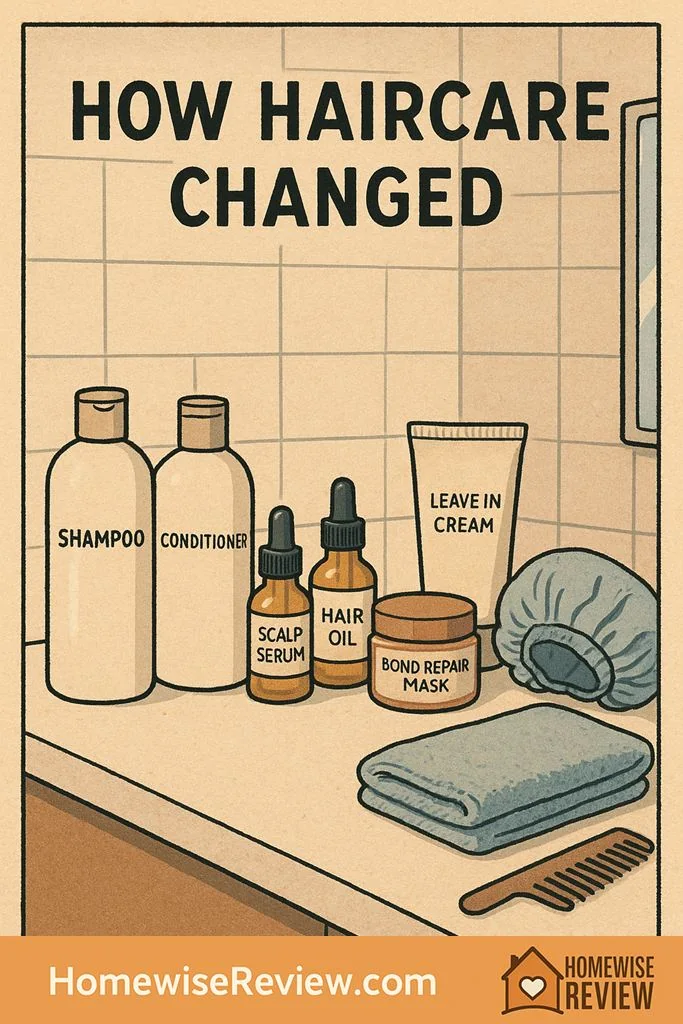
The modern hair aisle has borrowed the language and layered routines of skincare: scalp serums, exfoliants, bond treatments, masks, oils, leave-ins, heat protectants, and overnight products. Some of that specialization helps people choose around texture, damage, oil, and diagnosed scalp conditions. Some of it simply turns one workable routine into eight overlapping products.
The best way to use the change is to design from the problem backwards. Shampoo cleans the scalp. Conditioner reduces friction and improves combability. Styling products shape and hold. Treatments deserve a place only when they address a defined concern and produce a result you can observe.
From generic hair type to specific jobs
| Modern category | Problem it may address | Boundary to remember |
|---|---|---|
| Scalp serum or exfoliant | Selected buildup, excess oil, dryness, or comfort concerns | It does not diagnose dandruff, psoriasis, eczema, infection, or hair loss. |
| Bond-repair or strengthening treatment | Chemically or mechanically weakened hair and breakage management | “Repair” does not mean returning dead fibre to its virgin state. |
| Clarifying shampoo | Heavy styling residue, oils, waxes, minerals, or repeated dry shampoo | Frequent strong cleansing may roughen dry or processed lengths. |
| Leave-in conditioner or detangler | Friction, tangles, frizz, and combing damage | Too much can flatten fine hair or contribute to buildup. |
| Texture-specific styler | Definition, hold, elongation, volume, humidity control, or reduced manipulation | Curl pattern alone does not determine density, porosity, scalp oil, or climate needs. |
| Heat protectant | Reducing damage during blow-drying or hot-tool use | It lowers risk; it does not make unlimited temperature or repeated passes harmless. |
| Growth serum | A diagnosed form of hair loss when the active has relevant evidence | Hair shedding has many causes; a cosmetic claim is not a diagnosis. |
Scalp care became its own category
Separating the scalp from the lengths is genuinely useful. The scalp accumulates sebum, dead skin, sweat, microorganisms, and styling residue. The hair fibre needs enough cleansing to remove soil without unnecessary friction, plus conditioning where tangling and weathering are greatest.
That does not mean the scalp should copy a facial routine. A gritty scrub, multiple leave-on acids, oils, and fragranced serums can create irritation or residue. Start with the basic intervention that fits the symptom:
- Greasy roots: adjust shampoo frequency and technique before adding a leave-on treatment.
- Styling buildup: reduce product load or use an occasional suitable clarifying wash.
- Ordinary dry feeling: check water temperature, cleanser strength, wash frequency, and irritating products.
- Persistent scale or itch: consider dandruff or another scalp condition and choose an appropriate active or clinical assessment.
- Pain, sores, marked redness, scarring, or sudden loss: seek professional care rather than escalating cosmetics.
The American Academy of Dermatology recommends applying shampoo mainly to the scalp instead of rubbing it through the entire length. Frequency should follow how oily or dirty the scalp becomes and the needs of the hair texture, rather than a universal wash schedule.
“Repair” became more technical: and easier to overread
Hair beyond the scalp is nonliving fibre. Bleaching, chemical straightening, heat, ultraviolet exposure, water swelling, and repeated grooming can weather the cuticle and weaken the cortex. Conditioners, oils, polymers, silicones, proteins, and acidic products can reduce friction, improve surface alignment, fill or coat damaged areas temporarily, and help the fibre resist further handling.
Those are meaningful results. Fewer tangles and lower combing force can mean less breakage. A smoother surface can improve shine and frizz. But even sophisticated “bond” language does not justify assuming every formula permanently reverses structural destruction. Evidence belongs to the specific ingredient system, concentration, use instructions, and measured outcome, not to the word repair by itself.
Judge a repair treatment over several comparable wash cycles. Keep heat and styling stable, then track broken strands, detangling time, elasticity, roughness, and residue. If the treatment only makes hair feel stiff, coated, or harder to style, it has not earned its step.
Texture-specific care corrected an old default
One major improvement is the recognition that straight, fine hair is not the default. Curly and coily hair often benefits from different detangling timing, richer conditioning, reduced manipulation, and styling methods that support definition without forcing the fibre straight. The AAD advises people with thick or curly hair to detangle carefully while damp, often while conditioner provides slip, whereas straight hair can be allowed to dry somewhat before gentle combing.
Texture labels are a starting point, not a complete prescription. Two people with a similar curl pattern can have different strand diameter, density, chemical history, scalp oil, sensitivity, climate, and styling goals. One may need rich leave-in conditioning; the other may lose volume and develop buildup from the same amount.
Build around behaviour:
- How quickly does the scalp become oily or itchy?
- Where do tangles and breaks occur?
- Does hair absorb product quickly or remain coated?
- Is the goal definition, stretch, volume, smoothness, or protective styling?
- How much heat, bleach, colour, tension, swimming, or sun exposure does the fibre encounter?
Dry shampoo changed convenience, not cleansing
Dry shampoo can absorb oil and extend a style, but it does not wash away dead skin, product, and microorganisms with water. The AAD advises continuing regular shampoo-and-water cleansing and using dry shampoo sparingly where it is needed. Accumulation can leave hair dry or gritty and can irritate the scalp.
If dry shampoo is required every day to make the scalp comfortable, reassess the base routine. Apply a small amount to oily areas, follow the product directions, brush or comb as instructed, and wash normally after limited uses. Burning, tenderness, or persistent itch is a reason to stop.
Heat protection moved from optional to fundamental
Modern routines often focus on restorative products after damage while underestimating prevention. Excessive heat can damage every texture. Lower or medium tool settings, fewer passes, partial air-drying, and a product intended for heat protection are more defensible than assuming a mask can undo repeated high-temperature styling.
Technique matters as much as the bottle:
- Remove excess water gently with a towel or T-shirt; do not rub the lengths roughly.
- Detangle with conditioner or a suitable leave-in and begin at the ends.
- Distribute heat protectant according to its directions, including sectioning where needed.
- Use the lowest temperature that achieves the style and keep the tool moving.
- Limit repeated passes over the same section.
- Reduce frequency if breakage, roughness, white nodes, or split ends increase.
Hair-growth marketing expanded faster than diagnosis
More products now promise fuller, denser, or longer hair. The language can blur three different outcomes: reducing breakage, creating temporary volume, and changing follicle growth. A conditioner may help retain length by reducing breakage. A styling product may make hair appear thicker. Neither result proves regrowth.
Actual hair loss can reflect androgenetic alopecia, telogen effluvium, alopecia areata, traction, inflammation, scarring conditions, medication, illness, or nutrition problems, among other causes. The AAD advises early assessment because treatment depends on the cause. Buying several growth serums at once can delay the useful question: what type of loss is this?
Seek assessment for widening parts, receding edges, bald patches, scalp inflammation, rapid shedding, loss of eyebrows or body hair, or shedding that persists. Do not take high-dose hair supplements automatically; excess amounts of some nutrients can worsen hair loss.
Personalization should simplify the routine
A personalized routine is not one with the most products. It is one where each step has a job and the dosage fits the hair and scalp.
A dependable base
- Shampoo at a frequency and cleansing strength that keeps the scalp comfortable.
- Condition the areas that need slip, usually the lengths and ends.
- Detangle gently with a method suited to texture.
- Use heat protection when heat styling.
- Choose one styler for the required hold, definition, volume, or smoothness.
Add only for a measured problem
- Clarifier when confirmed residue persists.
- Medicated shampoo for the appropriate scalp indication.
- Leave-in when rinse-out conditioner does not provide enough detangling or frizz control.
- Pre-wash oil when it measurably reduces wash-day roughness or breakage.
- Strengthening treatment when processed hair benefits without becoming stiff or coated.
A four-week routine audit
- Define one primary problem. Use observable language such as “roots oily by day two” or “ends break during detangling.”
- Record the current routine. Include amounts, frequency, heat, chemical services, and protective styles.
- Keep a simple baseline for two washes. Note scalp comfort, tangles, shed hairs versus broken hairs, volume, and residue.
- Change one product or technique. Multiple simultaneous changes hide the cause of improvement or irritation.
- Use the product as directed. More concentration, contact time, or frequency is not automatically better.
- Review after four weeks. Keep a step only if its intended outcome improved enough to justify cost and effort.
- Escalate medical signs. Cosmetics should not delay assessment of persistent scalp disease or hair loss.
What has actually improved
Modern haircare is better at naming different needs: scalp cleansing is not the same as length conditioning; cosmetic smoothing is not the same as regrowth; coily hair does not require the same handling as straight hair; and prevention can matter more than post-damage rescue.
The enduring fundamentals are less fashionable but more reliable: clean according to need, condition to reduce friction, handle gently, limit damaging heat and tension, and diagnose persistent scalp or loss concerns. New categories are valuable when they make one of those jobs more precise, not when they turn a functioning routine into a permanent experiment.
Frequently Asked Questions
Do I need a scalp serum?
Not automatically. Start with appropriate shampoo frequency and technique. Add a scalp product only for a defined concern and stop if it causes burning, rash, or worsening buildup.
Can bond-repair products reverse bleach damage?
They may improve strength, feel, or resistance to breakage depending on the specific formula, but no cosmetic returns severely damaged nonliving fibre to its virgin state. Prevention and reduced processing remain important.
Is dry shampoo a replacement for washing?
No. It absorbs oil but does not clean the scalp with shampoo and water. Use it between washes, then return to regular cleansing.
How many products does a personalized routine need?
Often only cleanser, conditioner, suitable styler, and heat protection where relevant. Add treatments only when a specific problem and measurable benefit justify them.
When is hair loss more than a cosmetic problem?
Seek assessment for rapid or persistent shedding, bald patches, widening parts, receding edges, scalp inflammation, pain, sores, or scarring. Early diagnosis improves the chance of appropriate treatment.
Sources and evidence limits
- American Academy of Dermatology: Tips for healthy hair supports texture, cleansing, conditioning, detangling, and heat guidance.
- American Academy of Dermatology: Dry shampoo tips supports the cleansing and buildup boundaries.
- American Academy of Dermatology: Hair loss management supports early diagnosis, gentle care, and supplement cautions.
- Hair Cosmetics: An Overview supports the hair-fibre, conditioning, friction, and damage discussion.
- Shampoo and Conditioners: What a Dermatologist Should Know? supports matching cleansing and conditioning to hair and scalp needs.
This guide focuses on decisions supported by dermatology and cosmetic-science sources.