

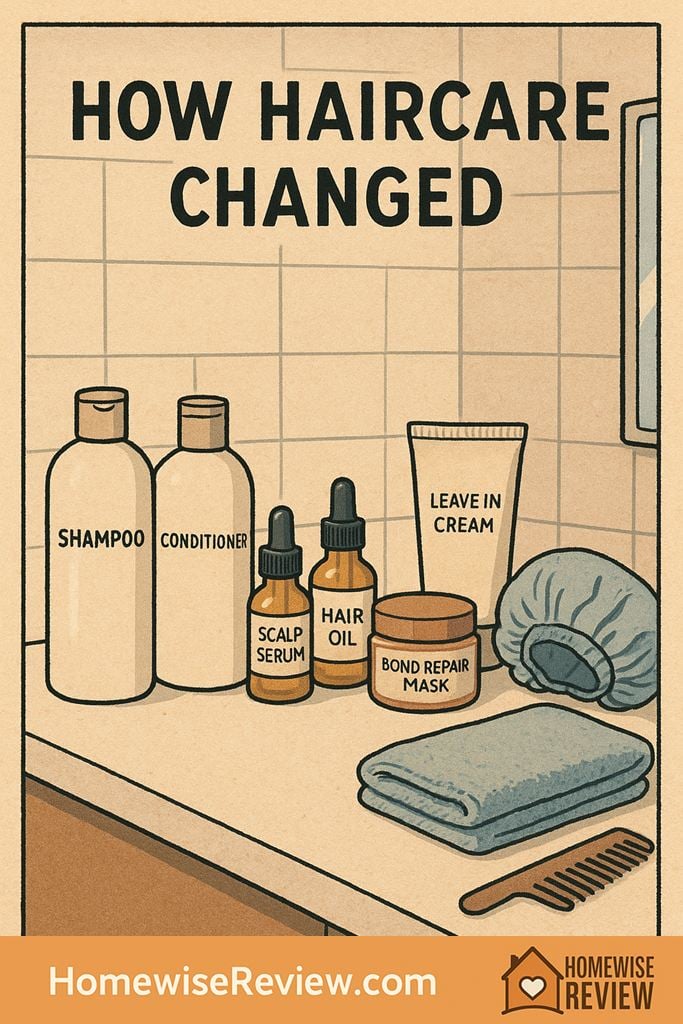
Haircare looks far more scientific and far more complicated than it did ten years ago. Search data and hair science point to the same story: routines became scalp-first, treatment-heavy, and deeply personalized.
- Google Trends shows scalp serum rising from near-invisible interest in the mid-2010s to a peak index of 100 in the 2020s.
- Rosemary oil hair growth reached a 100 search index in 2023 after minimal measurable interest before 2020.
- Bond repair hair went from niche search behavior to peak-level interest within the last five years, signaling mainstream demand for chemistry-based repair claims.
- Curly girl method reached a 100 index within the last decade, reflecting the shift toward texture-specific routines.
Ten years ago, mainstream haircare was mostly a three-item conversation: shampoo, conditioner, styling product. Today the category looks much closer to skincare, with exfoliating scalp treatments, pre-wash oils, bond-repair masks, leave-ins for specific textures, and heat protection treated as a basic step rather than an afterthought.
The data supports that shift. Google Trends shows terms like scalp serum, bond repair hair, and rosemary oil hair growth moving from niche curiosity to peak-level attention, while peer-reviewed literature increasingly treats the scalp as a distinct biological environment. The last decade did not just expand the hair aisle. It changed what people expect haircare to do.
Quick snapshot of the shift
- Then: wash and style. Now: treat, protect, and maintain between washes.
- Then: the hair shaft got most of the attention. Now: scalp health is a category of its own.
- Then: repair mostly meant softness. Now: brands talk about bonds, cuticles, pH, and breakage reduction.
- Then: one beauty standard dominated. Now: routines are built around texture, density, porosity, and scalp behavior.
Haircare became a treatment category
The biggest structural change is specialization. A decade ago, most shelves were organized around broad hair types like dry, oily, or color-treated. Now routines are built around narrower problems: scalp buildup, post-bleach breakage, humidity frizz, thinning edges, hard-water dullness, or heat damage.
That changes how people shop. Instead of replacing one shampoo when it runs out, many consumers now build a small system around a specific issue. Haircare moved from basic maintenance to targeted intervention, and that is why the category feels both more useful and more crowded.
The scalp became the new skin
One of the clearest signs of change is language. Terms that once belonged mostly to skincare, like barrier support, microbiome, exfoliation, pH balance, and soothing actives, now show up throughout haircare. Search interest in scalp serum reflects that shift, rising from barely visible in the mid-2010s to peak territory in the 2020s.
There is a scientific reason this trend stuck. Research on scalp condition, sebum, inflammation, and flaking has made it easier to explain why hair can look limp, irritated, or dull even when the strand itself is not the main issue. Healthy-looking hair starts at the scalp, and the market finally caught up to that fact.
The caution is that not every skincare habit belongs on the scalp. Too much exfoliation, too many leave-on actives, or heavily fragranced formulas can irritate as easily as they can help. The smarter shift is not treating the scalp exactly like facial skin. It is recognizing that scalp biology deserves its own rules.
Repair moved from marketing language to chemistry language
A decade ago, repair often meant a formula made damaged hair feel smoother for a day. Now repair claims are far more technical. Bond building, peptide support, acidifying treatments, cuticle sealing, protein balance, and heat protection are all mainstream talking points, not salon-only jargon.
Some of this is real progress. Cosmetic science has long shown that damaged fiber can be lubricated, coated, strengthened against combing stress, and protected from future wear. What changed over the last decade is that consumers learned to separate a soft finish from real breakage management.
At the same time, the language can overpromise. Hair outside the scalp is still fiber, not living tissue, so no product can fully reverse severe structural destruction. Modern haircare is better than it used to be at prevention and damage control. It is not magic, and more shoppers understand that now.
Texture-specific care went mainstream
The last decade also expanded the definition of what healthy hair looks like. Search interest in curly girl method reached peak levels within the decade, and with it came a much wider vocabulary: co-washing, plopping, diffusing, refreshing, satin protection, and wash-day routines built around shrinkage and moisture retention.
This is bigger than trend language. It changed formulation priorities. Sulfate-free cleansers, lighter leave-ins, richer masks, slip-focused detanglers, and frizz-control oils all benefited from a market that stopped treating straight hair as the default outcome. In practical terms, healthy hair is now more likely to mean less breakage and better definition than perfect smoothness.
That is real progress, but not perfect precision. Social media often turns texture care into hard rules, even though density, porosity, climate, and styling habits can matter just as much as curl pattern. The category is more inclusive than it was, but it is also more segmented.
Social media compressed the trend cycle
If one force changed haircare fastest, it was the speed of social platforms. In the 2010s, trends usually moved from salons and magazines into mass retail over time. Now a single ingredient or technique can explode in weeks, backed by before-and-after clips, creator routines, and algorithm-driven repetition.
Rosemary oil is the clearest example. Google Trends shows rosemary oil hair growth going from minimal measurable interest before 2020 to a peak index in 2023. That kind of acceleration helps explain why haircare now feels more reactive, more experimental, and more crowded than it did ten years ago.
This speed has benefits. Better education on heat protection, friction reduction, and gentle styling can spread quickly. But it also means anecdote often outruns evidence, especially around hair growth and regrowth claims that depend on diagnosis, time, and consistency more than a viral ingredient list.
Search behavior now favors problem-solvers
One of the clearest consumer changes is how specific the search language became. Instead of broad queries like dry hair or damaged hair, growth terms increasingly cluster around narrow fixes such as scalp serum, bond repair, hair gloss, clarifying shampoo, leave-in for fine hair, or oils for frizz.
That matters because search behavior reveals how people define the problem. A decade ago, the goal was often to make hair look better after washing. Today the goal is more diagnostic: protect bleached hair, calm buildup, reduce humidity frizz, or support curls without weighing them down.
This is the upside of modern haircare. The market now recognizes more real-world problems. The downside is that specificity can make ordinary routines feel incomplete, even when a simpler system would work just fine.
What actually changed most
The best way to summarize the decade is this: haircare moved closer to skincare, closer to identity, and closer to science language. Consumers became more ingredient-aware, more texture-aware, and much more willing to treat hair concerns as specific problems with specific solutions.
What did not change is just as important. Consistent cleansing, gentle handling, and realistic expectations still do more for most heads of hair than chasing every new launch. The evolution is real, but the smartest routines are still the ones that stay focused on the problem in front of you.
Methodology
This report combines U.S. Google Trends data from the past decade for terms including scalp serum, bond repair hair, curly girl method, and rosemary oil hair growth with peer-reviewed cosmetic science and dermatology literature. Google Trends values are indexed from 0 to 100, so they show relative search interest over time rather than raw search volume.
Buying Guides Based on This Data
If the category feels more complicated than it used to, the most useful place to start is learning how to find the right shampoo for your hair and scalp. If you want treatment benefits without the weighed-down finish that older formulas often had, our guide to the best lightweight leave-in conditioner shows where modern formulas have improved. And if the oil boom still feels hard to decode, check out our roundup of hair oils for frizzy hair for a more practical breakdown.
Frequently Asked Questions ▾
Is haircare really more science-based now?
Yes, at least in language and category design. Terms like scalp barrier, bond repair, pH, and microbiome are far more common than they were a decade ago, and many formulas are designed around measurable concerns like breakage, buildup, or irritation rather than broad promises like shine.
Why did scalp care grow so quickly?
It solves visible problems people feel right away, including oiliness, flakes, itch, odor, and flat roots. It also borrows familiar skincare logic, which makes a scalp scrub or serum easy for consumers to understand.
Sometimes, but they are rarely enough on their own. Viral ingredients can be helpful when they match a real need, but growth and repair claims are usually strongest when the rest of the routine is already sound and the underlying issue is identified correctly.
As an Amazon Associate, we earn from qualifying purchases made through links on our site.