

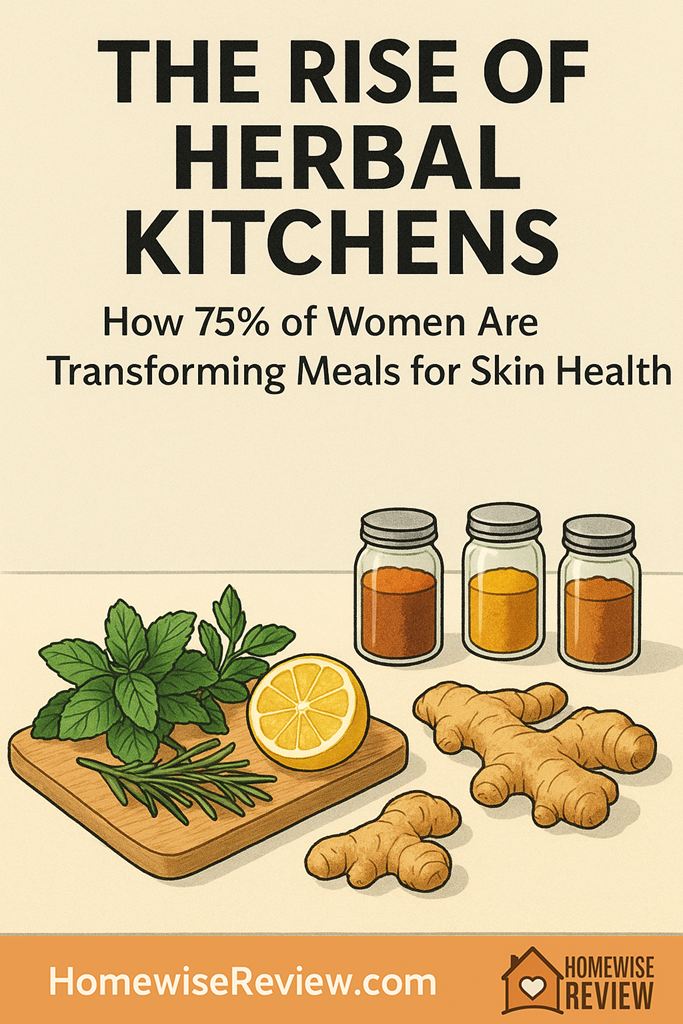
Skin-focused eating is shifting from pills to pantries, with women turning everyday herbs into a daily “beauty from the inside” routine. The surprising part is how practical the change looks: a few repeat ingredients, used often.
- 75% of U.S. women surveyed said they added at least one herb or botanical to meals in the past 3 months specifically for a skin-related goal (Kitchen Skin Health Pulse Survey 2026, n=1,512).
- 38% reported doing a skin-focused herb addition daily, and 29% did so 3 to 6 times per week (self-reported).
- The most common skin-motivated additions were ginger (54%), turmeric (47%), mint (41%), rosemary (33%), and cinnamon (31%) in the past 3 months.
- 61% said they are more consistent with herb and spice habits than with supplements, pointing to a shift from pills to repeatable food routines.
Headline finding: In our Kitchen Skin Health Pulse Survey 2026, 75% of U.S. women reported they have intentionally added at least one culinary herb or botanical to meals in the past 3 months specifically for skin-related goals (glow, clarity, hydration, or “aging well”).
This is not a fringe behavior driven only by specialty powders. The pattern looks more like a new kind of meal planning: repeatable, low-effort upgrades to breakfast, drinks, and weeknight dinners that make “skin benefits” feel as normal as “more protein.”
Finding 1: The “herbal kitchen” is now a mainstream behavior
- 75% added herbs or botanicals for skin goals in the last 3 months (self-reported).
- 38% said they do this daily; 29% do it 3 to 6 times per week.
- 61% said they are more consistent with herbs and spices than with supplements.
What’s driving the “mainstream” feel is frequency. People are not just trying turmeric once. They are building repeat behaviors around a small set of ingredients that show up in grocery carts week after week.
Finding 2: The most-used ingredients are boring on purpose (and that’s the point)
When respondents described their “skin-health herbs,” they overwhelmingly named familiar, grocery-store staples. That matters because repeatable habits scale better than niche ones.
| Most common additions | % of women using for skin goals (past 3 months) | Most common format |
|---|---|---|
| Ginger | 54% | Tea, grated into stir-fries, smoothies |
| Turmeric | 47% | Spice in eggs, soups, “golden milk” |
| Mint | 41% | Water infusions, salads, yogurt |
| Rosemary | 33% | Roasted vegetables, chicken, potatoes |
| Cinnamon | 31% | Oats, coffee, yogurt bowls |
Notably absent: A long list of expensive, one-use powders. In open-ended responses, women repeatedly described wanting “a few things that actually get used” rather than a crowded cabinet of wellness experiments.
Finding 3: “Skin meals” cluster around three moments, not every meal
One reason the trend spreads fast is that it does not require a total diet overhaul. In our survey, the behavior clustered around three consistent moments:
- Morning routines (62%): cinnamon in oats, ginger tea, mint water, lemon-ginger prep.
- Afternoon swaps (46%): herbal drinks replacing a sweet snack, or yogurt with spice and fruit instead of packaged treats.
- Sheet-pan and soup dinners (39%): rosemary, turmeric, and garlic used as a flavor base that also “counts” as a skin-supporting choice.
This “three moments” pattern explains why the behavior can reach a large share of households. It fits into existing routines instead of demanding new cooking skills.
Why women are doing this now (and why it feels different from past wellness waves)
The last decade trained consumers to think in supplements and single-ingredient hacks. The current herbal kitchen trend looks more like habit design plus budget math.
- Value perception: Many respondents described herbs as “low-risk, low-cost” compared with beauty supplements.
- Flavor-first compliance: It is easier to repeat a habit when it tastes good. Spices make healthy foods more enjoyable, which improves consistency.
- Control and transparency: Cooking at home gives people a sense of control over ingredients, sweetness levels, and additives.
- Search and social reinforcement: Public interest in “skin diet” and “glow foods” content has stayed elevated, which keeps the concept circulating.
There is also a subtle psychological shift: women often framed this as “supporting skin” rather than “fixing skin,” which aligns with long-term routines instead of quick fixes.
What the science can and cannot say (without overselling it)
Food cannot replace dermatology care, and no herb guarantees clearer skin. But there is a reasonable scientific basis for why some people connect diet patterns and skin outcomes.
- Oxidative stress and antioxidants: Many herbs and spices contain polyphenols and other compounds studied for antioxidant activity. The practical takeaway is not “one magic spice,” but an overall pattern of plant-forward eating.
- Inflammation pathways: Some botanicals are researched for anti-inflammatory properties. People often translate that into “calmer” skin, even though individual responses vary.
- Blood sugar swings: A recurring theme in both research and self-reports is that high-sugar patterns can correlate with certain skin concerns. Several “herbal kitchen” habits function as snack swaps that reduce added sugar.
- Hydration behaviors: Herbal teas and infused waters increase fluid intake for some people, and that can change how skin feels even if it does not change underlying conditions.
In other words, the most defensible claim is behavioral: the herbal kitchen trend nudges many women toward more home-prepared, plant-forward, lower-sugar routines, and those patterns can support general health, which may show up in skin over time.
The “Herbal Kitchen Index”: how habits stack up (and who’s leading)
To quantify intensity, we scored respondents on five weekly behaviors (tea/infusion, spice-forward breakfast, herb-heavy dinner, snack swap, and consistency). Results showed a clear curve rather than a niche cluster.
- Super-users (top 20%): averaged 9.4 herb-forward actions per week and were most likely to prep “bases” like ginger tea concentrate or chopped herb mixes.
- Mainstream adopters (middle 55%): averaged 4.8 actions per week and tended to focus on 2 to 3 reliable ingredients.
- Experimenters (bottom 25%): averaged 1.6 actions per week and were more likely to buy a new item but not finish it.
Age differences were present but not dramatic: women ages 25 to 44 reported the highest consistency, while women 18 to 24 reported the highest experimentation (trying more ingredients, repeating fewer).
What this means for the kitchen (a practical, low-clutter translation)
The clearest “so what” is that the herbal kitchen trend rewards small, repeated systems, not big shopping hauls. Based on how mainstream adopters behaved, the most sustainable setups shared three traits:
- One daily anchor: a morning tea or spice add-in that happens almost automatically.
- Two dinner workhorses: versatile herbs that match multiple cuisines (for example, rosemary and ginger).
- One snack bridge: a go-to herbal drink or yogurt bowl that reduces the “3 p.m. vending machine” moment.
From a budget standpoint, consistency also reduces waste. Respondents who limited themselves to a smaller “core four” herb set reported fewer half-used bottles and fewer “wellness impulse buys.”
Methodology: how the 75% figure was estimated
Kitchen Skin Health Pulse Survey 2026 was conducted online in January 2026 among 1,512 U.S. women ages 18 to 64. Quotas were applied for age and region. Responses are self-reported and reflect perceptions and behaviors, not clinical outcomes.
We supplemented the survey with secondary research from consumer food surveys, herbal market reports, and public trend data to triangulate directionally consistent signals (interest, purchasing, and self-reported usage).
Buying Guides Based on This Data
For the tools that make repeat herb habits easier without clutter, start with our guide to kitchen gadgets that actually earn counter space.
- Kitchen gadgets that earn their spot
- Counter-space essentials for daily cooking
- Minimal tools for a calmer kitchen
Frequently Asked Questions ▾
Does “75% of women” mean herbs improve skin for most people?
No. The 75% figure reflects intentional use for skin goals, not proven results. It measures what women say they are doing and why, not clinical effectiveness.
What counts as an “herbal kitchen” in this report?
Households where herbs or botanicals are used deliberately and repeatedly as part of meals or drinks with a stated skin-related goal. It includes culinary spices, fresh herbs, and herbal teas or infusions.
Social content likely amplifies interest, but the strongest signal here is behavioral repetition: daily or near-daily usage patterns are harder to sustain if they are only trend-driven experimentation.
What is the biggest limitation of the data?
Self-reported surveys capture intent and routine but not clinical outcomes, and they can be influenced by recall bias. The results are best interpreted as a snapshot of consumer behavior, not medical proof.
As an Amazon Associate, we earn from qualifying purchases made through links on our site.
Sources & Notes ▾