
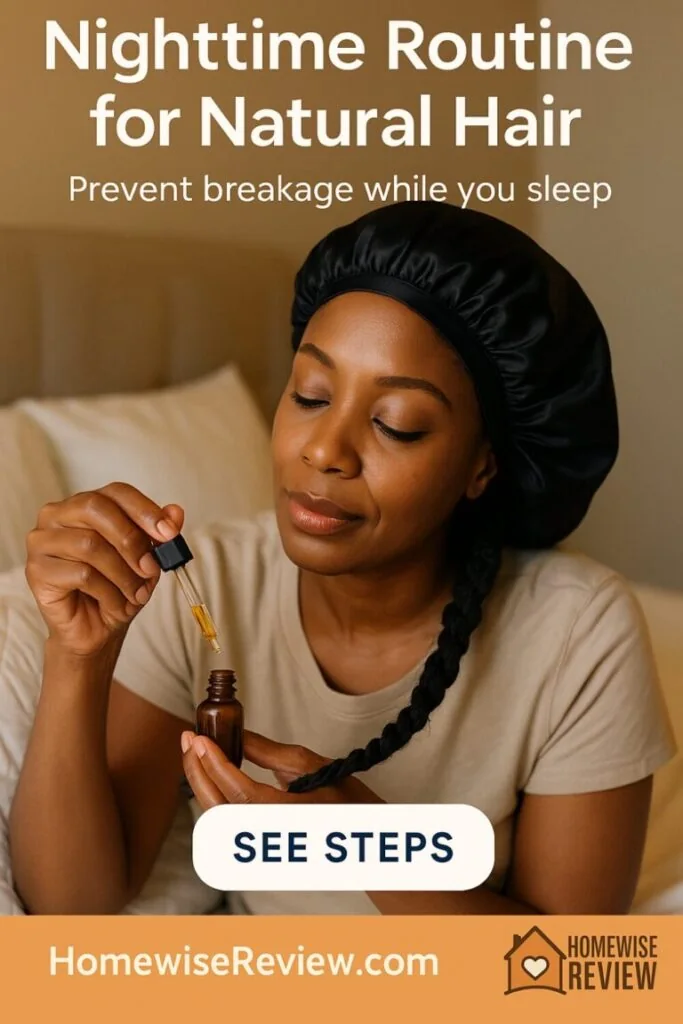
A Nighttime Routine for Natural Hair With Less Tension
A quick, realistic night routine for natural hair that stops friction, seals ends, and reduces breakage. Steps, stretch options, and weekly rhythm.

On this page
A nighttime routine can reduce avoidable tangling, pulling, and restyling, but it cannot guarantee that natural hair will not break. The best method depends on the style you are preserving, scalp comfort, and whether your hair actually needs added moisture. Start with dry hair, comfortable tension, and the fewest accessories or products that keep the style manageable.
Choose the night method by the morning goal
| Morning goal | Night setup | Main tradeoff |
|---|---|---|
| Keep a twist-out or braid-out organized | A few loose sections or chunky twists | Resetting can alter the original pattern |
| Preserve a wash-and-go | Loose high sections that do not pull the hairline | Shorter layers may not reach and roots may compress |
| Maintain stretch | Loose braids or gentle banding | Ties create repeated pressure points if overused |
| Protect a straightened finish | A comfortable wrap or loose sections | Tight wrapping can stress the hairline |
| Do the least possible | A smooth pillowcase and no reset | The style may need more reshaping in the morning |
A simple five-step routine
- Check that the hair and scalp are dry. Do not cover wet hair simply to save drying time.
- Inspect before adding product. If the hair is already flexible and the style is intact, skip the nightly mist, cream, and oil.
- Create only as many sections as needed. Use covered ties or clips without metal edges, and keep the hairline loose.
- Add moisture only where it solves a problem. If an end feels dry, test a small amount of an appropriate leave-in rather than soaking and resealing every section.
- Use a comfortable surface or covering. A smooth pillowcase, scarf, or bonnet may reduce snagging, but it should not grip, pull, or leave a painful line.
Do not detangle by force before bed
Night is a poor time to rush through a stubborn knot. Separate obvious loose tangles with fingers, but leave a tight knot for a proper damp, conditioned detangling session. The American Academy of Dermatology recommends handling tightly curled or textured hair while damp and using a wide-tooth comb to reduce breakage risk.
Tension matters more than a perfectly flat style
A ponytail, banded section, scarf, or wrap should not hurt. Repeated pulling can contribute to traction alopecia. Change the position of ties and wraps, keep them off tender areas, and loosen the setup if you see scalp bumps, broken hairs, or thinning around the hairline.
If you use banding for overnight stretch, follow the 4C banding guide and treat comfort as the limit rather than a fixed spacing rule.
Product decisions at night
- Water: useful for a deliberate refresh, but repeated wetting can also cause shrinkage and extend drying time.
- Leave-in: use when it improves flexibility or manageability, not as a compulsory nightly step.
- Cream or oil: neither adds water to hair, and neither repairs split ends. Use only when the result is better than the simpler routine.
- Gel or edge product: avoid layering it over old product every night; buildup and repeated brushing can create new problems.
Morning takedown
- Remove each tie or covering without dragging it across the ends.
- Let compressed sections settle before deciding they need more product.
- Reshape with fingers and address only the sections that lost definition.
- If a knot appears, save it for a slip-assisted detangling session.
When the routine is not the answer
- Persistent scalp itch, scaling, sores, or pain needs appropriate medical assessment.
- New bald patches, progressive hairline thinning, or sudden shedding should be discussed with a dermatologist.
- Split ends cannot be sealed back together by oil; trimming may be the practical option.
- A covering that repeatedly slips is optional; a smooth pillowcase may be the simpler setup.
For related decisions, see the hair breakage and split-end guide, 4C conditioner guide, and hair-oil guide. These pages compare causes and product categories; they do not guarantee repair.
Frequently Asked Questions
Do I need both a bonnet and a satin pillowcase?
No. Use the setup that stays comfortable and reduces snagging for your style. One smooth surface may be enough.
Should I oil my scalp every night?
Not automatically. Oil can add coating without addressing the cause of dryness, itching, or scaling. Persistent scalp symptoms deserve a proper assessment.
What is the best night style for preventing knots?
No style prevents every knot. Loose organized sections can reduce strands rubbing together, but the best choice is the one you can install and remove without tension or force.
Affiliate Disclosure
If you purchase through links on our site, we may earn a small commission at no extra cost to you.