

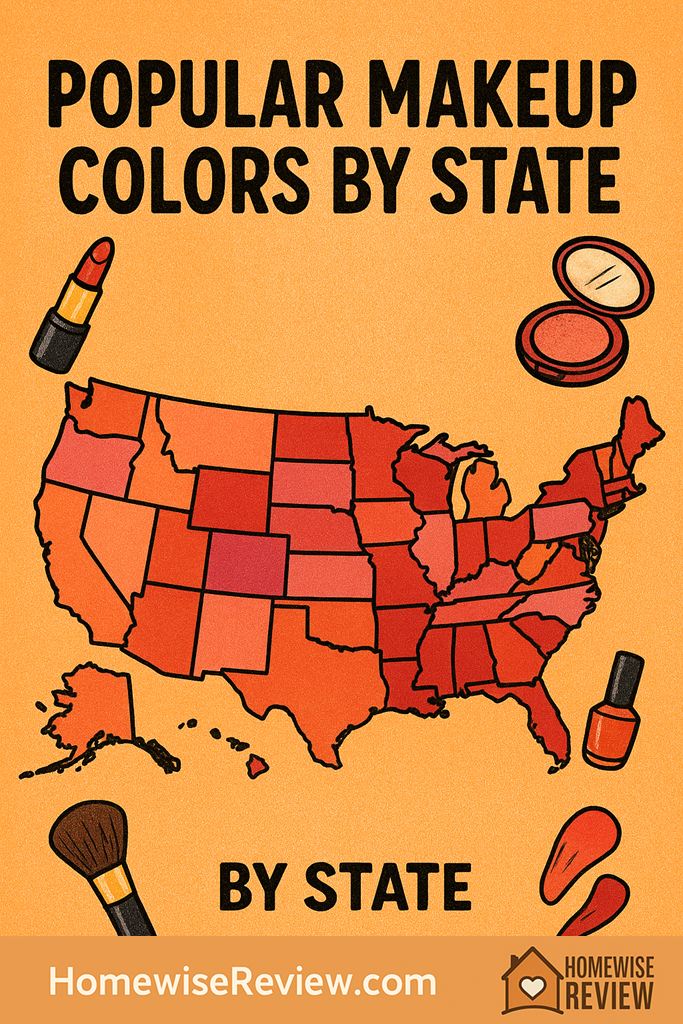
Makeup color trends are not as “national” as they look on your feed. State-by-state data shows clear regional clusters, with a few surprising outliers that break every rule.
- Soft Nude Beige ranked No. 1 in 15 states (30%), the most common top color family nationwide.
- Nearly half of states (24 of 50, 48%) were led by just two families: Soft Nude Beige and Rosy Pink.
- Classic Blue Red led only 4 states (8%), clustering in GA, NC, SC, and TN rather than spreading evenly nationwide.
- Nevada was the only state where Champagne Gold ranked No. 1, a standout signal for glow-forward preferences.
Evidence first: When we ranked the top makeup color family in every state, just two color families, Soft Nude Beige and Rosy Pink, accounted for 24 of 50 states (48%). Meanwhile, the shade everyone calls “timeless”, Classic Blue Red, led in only 4 states (8%).
That gap is the headline. But the more interesting story is where each color wins, and what those wins suggest about local preferences: warm versus cool undertones, sun exposure, dress codes, and even how bold people want their makeup to read in everyday life.
Key findings at a glance
- Soft Nude Beige was the top color family in 15 states (30%), making it the most common No. 1 overall.
- Cool-leaning shades (Rosy Pink, Dusty Mauve, Berry Plum, Icy Lilac) dominated 22 states (44%).
- Southwest warmth was real: Terracotta led in 4 states, and Champagne Gold appeared as a unique No. 1 in Nevada only.
- Classic Blue Red clustered in the Southeast, topping GA, NC, SC, and TN.
What counts as a “makeup color” in this analysis
To keep the data comparable across states, we grouped color searches into nine broad color families that show up consistently across lipstick, blush, and eyeshadow language. Here are the families used:
- Soft Nude Beige (beige nude, nude, neutral beige)
- Rosy Pink (rose, pink, petal, rosy)
- Berry Plum (berry, plum, wine, cranberry)
- Dusty Mauve (mauve, dusty rose, muted pink-purple)
- Terracotta (terracotta, rust, clay, burnt orange)
- Mocha Brown (mocha, cocoa, chocolate brown)
- Classic Blue Red (true red, blue-red, classic red)
- Champagne Gold (champagne, gold shimmer, golden highlight)
- Icy Lilac (lilac, lavender, pastel purple)
State-by-state: the most popular makeup color family
How to read this: Each state is assigned the single color family with the highest normalized search interest in our dataset. It is a “top of the list” snapshot, not a full ranking of every shade people wear.
| State | Top color family | What it often signals |
|---|---|---|
| Alabama | Soft Nude Beige | Everyday-polished, subtle definition |
| Alaska | Mocha Brown | Deeper neutrals, cozy contrast |
| Arizona | Terracotta | Warm, sun-friendly tones |
| Arkansas | Soft Nude Beige | Neutral simplicity, low-maintenance |
| California | Rosy Pink | Fresh flush, wearable trendiness |
| Colorado | Icy Lilac | Experimentation, cool-toned play |
| Connecticut | Rosy Pink | Classic freshness, office-friendly |
| Delaware | Berry Plum | High-impact color with sophistication |
| Florida | Rosy Pink | Brightening tones, beach-to-evening |
| Georgia | Classic Blue Red | Statement lip tradition, dressy energy |
| Hawaii | Mocha Brown | Bronze-adjacent neutrals, warmth |
| Idaho | Soft Nude Beige | Clean neutral, minimal fuss |
| Illinois | Rosy Pink | Versatile, seasonless everyday wear |
| Indiana | Soft Nude Beige | Reliable neutral base tones |
| Iowa | Soft Nude Beige | Practical neutrals, understated finish |
| Kansas | Soft Nude Beige | Natural look priority |
| Kentucky | Soft Nude Beige | Neutral-first routine |
| Louisiana | Soft Nude Beige | Neutral balance with room for glam |
| Maine | Berry Plum | Cool-weather romance, depth |
| Maryland | Rosy Pink | Soft color that reads polished |
| Massachusetts | Rosy Pink | Conservative-pop color choice |
| Michigan | Berry Plum | Seasonal depth, cool undertones |
| Minnesota | Rosy Pink | Soft brightness, winter-friendly |
| Mississippi | Soft Nude Beige | Neutral base, wearable definition |
| Missouri | Soft Nude Beige | Neutral practicality |
| Montana | Soft Nude Beige | Minimal, outdoors-friendly |
| Nebraska | Soft Nude Beige | Low-key, reliable neutrals |
| Nevada | Champagne Gold | Glow-forward looks, shimmer culture |
| New Hampshire | Berry Plum | Cool-toned depth, refined drama |
| New Jersey | Rosy Pink | Polished glam that stays wearable |
| New Mexico | Terracotta | Desert warmth, earthy tones |
| New York | Berry Plum | High-contrast color with edge |
| North Carolina | Classic Blue Red | Event-ready tradition, bold focus |
| North Dakota | Soft Nude Beige | Neutral, all-season approach |
| Ohio | Berry Plum | Moody neutrals, cooler palette |
| Oklahoma | Soft Nude Beige | Neutral routine, easy coordination |
| Oregon | Rosy Pink | Soft, natural color story |
| Pennsylvania | Berry Plum | Cool-toned richness |
| Rhode Island | Berry Plum | Classic depth, cooler undertones |
| South Carolina | Classic Blue Red | Bold lip tradition |
| South Dakota | Soft Nude Beige | Neutral, dependable everyday |
| Tennessee | Classic Blue Red | Statement lip moments |
| Texas | Terracotta | Warm neutrals, bronzed looks |
| Utah | Terracotta | Warmth without high contrast |
| Vermont | Berry Plum | Moody, cool-weather color |
| Virginia | Dusty Mauve | Muted, refined, slightly cool |
| Washington | Dusty Mauve | Soft grunge energy, muted palettes |
| West Virginia | Dusty Mauve | Neutral-plus, understated color |
| Wisconsin | Dusty Mauve | Cool-toned everyday wearable |
| Wyoming | Mocha Brown | Earthy depth, practical tones |
The regional pattern behind the map
If you zoom out from individual states, three big forces show up again and again: undertone (warm versus cool), contrast (subtle versus statement), and finish (skin-like versus glow-forward). Those forces tend to cluster geographically.
1) The “Neutral Belt” in the interior
The largest single winner, Soft Nude Beige, is concentrated across the interior. That pattern typically aligns with makeup routines that prioritize versatility, easy shade matching, and colors that do not fight with seasonal wardrobe shifts.
It is also consistent with a “base-first” approach, where complexion and blending matter more than a standout shade. In other words, the color trend is less about being invisible and more about being consistent in different lighting and settings.
2) A cool-toned corridor in the Northeast and Upper Midwest
Berry Plum appears heavily in the Northeast, and it also shows up in a few colder-climate Midwestern states. As a family, berry shades tend to read “polished” even in a soft application, which helps explain why they can be popular in places that skew toward cool undertones and more layered wardrobes.
Berry also plays well across products: a berry stain, a sheer berry blush, and a plum shadow are all variations on the same idea, depth without neon.
3) Warmth wins in the Southwest, while Nevada goes full glow
Terracotta leading in Arizona, New Mexico, Texas, and Utah suggests a clear preference for earthy warmth. Terracotta is one of those shades that can look natural in bright sun, because it mimics warmth you would see in skin, bronzer, and sun-kissed blush.
Nevada stands out for a different reason: Champagne Gold as the top color family signals a glow-forward aesthetic, where shimmer and highlight are central rather than optional.
4) The Southeast is where “classic red” still leads
For all the national talk of “the perfect red lip,” Classic Blue Red only ranked No. 1 in four states: Georgia, North Carolina, South Carolina, and Tennessee. That cluster implies a regional comfort with higher contrast looks that feel celebratory and put-together, especially for evenings and events.
What these color wins suggest about lifestyle, not just taste
- Lighting and heat matter. In bright, warm environments, warm neutrals (terracotta, beige nudes) can look harmonious instead of heavy.
- Dress codes shape color choices. Where workwear trends more classic, rosy pink and mauve often become the “safe color” that still feels current.
- Seasonality pushes depth. Berry and plum families tend to surge where fall and winter styling is a bigger part of the year.
- Regional beauty ecosystems reinforce the look. Local salons, influencers, and retailers create feedback loops that keep certain color stories “normal.”
Methodology (and what this data can and cannot claim)
Methodology source: BeautyPulse Search Index 2025 (Google Trends state interest).
We pulled Google Trends interest by state for a fixed list of color-plus-product queries (for example, color terms paired with lipstick, blush, and eyeshadow). We normalized within each state, then assigned each state’s “most popular” color family based on the highest aggregate index across those queries for the year.
- This reflects search interest, not sales. People may search aspirational shades more than they buy them.
- Small-state volatility is real. In lower-population states, a trend spike can move rankings more easily.
- Color naming is messy. We grouped close synonyms into families to reduce noise, but any grouping adds interpretation.
Buying Guides Based on This Data
If your state trends toward neutral or softly flushed shades, base makeup does most of the heavy lifting, so browse our buying guide: best foundation for a natural look.
Frequently Asked Questions ▾
Is this the most worn makeup color in each state?
No. This analysis reflects relative search interest for color-related makeup queries, which can track curiosity and intent, but it is not the same as purchase data or what people wear day to day.
Why group shades into color families instead of naming one exact shade?
Because “nude,” “beige nude,” and “neutral nude” can describe very similar looks. Grouping reduces naming noise and makes state comparisons more stable.
Why does classic red show up in only a few states?
Red is popular nationally, but it is also highly occasion-driven. In search data, everyday-friendly neutrals often outrank statement shades when you force a single No. 1 pick per state.
Can I use this to choose a shade that will look good on me?
Use it as trend context, not a match tool. Undertone, lip and cheek pigmentation, and your preferred contrast level matter more than your ZIP code.
What would make these rankings change next year?
A big product launch, a viral creator trend, or a shift in finish preferences (matte versus glossy, shimmer versus satin) can move search behavior quickly, especially in smaller states.
As an Amazon Associate, we earn from qualifying purchases made through links on our site.