

Quietly cleans small rooms while offering a premium look and app-driven auto control.
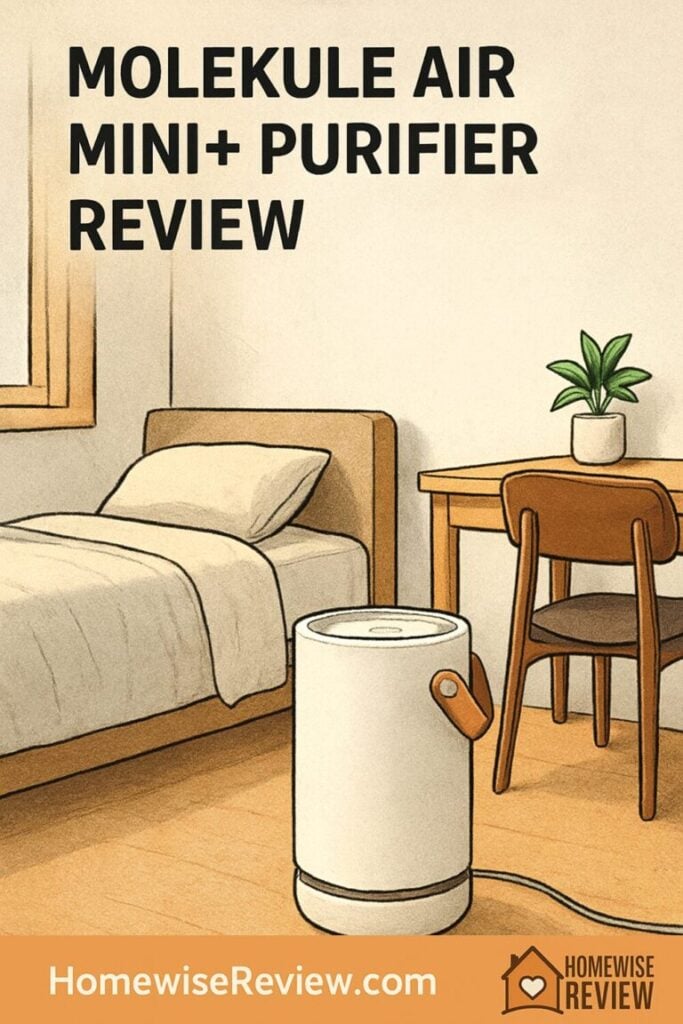
If you are tired of ugly air purifiers but still want cleaner air in a small room, the Molekule Air Mini+ promises premium design and smart purification in a compact package. The real question is whether its performance and ongoing costs justify the price.
🆕 2026 Product Update
As of 2026, the Molekule Air Mini+ still appeals to buyers who want a compact purifier with a polished look and app-based control for small rooms. The bigger shift is value: newer small-room models now often deliver stronger particle filtration and lower filter costs, so this one makes the most sense if design, quiet operation, and the PECO approach are your main priorities.
Overview
The Molekule Air Mini+ is a compact, design-forward air purifier aimed at small rooms such as bedrooms, nurseries, and home offices. It uses the brand’s proprietary PECO technology, which is designed to break down pollutants at a molecular level, instead of relying solely on traditional HEPA filtration.
Rated for spaces up to about 250 square feet, the Air Mini+ wraps that technology in a clean, minimalist cylinder with a leather carry strap and a simple touch interface on top. It also adds a particle sensor, an Auto Protect mode, and app connectivity that differentiates it from the standard Air Mini.
This is firmly a premium product, with a higher upfront price and more expensive filters than most small HEPA-based purifiers. In return, you get striking looks and a different approach to filtration, but you also accept a few tradeoffs in raw particle-cleaning performance and value.
If you are considering the Air Mini+, it is worth looking closely at how it feels to live with day to day, how quickly it cleans the air, and whether its unique tech lines up with your real-world needs.
Who it’s for
The Molekule Air Mini+ is best suited to people who care as much about aesthetics and quiet operation as they do about air cleaning. It looks more like a modern speaker than an appliance, so it fits easily into a well-designed living room, minimalist office, or carefully decorated nursery.
It also suits tech-friendly households who want app control, air quality readings, and an auto mode that responds to changes in particle levels. If you like to set a device once and let it manage itself, the Air Mini+ can fit that style of use.
Where it is less ideal is for buyers whose top priority is maximum particle removal per dollar. If you are dealing with serious allergies, wildfire smoke, or heavy dust and want the strongest, fastest filtration for the price, there are traditional HEPA purifiers that outperform it in independent tests, especially in medium to large rooms.
How it feels and performs
Design, build, and “feel”
The first impression of the Molekule Air Mini+ is how solid and thoughtfully finished it feels. The outer shell has a smooth, matte texture that resists fingerprints, with subtle perforations around the bottom for 360-degree air intake. A stitched leather strap on the side doubles as a handle and adds a slightly upscale, home-decor look.
At about the size of a small wastebasket, it is easy to pick up and move between rooms. The top surface has a clean, single-panel look with capacitive touch controls and small indicator lights that show fan speed and air quality status. Everything feels deliberately minimal, which helps it disappear visually in a room rather than screaming “appliance.”
Setup and controls
Out of the box, setup is straightforward. You remove the bottom cover, unwrap the filter, seat it in place, then plug in the unit. The touch controls on top let you cycle through fan speeds, activate Auto Protect mode, and view basic air quality feedback with color indicators.
Connecting to the Molekule app over Wi-Fi adds more detailed information and control. In the app, you can see approximate particle levels, change modes, set schedules, and check filter life. Some owners report occasional connectivity drops or delays when issuing commands, so expect a smart-home experience that is good but not flawless.
Filtration technology
Instead of relying purely on mechanical filtration, the Air Mini+ uses Molekule’s PECO system. Air first passes through a physical media that captures larger particles, then over a coated filter that is activated by light to trigger chemical reactions intended to break down pollutants like VOCs, bacteria, and mold spores.
In theory, this can address a broader range of contaminants than basic HEPA alone. In practice, you are still depending on the physical media to trap fine particles such as dust, pollen, and smoke, and Molekule’s filters are not always certified to the same HEPA standards that many competitors clearly publish. Independent reviewers have consistently found that Molekule purifiers clean particulate matter more slowly than top-tier HEPA units at similar price points.
Molekule emphasizes potential benefits for gases and microscopic biological pollutants, but there is less third-party testing available in those areas than for plain particle counts. For a typical household concerned mainly with dust, pet dander, and smoke, you should view the Air Mini+ primarily as a capable but not class-leading particle filter with some possible extra benefits that are harder to measure.
Real-world performance
In a small bedroom or home office, the Air Mini+ can gradually bring particle levels down and keep them relatively stable, especially if you keep it running continuously. Light cooking odors and everyday dust tend to dissipate over an hour or two, and the unit does a reasonable job maintaining a fresher-feeling space once it has caught up.
When faced with heavier loads, such as wildfire smoke or a city apartment with frequent outdoor pollution spikes, the limitations become clearer. The Auto Protect mode ramps up the fan as particles rise, but the time it takes to noticeably clear a room is often longer than similarly sized HEPA purifiers with higher clean air delivery rates. You may find you need to run it on higher settings for longer to get the same sense of clarity in the air.
For allergy sufferers, that means you might still experience relief in a small, closed bedroom, but the improvement may be more modest than what you would get from a high-CADR HEPA purifier. For households with very sensitive individuals, the Air Mini+ can work as a supplemental unit, though it is difficult to recommend as the only line of defense in a larger or very dusty home.
Noise levels
The Air Mini+ has multiple manual fan speeds plus Auto Protect. On the lowest settings, the sound is a soft hum that blends into background noise and is generally appropriate for sleeping, provided the unit is not directly next to your head. There is a subtle whoosh of air, but it is not harsh or rattling.
On higher speeds, the noise increases to a more noticeable white noise whoosh that some people find soothing and others find too prominent, especially in very quiet bedrooms. Compared with many compact purifiers, the tone is smoother but still clearly audible. If you are a light sleeper, you will likely want to keep it on low at night and rely on longer run times instead of brute-force speed.
Energy use and heat
Power draw is modest on the lower settings and rises as you move to higher speeds. In everyday use on low or Auto Protect, the unit does not add much to your electric bill. It produces only a slight warmth from the top exhaust, similar to other small purifiers, and it does not noticeably heat up a small room.
Filter life and ongoing costs
Molekule recommends replacing the Air Mini+ filter about every six months with typical use. The replacement filters are proprietary and cost significantly more than standard filters for many HEPA purifiers in the same room-size class.
Over a few years, the total cost of ownership can easily surpass that of competing models, even if those alternatives use carbon plus HEPA filters. There are subscription options that slightly reduce per-filter cost but still keep this in the premium range. If budget is a primary concern, this is one of the biggest strikes against the Air Mini+.
How to use for best results
Placement matters a lot with any small purifier, and the Air Mini+ is no exception. Set it on the floor or a low table with at least 12 to 18 inches of clearance around it, away from tight corners or directly under a shelf. Keeping it closer to the center of the room or near the main source of pollution, such as a doorway to a busy hallway, can improve effectiveness.
For consistent protection, leave the unit running all day in Auto Protect mode or at a low manual speed. Small purifiers work best when they are constantly filtering rather than cycling on only when the air is already bad. Closing windows and doors in your target room will also help it keep up, especially during pollen season or smoke events.
Get in the habit of checking and lightly vacuuming or wiping away visible dust on the intake area to prevent buildup. Use the app or the indicator lights to track filter status and plan ahead for replacements so you are not running a clogged filter past its prime.
If you are especially concerned about VOCs from new furniture, paint, or cleaning products, place the Air Mini+ in the affected room and let it run on a medium or higher setting for several hours at a time. Pair it with basic source-control habits, such as ventilating when using strong chemicals, for the best overall results.
Pros and cons
Pros
- Minimalist, attractive design that fits into modern decor without looking like an appliance.
- Compact and easy to carry from room to room with the integrated strap.
- Quiet and comfortable on low speeds, suitable for bedrooms and offices.
- Auto Protect mode and particle sensor automate fan speed based on air quality.
- App connectivity for remote control, scheduling, and filter monitoring.
- PECO technology targets a wider range of pollutants on paper, including some gases and microorganisms.
Cons
- More expensive upfront than many small HEPA purifiers with similar or better particle performance.
- Proprietary filters are costly and need replacement about every six months.
- Independent testing often shows slower particle removal than top HEPA competitors at similar price points.
- Best suited to small rooms; not powerful enough to clean large living areas on its own.
- Smart features depend on a stable Wi-Fi connection and can be finicky for some households.
- Lack of widely published, strong CADR data makes performance harder to compare directly with competitors.
Final verdict
The Molekule Air Mini+ is a thoughtfully designed, premium-feeling purifier that looks good, runs quietly on low, and offers convenient smart features. It is easy to live with, especially in a small bedroom or office where you want something subtle and hands-off rather than an industrial-looking box humming in the corner.
At the same time, its combination of modest small-room coverage, slower particle cleaning in many tests, and high filter costs makes it difficult to recommend as the best value for most households. If your primary goal is the strongest, most measurable reduction in dust, pollen, and smoke for every dollar spent, a traditional HEPA purifier with a high clean air delivery rate will usually be a better choice.
The Air Mini+ can make sense if you care deeply about design, are intrigued by PECO technology, and are willing to pay a premium for a stylish, compact purifier in a small space. For budget-conscious shoppers or anyone facing serious allergies or smoke problems, it is wiser to prioritize proven HEPA performance and lower long-term costs.
See also
If you are comparing the Molekule Air Mini+ with a more traditional option, our Levoit Core 300 review and the larger smart-enabled Levoit Core 400S review highlight what strong HEPA performance looks like in similar price brackets.
- See how the Molekule stacks up against a powerful competitor in our Blueair Pure 211i Max review.
- For heavy mold issues, our guide to the best air purifiers for mold focuses on high-CADR machines that can handle problem rooms.
- Allergy sufferers may find better relief in models featured in our best air purifiers for dust-mite allergies roundup.
FAQ
Is the Molekule Air Mini+ good for allergies?
The Air Mini+ can help reduce airborne allergens in a small, enclosed room, especially if you let it run continuously. However, independent testing suggests that many HEPA-based purifiers remove particles like pollen and pet dander more quickly and efficiently, particularly in medium or larger spaces. If allergies are severe, a higher-CADR HEPA purifier is usually a more reliable first choice, with the Air Mini+ better suited as a supplemental unit or as a design-forward solution in a small bedroom.
How noisy is the Molekule Air Mini+ at night?
On its lowest fan settings, the Air Mini+ produces a soft, steady hum that most people find acceptable for sleeping, especially if the unit is a few feet away from the bed. On medium to high speeds, the noise becomes more prominent and may be too loud for light sleepers in very quiet rooms. For night use, plan on running it on low for comfort and relying on longer run times and a closed bedroom door to maintain clean air.
How much does it cost to run the Molekule Air Mini+ long term?
Electricity use for the Air Mini+ is modest on lower speeds and will not significantly impact most power bills. The bigger expense is filters, which Molekule recommends replacing about every six months under typical use. Because the filters are proprietary and relatively expensive, your annual filter cost will usually be higher than for comparable HEPA purifiers, so factor that into your long-term budget.
Can the Molekule Air Mini+ handle wildfire smoke or city pollution?
The Air Mini+ can reduce smoke particles and urban pollution in a small room, especially if the space is sealed and the unit runs continuously. That said, it typically clears heavy smoke and fine particulate pollution more slowly than many high-CADR HEPA purifiers sized for the same or larger rooms. If wildfire smoke or smog is a recurring problem, you may want to pair the Air Mini+ with a more powerful HEPA purifier in common areas, or choose a single larger HEPA unit instead.
What is the difference between the Molekule Air Mini and the Air Mini+?
Both models share a similar compact design and use Molekule’s PECO-based filtration, but the Air Mini+ adds a particle sensor, an Auto Protect mode that automatically adjusts fan speed based on air quality, and more detailed feedback through the top display and app. The standard Air Mini is more basic and relies on manual speed control without real-time sensing. If you value set-and-forget operation and air quality readouts, the Air Mini+ is the more convenient option.
As an Amazon Associate, we earn from qualifying purchases made through links on our site.