

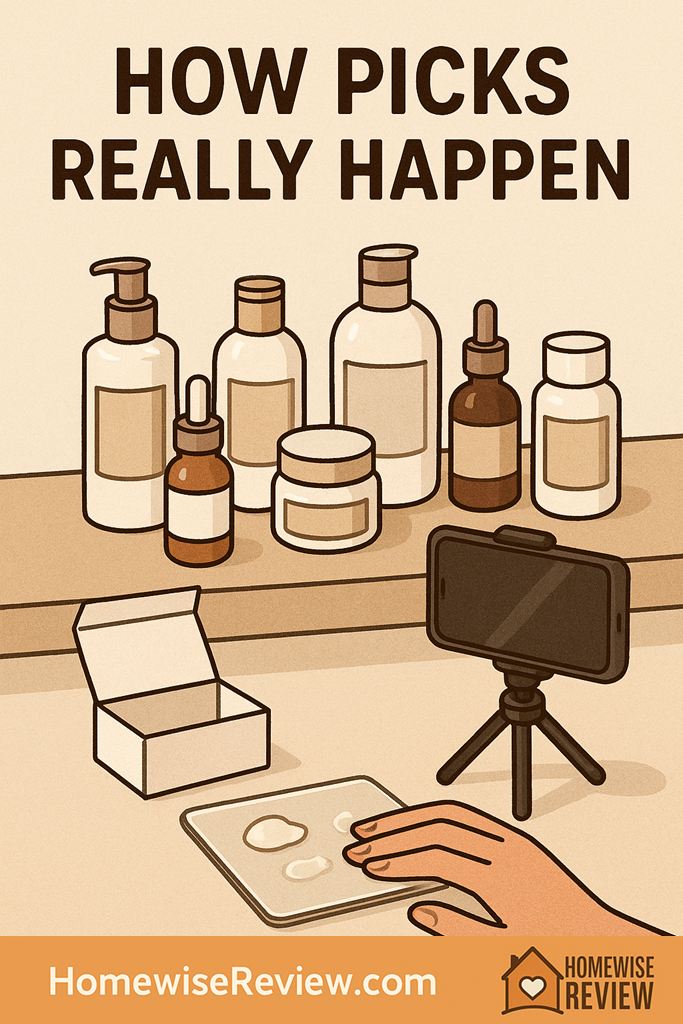
An influencer recommendation can show texture, packaging, and one person’s experience, but it cannot establish that a skincare product will work for your skin. Before buying, identify any brand relationship, separate observations from treatment claims, compare the creator’s skin and routine with yours, and check the label. Introduce only one new product at a time and test it on a small area first.
The goal is not to assume that sponsored advice is false or that unsponsored advice is impartial. It is to understand what evidence you actually have. A clear disclosure helps you weigh an endorsement; it does not validate the formula, and the absence of a visible disclosure does not prove that no relationship exists.
Check the relationship before the recommendation
The Federal Trade Commission says an influencer should make a material connection to a brand obvious. That includes payment, free or discounted products, employment, and personal or family relationships. The disclosure should be hard to miss and placed with the endorsement rather than buried after a “more” link, at the end of a video description, or inside a cluster of hashtags.
Look for plain language such as “ad,” “sponsored,” or “the brand sent me this product.” Vague labels such as “collab,” “ambassador,” or a standalone thank-you may not tell you what the creator received. Affiliate links and storefront commissions are also relevant because the creator can earn money when a viewer buys, even if the product was not part of a formal campaign.
| What you see | What it can tell you | What remains unknown |
|---|---|---|
| Clear ad or gifted-product disclosure | A brand relationship affected the context of the recommendation | Whether the opinion is accurate or the product suits you |
| Close-up texture and application footage | How that sample looked during that recording | Long-term tolerance, stability, or results |
| Before-and-after images | A visual difference may be present | Lighting, timing, routine changes, treatment, and whether the product caused it |
| Ingredient explanation | A reason the formula might fit a goal | Concentration, complete-formula behavior, and your response |
Separate experience from claims that require proof
“This felt light on my skin” is a personal observation. “This treats acne,” “repairs eczema,” or “rebuilds collagen” is an objective or health-related claim that requires appropriate support and may change how the product is regulated. The FTC tells endorsers not to claim an experience they did not have or repeat scientific or health claims the advertiser cannot substantiate.
The FDA does not preapprove ordinary cosmetic products or their claims before sale, apart from specific requirements such as approval for most color additives. Cosmetic labeling must still be truthful and not misleading. Claims that a product treats or prevents disease or affects the body’s structure or function can make it a drug under U.S. law. Treat dramatic promises as a cue to find the exact label, directions, active ingredients when applicable, and evidence, not as a reason to increase use.
Compare the creator’s context with your own
- Skin behavior: oily, dry, combination, sensitive, acne-prone, or affected by a diagnosed condition.
- Current routine: cleansers, moisturizers, sunscreen, exfoliants, retinoids, prescriptions, and procedures can change tolerance and results.
- Testing time: a first impression can assess feel and finish, not a durable change in pigmentation, acne, fine lines, or barrier function.
- Environment: climate, season, humidity, sun exposure, and makeup can change how a formula performs.
- Product version: check the market, shade, strength, fragrance option, and current ingredient list rather than assuming every variant is equivalent.
A creator can be completely honest and still be a poor match for you. The useful question is not “Do I trust this person?” but “Which parts of this experience transfer to my skin, routine, and goal?”
Use a controlled trial instead of copying a routine
Read the full label and follow its warnings and directions. Avoid starting several recommended products together; if irritation develops, you will not know which product caused it. The American Academy of Dermatology recommends testing a skincare product on a small area twice daily for seven to ten days, using it for the same amount of time it would normally remain on the skin. A wash-off cleanser, for example, should not be left on as if it were a cream.
If the test area becomes red, itchy, or swollen, wash the product off and stop using it. Severe or persistent reactions need medical advice. A home spot test can reduce uncertainty, but it does not diagnose an allergy; a dermatologist may use formal patch testing when the cause of repeated reactions is unclear.
A practical save-or-skip checklist
- Find the disclosure in the post, video, story, or live stream itself.
- Write down the exact benefit claimed and whether it is observation, opinion, or a claim requiring evidence.
- Check the current product label, directions, warnings, size, and complete ingredient list.
- Compare the creator’s skin type, routine, test length, and product version with yours.
- Decide what you would stop or delay so you can introduce only one new variable.
- Test a small area and stop if a reaction occurs.
Skip the recommendation when the claimed result is incompatible with the testing window, the product cannot be identified precisely, the routine context is hidden, or the sales pressure is stronger than the evidence. Saving a post for later is often more useful than buying during the launch window.
Frequently Asked Questions
Does gifted product always require a disclosure?
The FTC says a free or discounted product is a material connection when the influencer mentions it, even if the brand did not require a post. The disclosure should be clear and hard to miss.
Is an unsponsored recommendation automatically unbiased?
No. A creator may have affiliate income, prior brand relationships, audience incentives, personal preferences, or limited testing time. Evaluate the evidence and fit whether or not a formal sponsorship is disclosed.
Can patch testing prove a product will not irritate my face?
No. It is a practical screening step, not a guarantee or medical diagnosis. Facial skin and repeated full-routine use can respond differently. Stop if irritation develops and seek medical care for a severe or persistent reaction.
As an Amazon Associate, we earn from qualifying purchases made through links on our site.