

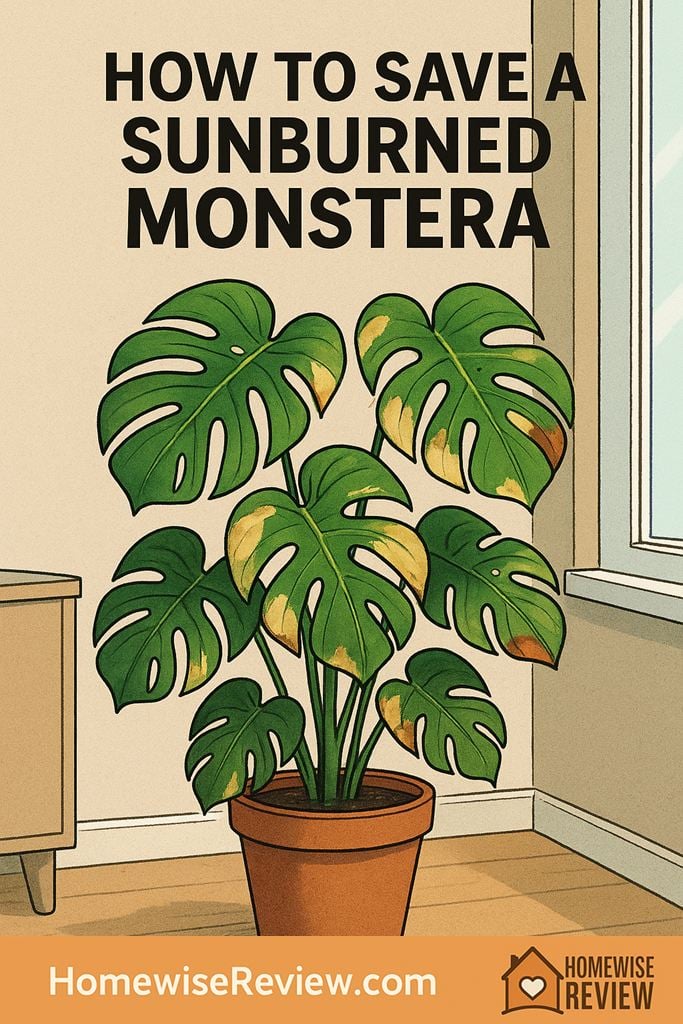
I slid my Monstera a little closer to the window for “better light,” and two days later the biggest leaf had bleached patches that turned crispy at the edges. My instinct was to water more and feed it, like I could nurse it back fast, but that only felt like piling stress on top of stress. Pulling it out of direct sun and giving it a calm, steady routine was what finally made new growth start unfurling again.
Sunburned Monstera leaves can look like a plant emergency, especially when the damage seems to spread overnight. The good news is that Monsteras are tough: once you remove the stress and tighten up care, they usually push fresh growth within a few weeks.
The key is knowing what to change immediately (light and watering) and what to pause (fertilizer and heavy repotting) so you do not stack extra stress on an already stressed plant.
What sunburn looks like on a Monstera (and what it is not)
Common sunburn symptoms
- Bleached or faded patches that look pale yellow, tan, or almost white.
- Crispy brown areas that feel dry and papery, often surrounded by a lighter “halo.”
- Damage on the most exposed leaves, usually the ones closest to a sunny window or the outside-facing side of the plant.
- Sharp boundaries between healthy green tissue and burned tissue (not always, but often).
Quick “not sunburn” checks
- Overwatering rot tends to cause yellowing that starts more evenly across a leaf, plus soft stems or a musty smell from the soil.
- Underwatering often shows as drooping and curling first, then browning at tips and edges across many leaves, not just the sun-facing side.
- Cold damage (near a drafty window) can cause dark, water-soaked spots that later turn brown and limp.
- Pests (thrips, spider mites) usually cause stippling, silvery scarring, or tiny specks, not large bleached patches.
If the damage showed up within 1 to 3 days after moving into stronger sun, that timing strongly points to sunburn.
First 24 hours: stop the burn and stabilize the plant
Step 1: Move it out of direct sun immediately
Put your Monstera in bright, indirect light right away. Indoors, that usually means a few feet back from a sunny window, or behind a sheer curtain. Outdoors, move it into full shade or dappled shade.
Step 2: Do not “compensate” with fertilizer
Skip fertilizer for now. A sunburned plant is not asking for more nutrients, it is asking for less stress. Fertilizing can push weak, thirsty growth and irritate already-damaged roots.
Step 3: Check soil moisture and water correctly
- If the top 2 inches feel dry, water thoroughly until water runs out the drainage holes, then empty the saucer.
- If the soil feels wet or heavy, do not water. Let it dry down a bit so roots can breathe.
Sunburn often happens alongside dehydration, but overwatering “to help” is one of the fastest ways to turn leaf damage into root trouble.
Step 4: Hold off on major pruning for a day
It is tempting to snip everything crispy right away. Give the plant a day to settle in its new spot and confirm the damage is not still expanding. Then prune strategically.
Assess the severity: keep, trim, or remove?
Sunburned areas will not turn green again, but partially damaged leaves can still photosynthesize and support recovery. Use this table to decide what to do.
| What you see | Severity | Best move |
|---|---|---|
| Small tan or pale patches; leaf is mostly green and firm | Mild | Keep the leaf. Monitor. Focus on light and watering. |
| Edges crispy; 25 to 40 percent of the leaf damaged | Moderate | Keep the leaf for now. You can trim dead edges for appearance. |
| Large bleached sections; 50 percent or more damaged | High | Remove the leaf at the petiole if it is dragging the plant down or looks ugly to you. |
| Multiple leaves burned plus drooping, mushy stems, sour soil smell | Sunburn plus root issue | Check roots and drainage. Consider repotting only if rot is present. |
How to prune a sunburned Monstera without setting it back
What to remove
- Fully crispy leaves with little green left.
- Leaves that are folding or splitting because the burned area is brittle.
- Any soft, blackened tissue on stems or petioles (this is not typical sunburn and suggests rot or cold damage).
How to cut
- Use clean, sharp scissors or pruners. Wipe blades with rubbing alcohol before and after.
- Follow the leaf stem (petiole) down to where it meets the main stem and cut cleanly, leaving the main stem intact.
- If only the edge is crispy, you can “detail trim” the dead portion, following the natural curve of the leaf. Leave a thin margin of brown rather than cutting into green tissue.
Try not to remove more than about one-third of the plant’s total leaf area at one time unless the leaves are truly gone. The plant needs green tissue to rebuild.
Fix the light: the real cure is prevention + acclimation
Most sunburn happens when a Monstera goes from low light to direct sun too quickly. Your goal is to return it to a stable “bright indirect” zone and only increase light slowly if you want faster growth.
Indoor light targets (simple and practical)
- Best everyday spot: Bright room, out of direct midday sun, with a clear view of the sky.
- South or west window: Usually needs a sheer curtain or distance (often 3 to 8 feet back, depending on how intense the window is).
- East window: Often works well, but watch for direct morning rays hitting the leaves for hours.
If you moved it outdoors, acclimate like this
Outdoor sun is dramatically stronger than indoor light. Even “shade” outdoors can be brighter than a living room.
| Days | Placement | What you are watching for |
|---|---|---|
| 1 to 4 | Full shade or under a covered patio | No new bleached spots; leaves stay firm |
| 5 to 10 | Dappled shade (brief gentle morning light is okay) | Leaf color stays even; no crispy expansion |
| 11+ | Only if desired: a little more morning sun, still avoid harsh midday | New leaves emerge without pale patches |
Watering after sunburn: keep roots steady, not soggy
Why watering needs change after leaf damage
Burned leaves often transpire less, meaning the plant may use water more slowly for a bit. That is why a sunburned Monstera can be at risk of overwatering even if you think it “needs extra.”
A simple watering method that works
- Check moisture with your finger (or a wooden skewer) before watering.
- Water when the top 2 inches are dry, then water thoroughly.
- Make sure the pot has drainage holes and the plant is not sitting in water.
Humidity and airflow: supportive, but not fussy
- Aim for moderate humidity if your home is dry, but prioritize good airflow.
- A pebble tray can help a little; a small humidifier helps more.
- Avoid misting if it leaves water sitting on damaged tissue, especially in a still corner.
Should you repot a sunburned Monstera?
Repotting is helpful only when the pot or soil is part of the problem. Otherwise, it is extra stress during recovery.
Repot only if one of these is true
- The soil stays wet for many days and feels dense or muddy.
- You smell sour, swampy odor, or you suspect root rot.
- The plant is severely rootbound and drying out too fast (water runs through immediately and the plant wilts quickly).
- The pot has no drainage (this is a non-negotiable fix).
If you do repot, keep it gentle
- Choose a pot only 1 to 2 inches wider than the current root ball.
- Use a chunky, airy mix (potting soil plus orchid bark and perlite is a common, easy blend).
- Trim only truly rotten roots (brown, mushy, hollow). Keep firm, light-colored roots.
- After repotting, place the plant back in bright indirect light and wait to fertilize.
When (and how) to fertilize again
Sunburn is a light injury, not a nutrient deficiency. Feed only after you see stability and new growth starting.
- Wait: Usually 3 to 6 weeks, or until you see a new leaf beginning to unfurl.
- Start small: Half-strength balanced houseplant fertilizer.
- Frequency: Every 4 to 6 weeks during active growth, less in winter if growth slows.
If your plant is recovering in lower light, it will need less fertilizer, not more.
What recovery looks like (and how long it takes)
Signs you are on the right track
- No new bleached patches appearing.
- Leaves feel firm (even if they are cosmetically damaged).
- New growth points look green and hydrated.
- A new leaf begins to form within 2 to 8 weeks (timing depends on season, light, and root health).
Signs you need to change course
- New spots show up even after moving out of direct sun (light is still too strong or reflective).
- Lower leaves yellow rapidly and stems feel soft (check for root rot).
- Soil never seems to dry (potting mix too dense, pot too large, or low light slowing uptake).
Preventing Monstera sunburn next time
- Increase light gradually: Move closer to a window in small steps every 5 to 7 days.
- Use a sheer curtain: It softens harsh rays without turning the room into low light.
- Watch for “hot spots”: Glass tables, white walls, and mirrors can reflect strong light onto leaves.
- Do not combine stressors: Avoid moving into brighter light the same week you repot, fertilize, or change watering habits.
- Rotate the plant: A quarter turn every week or two keeps one side from getting blasted.
Worth Knowing Before You Buy
Sunburn on a Monstera is not a watering problem. If bleached patches and crispy edges show up 1 to 3 days after you move it closer to a window or outside, adding more water or fertilizer just adds root stress to leaf damage. Move it out of direct sun and keep the rest of its care unchanged.
Bottom Line
Sunburned Monstera leaves will not turn green again, but the plant can absolutely recover if you remove direct sun, keep watering steady, and prune thoughtfully. Focus on stabilizing light and roots first, then resume feeding only after you see healthy new growth.
See also
If you are troubleshooting another stressed houseplant, start with our guide on saving a dying peace lily.
- Best garden tools for repotting and plant care
- Best fertilizers for healthy houseplants
- Best gloves for potting and pruning
- Garden tool organizers for small spaces
Frequently Asked Questions ▾
Can sunburned Monstera leaves turn green again?
No. Once leaf tissue is bleached or crispy from sunburn, it is permanently damaged. Your goal is to prevent further burn and support new, healthy leaves.
Should I cut off sunburned leaves right away?
Not always. If a leaf is mostly green, it still helps the plant make energy. Remove leaves that are more than about half damaged, fully crispy, or tearing and collapsing.
How long does it take a sunburned Monstera to recover?
You should see the damage stop expanding within a few days once the light is corrected. New growth often starts within 2 to 8 weeks, depending on light, temperature, and root health.
Is it better to move a Monstera to low light while it recovers?
Go for bright, indirect light, not low light. Too little light can slow recovery and increase the risk of overwatering because the soil dries more slowly.
Can I propagate a Monstera that got sunburned?
Yes, as long as you take a cutting with at least one node and the stem tissue is healthy. Avoid using severely stressed, soft, or rotting sections, and let the parent plant stabilize in good indirect light first.
As an Amazon Associate, we earn from qualifying purchases made through links on our site.