

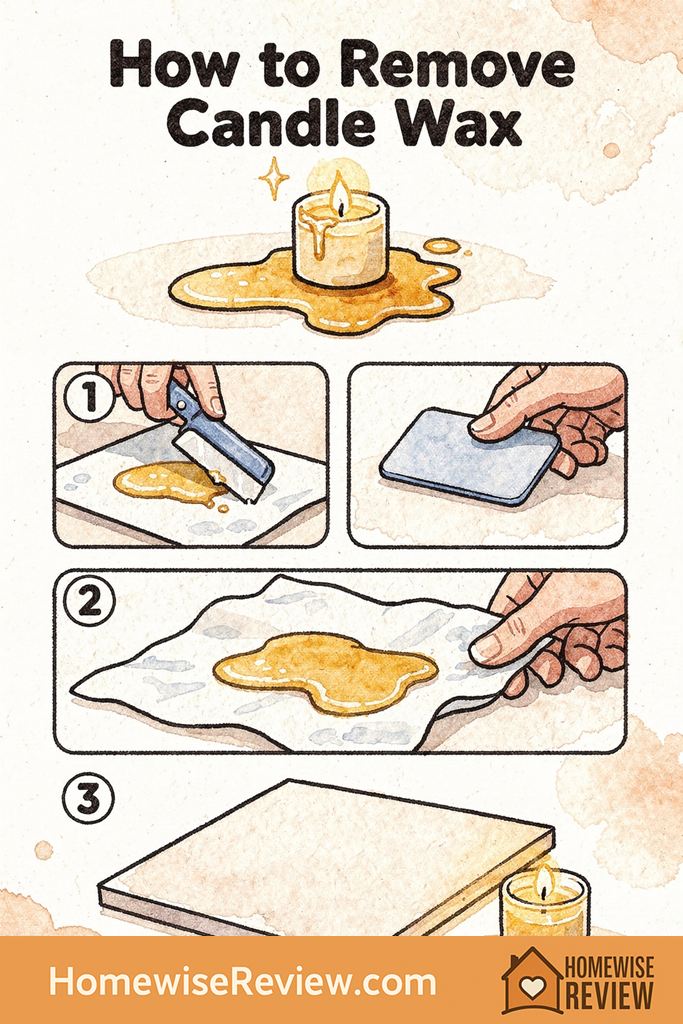
Spilled candle wax does not have to ruin your tablecloth, carpet, or favorite sweater. The trick is using the right temperature method for the surface so the wax lifts without spreading or setting a stain.
Candle wax is easiest to remove when you stop and let it harden first. If you try to wipe warm wax, it smears into fibers and leaves a bigger, greasier-looking spot. A calm, step-by-step approach usually gets you back to clean with minimal fuss.
The two core strategies are cold (to make wax brittle so it pops off) and gentle heat (to pull wax out of fibers into something absorbent). Most cleanup jobs use both, in that order.
Identify the surface first (the method depends on it)
Before you grab an iron or a butter knife, check what the wax landed on and whether the material can handle heat, moisture, or solvents. When in doubt, start with the least aggressive option: harden, scrape gently, then reassess.
Quick decision table: best method by surface
| Surface | Best first step | Best follow-up | Avoid |
|---|---|---|---|
| Hard surfaces (tile, metal, sealed counters) | Let harden, then scrape with plastic edge | Warm with hair dryer, wipe, then wash with dish soap | Metal scrapers that gouge |
| Fabric (cotton, denim, linens) | Freeze, then crack off chunks | Iron through paper to absorb remaining wax, then launder | Hot iron directly on fabric |
| Upholstery (couch, chairs) | Harden and lift chunks | Low heat and blot through paper, then spot-clean residue | Soaking the cushion with water |
| Carpet and rugs | Ice, then gently break and lift | Warm and blot, then treat dye or oily film | Scrubbing that frays fibers |
| Wood furniture (finished) | Harden, then lift with plastic card | Very gentle warmth, then buff and recondition if needed | High heat that turns finish cloudy |
| Unsealed stone or concrete | Harden, then chip carefully | Absorbent powder for oil residue, then mild cleaner | Strong solvents that discolor |
What you need (a simple wax-removal kit)
You do not need specialty products for most wax messes. A few household basics give you control over temperature, absorption, and gentle scraping.
Basic supplies
- Ice cubes in a zip-top bag, or a freezer pack
- A plastic scraper: old gift card, plastic spatula, or spoon edge
- Paper towels and/or brown paper bags
- Plain white paper (printer paper) or unprinted paper towels for blotting
- Iron (for fabrics) or a hair dryer (for hard surfaces and upholstery)
- Dish soap and warm water
Optional, helpful items
- Rubbing alcohol (for some dye residues on colorfast fabrics)
- Enzyme or upholstery-safe cleaner (for couches)
- Baking soda or cornstarch (for oily residue on porous surfaces)
- A white cotton cloth (for controlled blotting)
The safe, reliable method (works for most situations)
When you are unsure, use this order: harden, remove the bulk, then pull out what is left with gentle heat and absorption. That approach limits spreading and keeps you from grinding wax deeper into the material.
Step 1: Let it harden (or speed it up with ice)
- If wax is still soft, stop touching it and let it cool.
- To speed things up, place an ice bag on the wax for 3 to 5 minutes.
- For fabric, you can also put the item in the freezer for 20 to 30 minutes.
Step 2: Lift off chunks without digging
- Use a plastic edge to gently pop off thick pieces.
- Work from the outer edge toward the center so you do not spread it.
- If you feel resistance, stop and re-ice. Forcing it can tear fibers or scrape finishes.
Step 3: Pull remaining wax out with gentle heat and blotting (for fabric and upholstery)
This is the step that makes the difference on textiles. You are not trying to melt wax into the fabric. You are trying to warm it just enough to transfer into paper.
- Place the fabric face-down on several layers of paper towels, or sandwich the spot between paper layers.
- Set an iron to low heat with no steam. Start at the lowest setting that can warm wax.
- Press for 3 to 5 seconds, lift, and check the paper. You should see wax transferring.
- Move to a clean part of the paper and repeat until no more wax transfers.
- Launder or spot-clean afterward to remove any oily film or dye.
Step 4: Wash away the last film (for hard surfaces)
- After scraping, warm any thin remaining wax with a hair dryer on low for 10 to 20 seconds.
- Wipe immediately with a paper towel.
- Wash with a drop of dish soap in warm water, then dry to prevent streaks.
Surface-by-surface instructions
The basics stay the same, but these tweaks help you avoid the most common mishaps like scorched fabric, frayed carpet, or cloudy wood finish.
How to remove candle wax from clothing and washable fabrics
- Freeze and crack: Harden the wax, then break off as much as possible with your fingernail or a plastic edge.
- Iron and absorb: Use the low-heat blot method with paper until the transfer stops.
- Pre-treat: If you see an oily ring, rub in a small amount of dish soap, let it sit 10 minutes, then rinse warm.
- Launder smart: Wash according to the care label. Air-dry first and check the spot before using the dryer, because heat can set leftover residue.
How to remove candle wax from upholstery (couch, chairs)
Upholstery is usually about controlled heat and minimal moisture. If you have removable cushion covers, treat them like fabric, but keep foam inserts away from water and heat.
- Ice the wax and lift chunks carefully.
- Place paper towels over the spot and use a hair dryer on low to warm the wax.
- Blot straight down. Replace paper often so you are not re-depositing wax.
- If an oily spot remains, use a tiny drop of dish soap diluted in water and blot, not scrub. Follow with plain water on a cloth, then dry with a towel.
How to remove candle wax from carpet and rugs
Carpet is the easiest place to accidentally make things worse. Your goal is to lift wax out of the pile without fuzzing or spreading it down into the backing.
- Harden: Ice for 5 minutes.
- Break and lift: Use a plastic scraper to gently lift shards. Vacuum up small bits.
- Warm and blot: Put a plain white paper towel over the spot and briefly press with a warm iron on low, or use a hair dryer and blot. Keep the heat low and controlled.
- Spot-clean: If there is residue, use a small amount of dish soap solution and blot. Rinse by blotting with clean water, then press with towels to dry.
How to remove candle wax from wood furniture
Finished wood can turn cloudy or sticky if it gets too hot. Keep tools plastic and heat minimal.
- Let wax fully harden. If it is soft, put an ice bag on it for 2 to 3 minutes.
- Gently lift with a plastic card, working with the grain.
- If a thin film remains, use a hair dryer on low for a few seconds and wipe immediately.
- Buff with a soft cloth. If the finish looks dull, a small amount of furniture polish can help, but test first in an inconspicuous spot.
How to remove candle wax from tile, laminate, and sealed counters
- Harden and scrape with a plastic edge.
- Use warm soapy water to remove leftover film.
- For textured grout lines, a soft brush with dish soap can help lift residue without damaging the surface.
How to remove candle wax from stone, concrete, and other porous surfaces
Porous materials can hold onto the oily part of wax even after the chunks are gone. Plan for a second step that pulls oils out, not just surface cleaning.
- Chip off hardened wax carefully with a plastic scraper.
- Sprinkle baking soda or cornstarch over any darkened area and let it sit 30 to 60 minutes to absorb oils.
- Sweep or vacuum the powder, then clean with a mild detergent solution and blot dry.
- Repeat the powder step if the area still looks shadowed.
What if the wax was colored or scented?
Colored wax can leave dye behind, and heavily fragranced wax can leave an oily halo. Remove the wax first, then address the remaining discoloration or slickness.
After-wax residue checklist
- Oily ring on fabric: Dish soap pre-treat, then wash. Check before drying.
- Dye shadow on fabric: Spot-test rubbing alcohol on a hidden seam, then dab lightly with a white cloth. Rinse and wash.
- Greasy feel on hard surfaces: Dish soap and warm water, then a clean-water wipe.
- Stubborn carpet discoloration: Blot with a mild carpet-safe cleaner and dry thoroughly to prevent wicking.
Common mistakes that make wax stains harder
- Wiping warm wax: This spreads it and drives it into fibers.
- Using a high iron setting: High heat can scorch fabric, melt synthetics, or set dyes.
- Scrubbing carpet: Scrubbing frays the pile and pushes wax deeper.
- Using sharp metal tools on wood or glass: Scratches are often permanent, even if the wax comes off.
- Putting fabric in the dryer too soon: If residue remains, dryer heat can lock it in.
How to prevent candle wax spills (simple, realistic habits)
A little prevention goes a long way, especially if candles are part of your everyday routine. My easiest win at home has been keeping candles on a stable tray, because it catches drips and makes cleanup one contained job.
- Use a candle plate or tray that is wider than the candle base.
- Trim wicks to about 1/4 inch to reduce smoking and splatter.
- Keep candles away from vents and drafts that tilt flames and melt wax unevenly.
- Skip moving a lit candle. Extinguish, let it cool, then relocate.
💡 Editor’s Final Thoughts
For most candle wax messes, the winning combo is: harden with cold, lift the chunks, then use gentle heat and blotting to pull remaining wax into paper. Finish by washing away any oily film or dye residue, and always keep heat lower than you think you need.
See also
If your spill is on jars or votives, start with Remove candle wax from glass for the safest methods on smooth, breakable surfaces.
- How to remove crayon marks from walls and fabric
- How to remove grease from carpet
- See our guide on removing slime from a couch
- Remove blood from a couch without spreading the stain
Frequently Asked Questions ▾
Can I use vinegar to remove candle wax?
Vinegar does not dissolve wax well, so it is not the best first step. Use cold to harden and a plastic scraper to lift, then use gentle heat and blotting for fabrics, and dish soap for the leftover film.
Will rubbing alcohol remove wax?
Alcohol is not great at dissolving the wax itself, but it can help with leftover dye staining on colorfast fabrics after the wax has been removed. Always spot-test first and dab gently with a white cloth.
How do you get candle wax out of carpet without an iron?
Use ice to harden, lift off chunks, then warm the spot with a hair dryer on low while blotting with paper towels. Work slowly and keep replacing the paper so the wax transfers out instead of re-soaking into the fibers.
What if wax is on a delicate fabric like silk or wool?
Start with freezing and gentle lifting, then use very low heat and blotting through paper only if the care label allows it. If the fabric is labeled dry clean only or you are unsure, it is safest to take it to a professional cleaner and tell them it is candle wax.
Why is there still a dark spot after the wax is gone?
That is usually an oily residue or dye from colored wax. Treat fabric with a small amount of dish soap before washing, and use absorbent powder like baking soda on porous surfaces to pull out oil, repeating if needed.
As an Amazon Associate, we earn from qualifying purchases made through links on our site.