

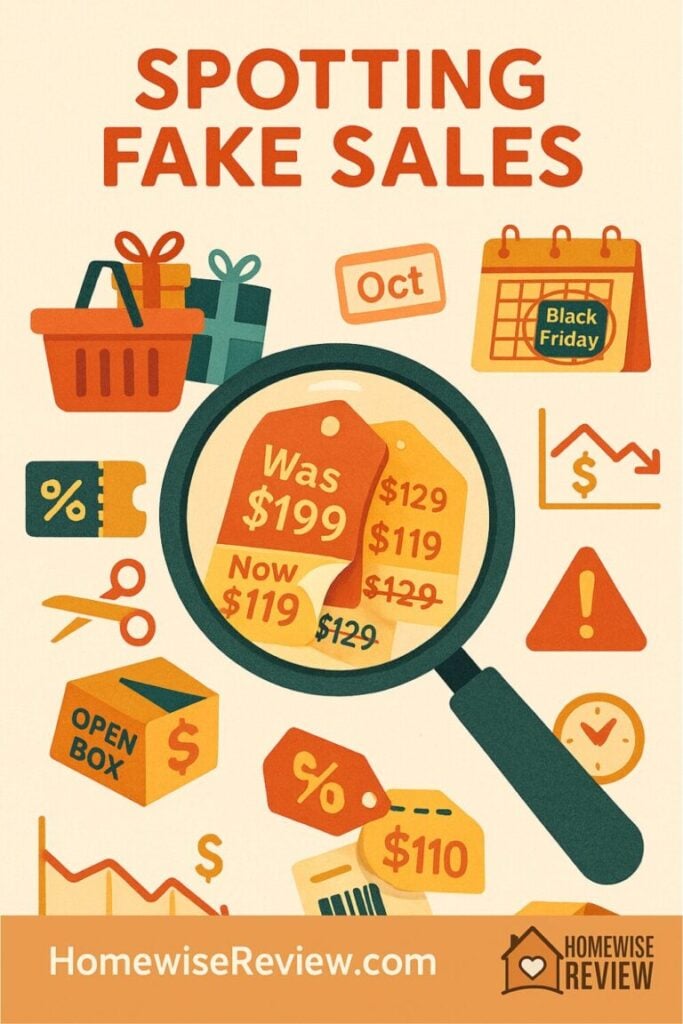
Big “was/now” discounts can be staged—prices quietly spike, old stock gets dressed up as new, and bundles hide the real per-unit cost. Use this fast checklist to verify model numbers, check price history, and calculate true final cost so you can spot the traps and grab the real deals.
Get quick, practical tips to spot real bargains—and avoid deceptive pricing tricks—before you buy during major sales events.
This guide helps you shop smarter. It breaks down how fake price drops happen, how older stock can be presented like the newest model, and how bundles, coupons, and “up to” wording can quietly change the math. You’ll learn how to confirm exact model numbers, use price history instead of flashy “was” prices, review warranty and return terms that can wipe out a discount, and avoid per-unit pricing traps in multipacks and subscriptions. You’ll also see how a true markdown differs from a short-term price hike disguised as a “doorbuster,” plus how to shop marketplace sellers without drifting into counterfeit or gray-market risk.
This is designed to be fast. In 10 minutes or less, you can: verify the SKU on the brand’s site, scan a 60–180 day price chart, sanity-check recent reviews, compare two authorized competitors, and calculate your final landed cost (price + coupon/rebate + shipping + tax + return/restocking risk). If you’re shopping for tech, small appliances, cookware, toys, beauty, or baby gear, the category-specific checks below will help you cut through the hype.
Use this before big events (October deal days, Black Friday/Cyber Monday), during retailer “anniversary” sales, or anytime a banner looks too good to be true. Real deals do exist—and they’re worth grabbing—but you don’t need to guess. With a simple process and a clear eye for red flags, you can keep the savings and skip the sales theater.
TL;DR — Quick Red Flags
- “Was $199, now $119!” but the “was” price only appeared briefly (classic anchoring).
- Older model photographed like the current version (the model number is the giveaway).
- Bundle math where the base price rises right before a coupon or “bundle discount” is applied.
- Open-box/refurb sold as new (check condition notes and warranty eligibility).
- Variant bait: only the lime-green size XS is 45% off; the popular option is full price.
- “Up to 60% off” where only one item hits 60% and most are 10–15%.
- Per-unit pricing is worse in multipacks (pack-size tricks).
- Marketplace mystery brands with recycled photos, suspicious review patterns, or inconsistent seller info.
1) The 12 Most Common Sales Tactics (and how to beat them)
1) MSRP Anchoring & “Was/Now” Price Games
The trick: A big discount is shown against an inflated MSRP or a short-lived “strike-through” price to make the deal look dramatic.
Protect yourself:
- Treat “was” prices as marketing, not proof.
- Use a price-history tracker (any reputable tool) to see the real street price over the last 30–180 days.
- If today’s price is close to the typical price, it’s not much of a deal.
2) Short-Term Price Hike → “Big Sale”
The trick: The price jumps for a few days, then drops back down and gets labeled a “sale.”
Protect yourself: Compare today’s price to the median of the last 60–90 days—not the “was” price.
3) Old Stock in New Clothes
The trick: Last year’s model (or a lower-spec version) uses the hero image and naming of the current model; only the model number tells the truth.
Protect yourself:
- Verify the exact model number (SKU/GTIN/UPC) on the brand’s site.
- Check the release year and the support window for firmware/parts.
- For appliances, look for manufacture date codes on listings or labels when available.
4) Variant & Color Bait
The trick: One unpopular color/size gets a deep discount to justify the banner, while the most popular options stay near full price.
Protect yourself: Click through every variant and only buy if you genuinely want the discounted option.
5) Bundle Math & Coupon Illusions
The trick: “20% off when you bundle” after base prices quietly rise, or coupons that only apply to add-ons you don’t need.
Protect yourself: Price each component a la carte and do the math. If the bundle isn’t cheaper than buying the exact pieces separately, skip it.
6) Shrinkflation & Multi-Pack Traps
The trick: A “value pack” costs more per unit than single items, or a “new formula” comes in a smaller bottle.
Protect yourself: Always check price per ounce/unit. Many listings show it—if not, do a quick calculation.
7) Open-Box/Refurb Masquerade
The trick: “Like new”/“renewed” options are placed prominently, but the warranty may be shorter or handled by a third party.
Protect yourself:
- Read the condition notes closely.
- Confirm the warranty and the return window (and who provides coverage).
- For gifts, choose new unless the discount is substantial and the warranty terms are clear.
8) Third-Party Marketplace Shenanigans
The trick: Copycat listings, merged reviews for unrelated items, or sellers swapping inferior products under a popular listing.
Protect yourself:
- Read the most recent reviews and watch for mentions of different products.
- Check the seller name, feedback, and the exact “Ships from/Sold by” info.
- For higher-risk purchases, stick to the brand store or authorized dealers.
9) Countdown Timers & “Only 2 Left”
The trick: Endless “lightning deals,” auto-refreshing stock counters, or per-variant inventory used to create pressure.
Protect yourself: Don’t panic-buy. If the discount is small, a similar price often comes back.
10) Loyalty Points & Rebate Fog
The trick: “$200 off after points/mail-in rebate,” even though the upfront price barely changes.
Protect yourself: Value points conservatively and treat mail-in rebates as uncertain until they’re in your hands.
11) Subscription Discounts With a Catch
The trick: “Subscribe & Save 15%” applies to the first shipment, then later orders revert to a higher price.
Protect yourself: After the first delivery, pause, change the delivery date, or cancel if the pricing no longer works for you.
12) Shipping & Restocking Fee Gotchas
The trick: A low item price is offset by expensive shipping or a restocking fee on returns.
Protect yourself: Check your final landed cost and read the return policy before you place the order.
2) 10-Minute Due-Diligence Flow
- Confirm the exact model: match the SKU/GTIN on the brand’s site.
- Check the release year and support status (firmware/parts).
- Scan a price history (30–180 days).
- Read the last 10 reviews (watch for recent issues and obvious fake-review patterns).
- Compare two competitors (price + warranty + return window).
- Check per-unit price for consumables and multipacks.
- Verify the seller (authorized? brand store? clear return terms?).
- Calculate your real cost: Final = Sale price − Coupon − Rebate cash + Shipping + Tax
- Warranty & returns: length, who services it, and any restocking fee.
- Screenshot the offer (price + terms) before checkout.
3) How to Spot Old-Stock Dumps Disguised as “New”
- Model codes: Brands often add a suffix or year digit (e.g., A3300 vs A3500). Search the exact code.
- Spec sheets: Compare key specs like ports, wattage, and wireless standards (e.g., Wi‑Fi 5 vs Wi‑Fi 6).
- Manufacture date: Many appliances and electronics include a date code (often YYWW or MM/YY).
- Firmware notes: Check the brand’s support page for the most recent update date.
- Warranty start: Some warranties begin at purchase, while others may be tied to activation/registration—confirm the policy for the item you’re buying.
4) “Math Lab”: Is It Actually Cheaper?
Example: $299 “sale” with a 10% stackable coupon, $15 shipping, and 8% tax.
- Sale: $299 → Coupon –$29.90 = $269.10
- Shipping $15 = $284.10
- Tax 8% = $306.83
Compare to competitor: $289 with free shipping (and tax collected at checkout if applicable) → $289 is the better buy.
5) Category-Specific Checks
Tech & small appliances
- Is an authorized dealer required for the manufacturer warranty?
- Battery age (for cordless gear): look for a manufacture date; older stock can mean less usable life.
- Update policy (phones/tablets) and spare parts availability (robot vacuums, espresso machines).
Kitchenware & cookware
- Generation differences (materials, coatings, knobs/handles, temperature ratings).
- Confirm real capacity and dimensions (photos can be misleading).
Toys & baby
- Check the recall list (CPSC).
- Confirm age rating and small-parts warnings.
Beauty & skincare
- Check the batch code for manufacture/expiry where available.
- Be cautious with unauthorized sellers (counterfeit/gray-market risk).
6) What’s Legal vs. Shady (U.S. context)
- The FTC can take action on deceptive pricing (fake former prices, bait-and-switch).
- Many gray-area tactics (variant bait, vague “limited-time” language) can still be legal marketing, even if they’re misleading.
- Keep screenshots. If a claim seems deceptive, you can:
- Contact retailer support and ask them to honor the advertised terms.
- Dispute the charge with your card issuer if the item isn’t as described.
- Report repeat patterns to the FTC.
Frequently Asked Questions ▾
Are fake “was” prices illegal?
If a seller didn’t actually sell the item at the “was” price (or only did so briefly), regulators may consider the claim deceptive. Enforcement varies, so it’s smart to confirm with price-history data.
Is open-box/refurb worth it?
It can be—if the discount is meaningful, the condition is clearly described, and the warranty and return policy are acceptable. For gifts, new is usually the safer choice unless the savings are significant and coverage is clear.
Why does one color cost way less?
Retailers often discount unpopular colors or overstocked sizes to advertise an “up to ___% off” headline. If you wouldn’t choose that variant, it’s not really a deal for you.
How do I know if a marketplace listing is hijacked?
Watch for reviews mentioning different products, mismatched photos, or signs that the brand/name changed over time. When in doubt, buy from the brand store or a clearly identified authorized seller.
What should I do if I get the wrong/older model?
Document the unboxing, take photos of the model label/serial number, and contact support right away. If it isn’t resolved, request a return and consider using your card issuer’s purchase protections.