
What Does Clinical Strength Mean? We Checked 30 Antiperspirant Labels
We audited 30 current antiperspirant Drug Facts labels for active percentages, salts, bedtime directions, fragrance wording and 72/96-hour claims.

Research completed and last verified 25 August 2026. Products checked: 30. Primary sources: 33. Additional sources: 2 DailyMed API documentation pages. Research type: Product and brand claim audit. Hands-on testing performed by HomeWise: No.
On this page
- What the 30 labels showed
- All 30 antiperspirant labels in the audit
- “Clinical” did not identify one active or one percentage
- Bedtime directions were the strongest label pattern
- Long-duration wording crossed the label groups
- Seven records needed extra care during normalization
- How to use the audit when choosing an antiperspirant
- Current listing shortcuts
- HomeWise Research methodology
- Related HomeWise guides
“Clinical strength” sounds like a measurable tier. Current antiperspirant labels tell a more complicated story. We assembled 30 exact U.S. Drug Facts records (15 with clinical wording in the label title or package panel and 15 without that wording) and compared the active salt, displayed percentage, format, directions and duration claims.
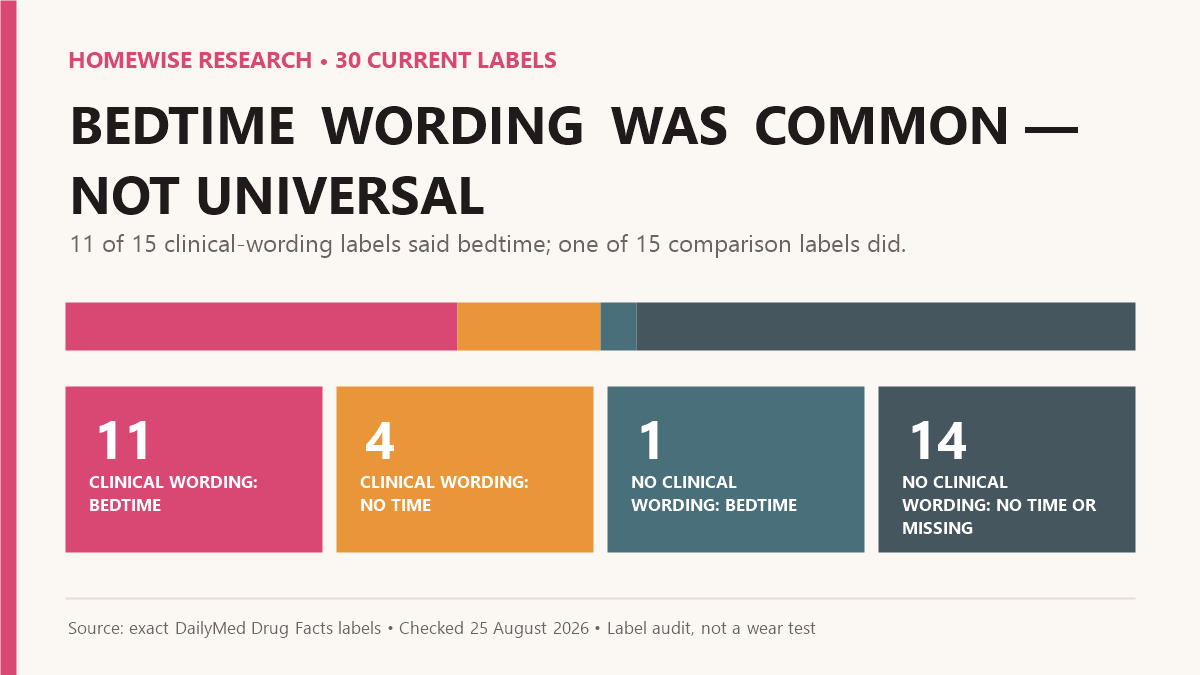
The main finding: the active-percentage ranges overlap. The 14 clinical-wording labels with unambiguous displayed percentages ran from 15% to 25%; the 15 comparison labels ran from 9.6% to 25%. One clinical label has malformed percentage text and is excluded from these concentration statistics. The clearest difference was in how the products told people to use them: 11 of 15 clinical-wording labels explicitly said bedtime, compared with one of 15 labels without clinical wording.
That does not make bedtime wording a definition of clinical strength. Four clinical-wording labels in our sample did not give a time of day, and the comparison group included both a bedtime-directed product and a 25% label. The practical lesson is to read the exact Drug Facts panel rather than treat the front-label phrase as a standardized concentration.
What the 30 labels showed
| Measure | Clinical wording (15) | No clinical wording (15) |
|---|---|---|
| Displayed active range | 15%–25% (14 readable values) | 9.6%–25% |
| Median displayed active | 20% (14 readable values) | 17% |
| Mean displayed active | 19.16% (14 readable values) | 17% |
| Distinct active salts | 5 | 6 |
| Explicit bedtime direction | 11 of 15 | 1 of 15 |
| Explicit dry-skin wording | 3 of 15 | 0 of 15 |
| 72-hour wording | 3 of 15 | 3 of 15 |
| 96-hour wording | 3 of 15 | 0 of 15 |
| Fragrance/parfum term listed | 12 of 15 | 12 of 15 |
Do not read this as an efficacy ranking. A percentage of one aluminum salt in a stick cannot be treated as directly equivalent to the same percentage of another salt in a spray, gel or solution. Formula, delivery and use conditions matter. The table reports label facts; HomeWise did not measure sweat reduction.
All 30 antiperspirant labels in the audit
Product names link to the exact DailyMed label record retained for this analysis. “Bedtime” means the directions explicitly used bedtime or bed wording. A blank duration means neither 72H nor 96H appeared in the checked official title or label text.
| Product | Group | Displayed active | Format | Label timing | Duration |
|---|---|---|---|---|---|
| Secret Clinical Strength Clear Stress Response | Clinical wording | Aluminum zirconium octachlorohydrex gly 20% | Gel | Bedtime | 72H |
| Secret Clinical Completely Clean Soft Solid | Clinical wording | Aluminum zirconium trichlorohydrex gly 20% | Cream | Bedtime | Not stated |
| Secret Clinical Invisible Free and Sensitive | Clinical wording | Aluminum zirconium tetrachlorohydrex gly 20% | Stick | Bedtime | Not stated |
| Secret Clinical Dry Completely Clean | Clinical wording | Aluminum sesquichlorohydrate; malformed percentage text, excluded from concentration statistics | Aerosol spray | No time stated | Not stated |
| Degree Clinical Invisible Solid Cool Rush 96H | Clinical wording | Aluminum sesquichlorohydrate 17% | Stick | No time stated | 96H |
| Degree Clinical Soft Solid Summer Rose | Clinical wording | Aluminum zirconium tetrachlorohydrex gly 20% | Stick | Bedtime | Not stated |
| Dove Clinical Care Cool Essentials Soft Solid 96H | Clinical wording | Aluminum zirconium tetrachlorohydrex gly 20% | Stick | Bedtime | 96H |
| Dove Clinical Care Soft Sensitive Dry Spray 96H | Clinical wording | Aluminum sesquichlorohydrate 16.2% | Aerosol spray | No time stated | 96H |
| Gillette Clinical Protection Power Rush Clear Gel | Clinical wording | Aluminum zirconium octachlorohydrex gly 20% | Gel | Bedtime | Not stated |
| Gillette Clinical Protection Arctic Ice Soft Solid | Clinical wording | Aluminum zirconium trichlorohydrex gly 20% | Cream | Bedtime | Not stated |
| Old Spice Clinical Sweat Defense Stronger Swagger | Clinical wording | Aluminum zirconium trichlorohydrex gly 20% | Stick | Bedtime | Not stated |
| Mitchum Clinical Soft Solid Unscented | Clinical wording | Aluminum zirconium tetrachlorohydrex gly 20% | Stick | No time stated | Not stated |
| Certain Dri Extra Strength Clinical Solid | Clinical wording | Aluminum sesquichlorohydrate 25% | Stick | Bedtime; dry-skin wording | 72H |
| Certain Dri Clinical Strength Prescription Protection Roll-On | Clinical wording | Aluminum chloride 15% | For solution | Bedtime; dry-skin wording | 72H |
| SweatBlock Original Maximum Clinical Protection | Clinical wording | Aluminum chloride 15% | Solution | Bedtime; dry-skin wording | Not stated |
| Secret Bubble Bath Invisible | No clinical wording | Aluminum zirconium tetrachlorohydrex gly 17% | Stick | No time stated | Not stated |
| Secret Berry Bright Clear Gel | No clinical wording | Aluminum zirconium octachlorohydrex gly 16% | Gel | No time stated | Not stated |
| Degree Advanced Protection Sport Defense | No clinical wording | Aluminum sesquichlorohydrate 16% | Stick | No time stated | Not stated |
| Degree Essential Protection Cool Rush | No clinical wording | Aluminum zirconium tetrachlorohydrex gly 18.2% | Stick | No time stated | Not stated |
| Degree Total Protection Pure Aloe Dry Spray | No clinical wording | Aluminum sesquichlorohydrate 15.2% | Aerosol | No time stated | Not stated |
| Dove Advanced Care Invisible Clear Finish 72H | No clinical wording | Aluminum sesquichlorohydrate 9.6% | Stick | No time stated | 72H |
| Dove Advanced Care Cool Essentials 72H Dry Spray | No clinical wording | Aluminum sesquichlorohydrate 15.2% | Aerosol spray | No time stated | 72H |
| Dove Men+Care Cool Fresh 72H | No clinical wording | Aluminum sesquichlorohydrate 12.8% | Stick | No time stated | 72H |
| Mitchum Clear Gel | No clinical wording | Aluminum sesquichlorohydrate 25% | Liquid | Directions section missing | Not stated |
| Harry’s Antiperspirant Fig | No clinical wording | Aluminum zirconium trichlorohydrex gly 16% | Stick | No time stated | Not stated |
| Ban Roll-On Antiperspirant Deodorant Unscented | No clinical wording | Aluminum chlorohydrate 18% | Liquid | No time stated | Not stated |
| Old Spice Fresh High Endurance Antiperspirant and Deodorant | No clinical wording | Aluminum zirconium pentachlorohydrex gly 17% | Stick | No time stated | Not stated |
| UltraMax Invisible Solid Fresh | No clinical wording | Aluminum chlorohydrate 19% | Stick | No time stated | Not stated |
| Carpe Antiperspirant Fragrance Free | No clinical wording | Aluminum sesquichlorohydrate 20% | Stick | Bedtime and morning | Not stated |
| Duradry Antiperspirant Deodorant Stick | No clinical wording | Aluminum zirconium trichlorohydrex gly 20% | Stick | No time stated | Not stated |
“Clinical” did not identify one active or one percentage
The 15 clinical-wording labels used five different active salts. Aluminum zirconium tetrachlorohydrex gly was most common at four products, and aluminum sesquichlorohydrate also appeared four times. Aluminum chloride, aluminum zirconium octachlorohydrex gly and aluminum zirconium trichlorohydrex gly filled out the group.
The comparison labels were just as varied, using six salts. Their 17% median was lower than the 20% median of the 14 readable clinical-group values, but these percentages do not rank performance. Mitchum Clear Gel carried a displayed 25% active without clinical wording. Secret Clinical Dry’s malformed percentage text cannot establish a valid 7% example.
This is why a front-label word is a poor shortcut for comparing formulas. The FDA’s OTC Monograph M019 sets conditions for antiperspirant active ingredients and labeling. Our audit then reports what each current Drug Facts record actually says; it does not assume equal performance from equal-looking numbers.
Bedtime directions were the strongest label pattern
Eleven clinical-wording labels explicitly directed bedtime use. That included soft solids, clear gels, sticks, a roll-on and a wipe solution. The directions were not universal: Secret Clinical Dry, Degree Clinical Invisible Solid, Dove Clinical dry spray and Mitchum Clinical soft solid did not state a time of day in the checked Drug Facts directions.
Carpe Fragrance Free was the lone comparison product with an explicit bedtime direction; it also said to apply again in the morning. The other 13 comparison labels with a directions section gave no time of day. Mitchum Clear Gel’s retained label XML did not expose a directions section, so we classified it as missing rather than guessing.
The pattern is useful because application timing can affect real-world use. The American Academy of Dermatology’s hyperhidrosis guidance discusses applying antiperspirant to dry skin before bedtime, while the International Hyperhidrosis Society’s antiperspirant guide also emphasizes strength and use technique. Follow the exact package directions and seek medical advice for persistent excessive sweating or irritation.
Long-duration wording crossed the label groups
Three clinical-wording products and three comparison products used 72-hour wording. Three clinical products used 96-hour wording. The remaining 21 labels did not use either duration in the retained title or label text.
Those numbers describe claims, not a HomeWise wear test. A 96-hour title does not prove that every user will stay dry for four days, and the absence of a duration claim does not establish weaker performance. Duration wording is another field to verify rather than a substitute for the complete directions.
Seven records needed extra care during normalization
Structured Product Labels contain both reader-facing Drug Facts text and machine-readable quantities. Those fields are not always presented on the same basis.
- Secret Clinical Dry Completely Clean: the structured quantity is 24.7 g per 100 g, while the retained Drug Facts text reads “24.7.0% (anhydrous).” That malformed text is not a valid 7% declaration. We preserve both source fields and exclude this record from the displayed-percentage range, median and mean, without guessing a corrected label percentage.
- Certain Dri Clinical Roll-On: the structured field says 0.15 g per 100 mL while the Drug Facts text says 15%. We did not silently convert or overwrite either value.
- SweatBlock, Mitchum Clear Gel, Harry’s and Ban: the structured field uses a different mass or volume basis from the displayed percentage. We used the reader-facing percentage and retained the original structured quantity in the dataset.
- Dove Men+Care Cool Fresh: the active line renders “12.8” without a percent sign; its structured quantity supplies the matching 12.8 g per 100 g value.
These cases are a practical reason to preserve the exact source rather than build a comparison from retailer snippets.
How to use the audit when choosing an antiperspirant
| Your question | Field to check | What not to assume |
|---|---|---|
| Does it reduce sweat or only address odor? | Drug Facts active and the Uses section | That every product called deodorant is an antiperspirant |
| When should I apply it? | Directions on the exact package | That every clinical-wording product says bedtime |
| Is a higher percentage automatically stronger? | Active salt, percentage, format and directions together | That percentages across different salts and formats rank performance |
| Is it fragrance-free? | An explicit fragrance-free claim plus the current ingredient list | That no `fragrance` or `parfum` term found proves fragrance-free status |
| Will it last 72 or 96 hours? | The exact current claim and directions | That clinical wording guarantees a duration claim |
Current listing shortcuts
The audit does not name an overall winner. If a label row fits what you are looking for, use the exact product name and recheck the current package before buying. These are affiliate search links; HomeWise may earn a commission from qualifying purchases, with no effect on the findings.
- Check current Secret Clinical Strength listings
- Check current Degree Clinical listings
- Check current Dove Clinical Care listings
- Check current Certain Dri listings
- Check current Carpe fragrance-free listings
HomeWise Research methodology
- Research completed: 25 August 2026
- Products/data points checked: 30 exact antiperspirant label records
- Primary sources consulted: 33: the 30 exact DailyMed records, FDA OTC Monograph M019, American Academy of Dermatology guidance and International Hyperhidrosis Society guidance
- Additional sources: 2 DailyMed API documentation pages
- Research type: Product and brand claim audit
- Hands-on testing performed by HomeWise: No
- Last verified: 25 August 2026
We selected 15 labels with clinical wording in the DailyMed title or package panel and 15 comparison labels without that wording. The sample spans major mass-market brands, specialist sweat-control brands and multiple formats. Every included marketing period covered the research date. We downloaded and retained the exact XML, then normalized the displayed active percentage, structured quantity, salt, format, directions, time-of-day wording, dry-skin wording, fragrance/parfum term and 72H/96H wording. Concentration statistics use 14 unambiguous displayed values in the clinical-wording group and 15 in the comparison group. The clinical median averages the middle two sorted values; the comparison median uses its middle value. Means are simple arithmetic means rounded to two decimals. The malformed Secret Clinical Dry percentage remains visible as an excluded record; the full 15/15 groups still supply the timing, salt, fragrance and duration counts.
One candidate Right Guard record was excluded because its current XML lacked the Uses and inactive-ingredient sections required for this audit. It was replaced before analysis, not patched with retailer data. Where structured and visible fields differed, we preserved both and used the visible Drug Facts percentage for the group comparison.
Limitations: this is an intentionally balanced comparison sample, not a market-share-weighted census. A marketing period covering the date does not guarantee stock at a particular retailer. The audit evaluates published labels and claims, not sweat reduction, comfort, residue, scent or irritation. Different salts, dosage forms and formulations prevent a simple percentage-based performance ranking.
Related HomeWise guides
Use this audit as the label-evidence layer, then choose a format and routine with our antiperspirants for excessive sweating guide, stress-sweat deodorant guide, fragrance-free deodorant guide and underarm discoloration-conscious deodorant guide. Browse the curated HomeWise Skincare hub for the wider body-care library.