

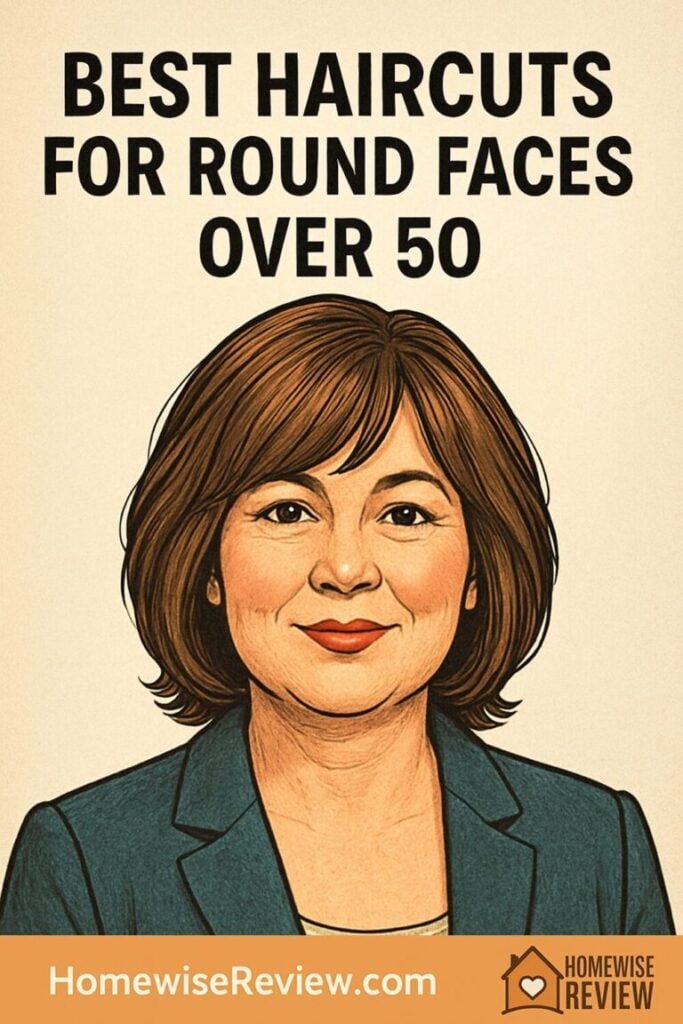
You want a modern cut that softens a round face after 50 without adding bulk or extra styling time. Here is how to choose a haircut that lifts, slims, and still feels like you.
How to know if you have a round face
A round face is usually close to the same width and length, with full cheeks and a softer jawline. You may feel like your face looks widest at the cheeks rather than at the forehead or jaw. Many people over 50 also notice that a round face can look softer with age as skin loses firmness.
If you are unsure, stand in front of a mirror with your hair pulled back and trace your face outline on the mirror with a washable pencil or your finger. If the shape looks more like a circle or a soft square with rounded corners, you likely have a round face. Knowing this helps you and your stylist choose a cut that visually lengthens and lifts.
Haircut principles that flatter round faces over 50
The goal with a round face is to create the illusion of more length and less width through shape, movement, and volume placement. This does not mean hiding your face. It simply means using your haircut to guide where the eye goes first.
- Add a bit of height at the crown. A little lift on top makes the face look longer and draws attention upward.
- Keep volume away from the widest part of your face. Heavy fullness right at the cheeks can make the face look rounder.
- Use vertical lines and soft angles. Long layers, face-framing pieces, and side-swept bangs add vertical movement instead of horizontal width.
- Avoid very blunt, all-one-length cuts at the jaw. These create a solid horizontal line that mirrors the widest part of a round face.
- Think movement, not bulk. Especially after 50, hair can be thinner or more fragile, so light, blended layers often look more modern and youthful than rigid shapes.
With these principles in mind, you can adapt almost any length to flatter a round face. The key is where the cut holds weight, where it shows movement, and how much styling you realistically want to do.
Best short haircuts for round faces over 50
Short hair can be incredibly flattering for a round face when it is shaped carefully. The focus is on adding structure, top volume, and a bit of angle without turning the cut into a helmet.
Soft pixie with height at the crown
A soft pixie sits close at the sides and back, then stays slightly longer and textured on top. This extra length on top creates vertical height and draws the eye upward, which visually lengthens a round face.
Ask your stylist for a pixie with soft, piecey layers and longer bangs that can sweep slightly to one side. This lets you play with volume using a light mousse or root spray, and it keeps the overall effect feminine instead of harsh.
Tapered crop with side bangs
A tapered crop is a short cut that gradually narrows around the nape and sides while keeping more length through the top and front. For round faces over 50, it works best when the sides are neat but not shaved, and the top is long enough for some lift and side-swept fringe.
This cut is great if you want a low-maintenance style that still feels polished. The side bangs break up the width of the forehead and create a diagonal line across the face, which is very slimming.
Chin-length bob with strategic layers
A classic bob around the chin can work well if it is slightly longer in front and softly layered or textured. A blunt, one-length bob that hits exactly at the fullest part of your cheeks can exaggerate roundness, so ask your stylist to angle the front pieces a bit longer and add movement at the ends.
Style this cut with a side part and a gentle bend through the lengths rather than a stiff, flat finish. That subtle movement keeps the shape from forming a perfect, face-widening line.
Best medium and long haircuts for round faces over 50
Medium and longer lengths can beautifully balance a round face if the layers are placed to create length and softness. The risk with long hair is letting it hang heavy at one length, which can drag your features down and emphasize fullness.
The long bob (lob)
A lob that hits between the collarbone and the top of the chest is one of the most universally flattering options for round faces over 50. The extra length below the jaw visually stretches the face, while light layering prevents a blocky outline.
Ask for a lob that is slightly longer in front with soft, blended layers through the ends. A deep side part or side-swept fringe adds asymmetry that slims and modernizes the overall look.
Shoulder-length layers with face framing
If you like some swing and movement, shoulder-length hair with long layers and face-framing pieces is a strong choice. The layers should start around the cheekbones or slightly below, then angle down past the jaw.
This creates vertical lines along the sides of your face instead of adding bulk at your cheeks. You can wear it straight with a bit of bend at the ends or enhance natural wave. Either way, the movement helps soften and lengthen the face.
Long hair with long layers
You do not have to cut your hair short just because you are over 50. Long hair can flatter a round face as long as it has long, airy layers and face-framing pieces that start below the cheekbone.
Ask for long layers that remove weight from the bottom and mid-lengths while keeping the ends looking full. Avoid a straight, blunt hemline across your back; a slightly U-shaped or V-shaped outline is usually more flattering and keeps the hair from overwhelming your features.
Short vs long hair for round faces over 50
Both short and long cuts can work, so the better question is what fits your lifestyle and hair texture.
- Short hair pros: Quicker to dry, can give an instant lift to facial features, and often looks sharper and more intentional.
- Short hair cons: Needs more frequent trims to keep its shape, and leaves less room to hide a bad styling day or awkward grow-out.
- Longer hair pros: Offers more styling options such as updos and ponytails, and can visually lengthen the face when layered well.
- Longer hair cons: Can feel heavy or drag the face down if layers are not maintained, and may take more time to wash and dry.
Think about how often you realistically want to visit the salon, how much time you spend styling, and whether you enjoy changing your look day to day. Use that to guide your choice more than age alone.
Bangs that work for round faces over 50
Bangs can be a powerful tool to balance a round face, soften lines, and draw attention to your eyes. The key is to avoid a heavy, blunt line that cuts straight across the widest part of your face.
Side-swept fringe
Side-swept bangs are ideal for round faces because they create a diagonal line across the forehead. This diagonal breaks up the symmetry that can make round faces look wider.
Ask your stylist for bangs that start slightly deeper in the part and taper longer toward the side of your face. They should blend seamlessly into your layers so they grow out gracefully and can be styled off your face when you prefer.
Curtain bangs
Curtain bangs part in the middle or slightly off-center, then angle out to frame your eyes and cheekbones. For round faces, they work best when the shortest point hits somewhere between the brow and the top of the cheekbone, not right at the cheeks.
This style adds softness around the face and can camouflage a higher forehead while still leaving plenty of openness. It is especially flattering with shoulder-length lobs and layered cuts.
Light, wispy fringe instead of heavy straight bangs
If you like the idea of bangs but worry about emphasizing roundness, ask for a soft, wispy fringe instead of a thick, blunt one. The lightness lets some skin show through, so you get the benefit of framing without a solid horizontal line.
Keep them slightly longer through the middle and allow the ends to blend into your face-framing layers. This approach is forgiving as they grow and does not require perfection every morning.
Adapting your cut to gray, fine, curly, or straight hair
Hair texture and density change with age, which affects how a haircut will actually look on you compared to a photo. Tailor your choice to how your hair behaves now, not how it looked twenty years ago.
Fine or thinning hair
For fine or thinning hair, overly long, heavy styles can make the ends look stringy and emphasize scalp visibility. A short pixie, tapered crop, or lob with light layering usually gives the appearance of more body.
Ask your stylist for layers that are soft and internal, not choppy, so you do not lose too much density at the ends. A bit of strategic volume at the crown combined with minimal thickness at the sides will slim your face while making your hair look fuller.
Curly or wavy hair
Curly and wavy hair naturally has more volume, so the main challenge for round faces is controlling where that volume sits. You generally want more height and controlled fullness below the cheekbone, not a round halo starting right at the ears.
Ask for long layers that encourage curls to stack downward instead of puffing outward at one level. Dry-cutting curls or at least checking the shape when dry can help your stylist see where the face-framing pieces should land to flatter your features.
Straight, heavy hair
Straight, dense hair tends to fall in a solid sheet, which can make a round face look boxed in. Strategic layering and texturizing are your friends here, whether your hair is short, medium, or long.
A lob or shoulder-length cut with long layers and either side-swept or curtain bangs is often ideal. It adds the movement and angles you need without making the ends look thin or ragged.
How to talk to your stylist and choose the right cut
Walking into the salon with a clear but flexible idea will help you get a cut that truly suits you. Instead of just asking for a specific celebrity style, explain what you want your haircut to do for your face and lifestyle.
- Bring 2 to 4 photos of cuts you like, ideally on women with similar length and texture to your own hair.
- Describe what you dislike about your current hair such as “too much width at my cheeks” or “falls flat on top” so your stylist can correct it.
- Be honest about how much time you spend styling. If you only want five minutes, avoid cuts that require regular blowouts or hot tools.
- Ask your stylist where the cut will hold its weight and how often you will need trims to maintain the shape.
Use language like “I would like a cut that slims my cheeks, adds a little height at the crown, and gives soft movement around my face.” This tells the stylist how to adapt any length to flatter your round face.
Styling tips to keep your haircut flattering
The right cut should look good even on low-effort days, but a few simple styling habits make a big difference in how it flatters your face.
- Lift the roots at the crown. Use a round brush or a small amount of volumizing product only at the roots on top, not at the sides.
- Soften the ends. Whether your hair is straight or curly, aim for soft bends or defined curls at the ends instead of stiff, straight lines that widen the face.
- Watch your part line. A side part or slightly off-center part is usually more flattering than a dead-center part on very round faces.
- Do a quick face-framing check. After styling, pull a mirror closer and see where your shortest face-framing pieces hit. Aiming for between the cheekbone and jaw usually works best.
When you style, think about directing hair vertically and diagonally rather than horizontally. Even small tweaks like tucking one side behind your ear or flipping your bangs to the opposite side can change the balance of your face in a good way.
See also
For managing hair texture changes with age, see our comprehensive guide to menopause and hair changes, which pairs well with choosing the best conditioner for fine hair to maintain softness and shine. – Discover how to care for your hair at night with the differences between silk vs satin bonnets and pillowcases. – Find the perfect finishing touch with the best hairspray for fine hair that offers hold without stiffness. – Learn about styling tools and products suited to your style by reading our guide on the best hair brushes and hairsprays by hair type and style.FAQ
What haircut makes a round face look slimmer after 50?
Cuts that add a bit of height at the crown and length below the jaw tend to be most slimming. A collarbone-length lob with soft layers and side-swept or curtain bangs is especially flattering because it pulls the eye downward and diagonally instead of across the widest part of your face.
Are short pixie cuts a good idea for round faces over 50?
Yes, as long as the pixie is tailored to your face shape. A soft, slightly longer pixie on top with slim, gently tapered sides creates vertical lift and reduces width at the cheeks. The version that is least flattering is a very round, uniform pixie with too much bulk at the sides, which can mirror the roundness of your face.
Should women over 50 with round faces avoid bangs?
No, you do not need to avoid bangs, but you should choose the right style. Side-swept or curtain bangs that angle downward and blend into your layers are more flattering than heavy, blunt straight-across bangs, which can shorten and widen the face. Light, wispy fringe is also a good option if you want softness without a strong horizontal line.
How often should I trim a flattering cut for a round face?
Most short cuts and lobs benefit from a trim every 5 to 8 weeks to maintain their shape and keep the layers working for your face. Longer layered cuts can often go 8 to 12 weeks between trims, but plan to refresh face-framing pieces regularly so they continue to sit at the most flattering points around your cheeks and jaw.
What should I tell my stylist if I hate how wide my cheeks look in photos?
Explain clearly that you feel your face looks widest at the cheeks and that your goals are more height at the crown and less bulk at the sides. Ask for a cut with soft, vertical or diagonal movement around your face, such as a layered lob with side-swept bangs or long layers with face-framing pieces starting below the cheekbone. Bringing a few photos that show these details will help your stylist adjust length and layers to slim your features.
As an Amazon Associate, we earn from qualifying purchases made through links on our site.