

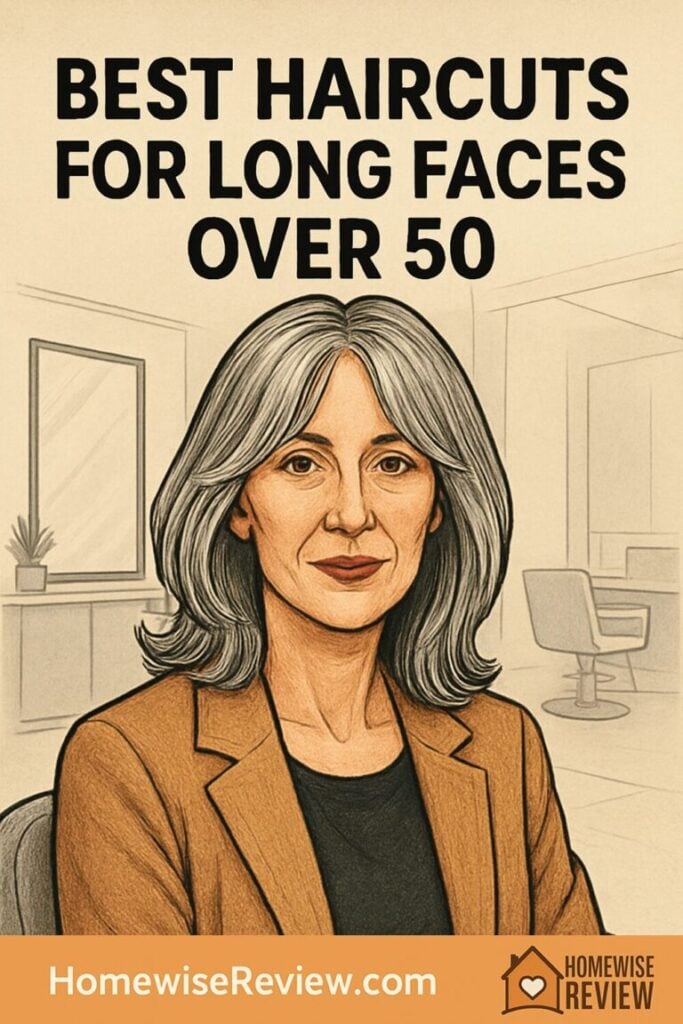
If you have a long face shape over 50, the right haircut can soften strong features, make thinning hair look fuller, and take years off your look without adding styling stress.
Mid-length, blended layers boost side volume and movement to soften features and make hair look fuller without extra styling.
Reaching 50 often means your hair does not behave the way it used to. It may be finer, drier, or show more natural texture, and if you also have a long face shape, the wrong cut can make your features look even longer and more tired. The good news is that a few smart haircut choices can balance your proportions, soften lines, and create a youthful, lifted effect.
How to Know If You Have a Long Face Shape
Before you choose a haircut, make sure you really have a long face shape and not an oval one. Stand in front of a mirror with your hair pulled back and notice the overall outline of your face.
- Your face looks noticeably longer than it is wide.
- You often have a higher forehead.
- Your chin is on the longer side instead of short and rounded.
- Cheekbones are not dramatically wider than your forehead or jaw.
If your face is only slightly longer than it is wide, you may be more oval, which is easier to flatter. A true long face shape benefits most from haircuts that add width and break up the vertical line from forehead to chin.
What Makes a Haircut Flattering for Long Faces Over 50
At 50 and beyond, you want hair that looks modern and healthy without a lot of work. The most flattering haircuts for long faces over 50 have a few things in common.
- They add width, not height. Volume at the sides, cheekbones, and jaw helps balance a longer face. Very tall crowns or flat sides can make the face look even longer.
- They break up length with layers or bangs. Strategic layers and fringe divide the face into more pleasing proportions and soften strong features.
- They avoid dragging the eye downward. Hair that is too long, heavy, or blunt at the bottom pulls the face down and can highlight sagging or deep lines.
- They respect real-life upkeep. If you only want to style for 5 to 10 minutes, your cut should be shaped to air-dry nicely or need minimal tools.
Keep these principles in mind as you consider specific haircut ideas. Your ideal cut will hit more than one of these points and suit your hair texture.
Best Haircut Ideas for Long Faces Over 50
You do not have to copy one exact hairstyle. Use these ideas as starting points and adjust the length, layers, or fringe based on your stylist’s advice and your own comfort level.
1. Shoulder-Length Lob With Soft Layers
A long bob, or lob, that hits between the collarbone and the top of the shoulders is one of the most versatile options for long faces over 50. The length gives you movement without dragging your features down. Soft, blended layers through the mid-lengths and ends add width and create a gentle, face-framing effect.
Ask your stylist for a lob that is slightly shorter in the back and a touch longer in the front. This shape keeps the hair from collapsing at the nape and subtly draws attention to your cheekbones instead of your chin. If your hair is fine or thinning, keep the layers light so you do not lose density at the ends.
2. Layered Lob With Curtain Bangs
Curtain bangs are a top choice for long faces because they shorten the look of a high forehead and create softness around the eyes. Paired with a layered lob, they can be very flattering on women over 50. The key is to keep the fringe long and airy, not blunt and heavy.
Ask for bangs that part in the center or slightly off-center and graze somewhere between your eyelashes and cheekbones, with longer pieces that blend into your layers. This style works especially well if you wear glasses because the fringe can sit right over or around the frames without fighting them. A round brush or a small flat iron is usually enough to shape curtain bangs in a couple of minutes.
3. Chin-Length Bob With Side-Swept Fringe
If you like shorter hair but do not want to expose too much of your face, a chin-length bob with a side-swept fringe is a strong option. The bob’s horizontal line visually shortens the face, while the side fringe cuts across the length and softens strong features. This style is especially nice if your jawline is still defined and you want to show it off.
Ask for a classic bob that hits at or slightly below the chin, with a subtle graduation at the back so it does not flip out. The fringe should start from a side part, with the longest point near the cheekbone. Avoid making the crown too puffy, which can undo the balancing effect and make your face look longer.
4. Soft Shag Around Collarbone Length
The modern shag is not the choppy, heavy cut from the 1970s. A soft shag with piecey layers around the collarbone is one of the best haircuts for long faces over 50 when you want movement and a relaxed feel. The layers add width at the sides, and the overall shape gives a youthful lift.
Ask your stylist for long, feathery layers starting around the cheekbones or lips, with the longest length landing near the collarbone. This style works beautifully with natural wave or curl and can make fine hair appear fuller. Just be sure your ends are not over-thinned; you still want some weight for a healthy look.
5. Mid-Length Waves With Face-Framing Layers
If you prefer to keep some length, aim for hair that falls between the collarbone and the upper chest, with soft waves and face-framing layers. This length gives you the feel of long hair without elongating your face too much. The waves add side volume and a gentle, flattering curve around the face.
Ask for long layers that start around the chin and taper into the rest of your hair so there is no harsh step. When styling, focus your wave pattern from the cheekbones down, leaving the roots a bit smoother. This keeps the look modern and avoids the triangle shape that can appear with curls only at the bottom.
6. Rounded Cut for Natural Curls
If you have naturally curly hair, a rounded shape is ideal for a long face. Volume at the sides and a softly curved outline help cancel out vertical length and create a balanced silhouette. A well-shaped curly cut can also reduce frizz and make your daily routine much simpler.
Ask for a cut that is tailored to your curl pattern, with layers that encourage the hair to sit in a gentle oval around your face. Many curl specialists cut hair dry so they can see how each curl falls. Consider adding a long, curly fringe or a few shorter curls around the forehead to shorten the appearance of the face even more.
7. Soft Pixie With Side Volume
A pixie can be very flattering on a long face over 50 as long as it has side volume and softness. Very tight, flat pixies can make the face look longer and harsher. A well-cut pixie, on the other hand, highlights your eyes and cheekbones and is easy to style.
Ask for a pixie with longer layers on top and at the sides that you can push forward or to one side. Keep the hair at the crown a bit textured rather than spiky, and avoid cutting it too short at the temples. A soft fringe that skims the forehead can make this cut especially flattering.
Short vs Medium Length for Long Faces After 50
When you are choosing between going shorter or staying closer to your shoulders, it helps to weigh how each option works with a long face shape and mature hair.
- Short hair pros: Lighter on thinning hair, quick to dry and style, and can give an instant lift to your features.
- Short hair cons: Can emphasize a long face if cut too flat or too tight, and usually needs more frequent trims.
- Medium length pros: Easier to build in side volume and soft movement, flexible for updos or clips, and flattering for most hair textures.
- Medium length cons: Can drag the face down if left too heavy and may take more effort to dry if hair is very thick.
If you are unsure, starting with a collarbone or shoulder-length cut is a safe middle ground. You can always go shorter later once you see how the shape flatters your features.
Should You Get Bangs With a Long Face Over 50?
Bangs are one of the quickest ways to shorten and soften a long face. They also hide a high forehead and can help cover stubborn forehead lines if that bothers you. The key is choosing a fringe style that works with your hair texture and maintenance habits.
Curtain Bangs
Curtain bangs are parted in the middle or slightly off-center and angle down toward the cheekbones. They work with straight, wavy, or curly hair and grow out gracefully. On a long face, they visually shorten the forehead and pull attention to the eyes.
Soft Side-Swept Bangs
If you like wearing a side part, side-swept bangs are a gentle option. They work well on straight and slightly wavy hair and do not require as much styling precision as blunt bangs. For long faces, keep the shortest point somewhere between the brows and the top of the cheekbones.
What to Avoid in Bangs
Very short micro bangs and extremely heavy, blunt bangs can be tricky after 50, especially if your hair is thinning at the front. They tend to highlight every change in your hairline and can be hard to style on days when your hair is flat or frizzy. Unless you enjoy daily styling, you will likely be happier with a softer, more forgiving fringe.
Match Your Haircut to Your Texture and Lifestyle
Your face shape is only one part of the picture. To love your haircut at 50 and beyond, you also need it to work with your texture and the time you realistically want to spend on it.
Fine or Thinning Hair
For finer hair, keep your cuts closer to chin or shoulder length with light, strategic layers. Too many layers can make the ends look stringy. A blunt or softly blunt perimeter with a few face-framing pieces usually looks fuller on a long face.
Use lightweight volumizing products instead of heavy creams that weigh hair down. A round brush and a quick blow dry at the roots can create the side volume that flatters a long face without needing a full salon-style blowout every day.
Thick or Coarse Hair
If your hair is dense or coarse, your stylist can use internal layering and texturizing to remove weight. A mid-length shag or layered lob can keep your hair from forming a heavy curtain along your cheeks, which would emphasize length. Just avoid over-thinning the ends, which can create a frizzy, aging look.
For easy home styling, a smoothing cream or serum on the mid-lengths and ends helps define your layers. You can let your hair air-dry partway, then finish with a brush and dryer to polish the top and sides where shape matters most.
Curly or Wavy Hair
Curls and waves are a powerful ally for long faces because they naturally add volume to the sides of your face. The right cut encourages that width in a controlled way. A rounded or softly triangular shape with layers designed for your curl pattern keeps things balanced.
To keep curls healthy and defined, avoid daily heat styling. Instead, use curl creams or foams and diffuse or air-dry whenever possible. Trimming every 8 to 12 weeks keeps the outline of your cut clean so your curls do not collapse or form a heavy, droopy shape.
Straight Hair
Straight hair can look very sleek and elegant on a long face, but if it is all one length and very long, it often pulls the face down. A lob or collarbone cut with slight layering is usually more flattering. Adding a soft fringe or just a few shorter pieces around the face makes a big difference.
Use a light smoothing product only where you need it so the sides do not fall too flat. A quick pass with a large curling iron or flat iron curled away from the face can create just enough bend to add width at the cheeks.
How to Talk to Your Stylist So You Get the Right Cut
Even the best haircut idea can miss the mark if you and your stylist are not on the same page. A simple conversation plan can help you walk out with a cut that truly suits your long face and your life.
- Bring 2 or 3 photos. Choose pictures of women whose face shape is similar to yours and whose hair texture is close to what you have, not just what you wish you had.
- Describe what you dislike now. For example, “My face looks too long,” or “My hair drags my features down.” This tells your stylist what to fix.
- Be honest about styling time. If you only want 5 minutes most days, say so. Your stylist can adjust the cut to air-dry better or need fewer tools.
- Ask for balance, not miracles. Use phrases like “I want more width here at my cheeks” or “I would like my forehead to look less high.” That invites solutions without unrealistic expectations.
- Request a quick styling lesson. Ask your stylist to show you how to shape your bangs or add side volume using your own tools where possible.
See also
For insight on how menopause affects hair density, texture, and care routines, explore menopause and hair changes. You might also find helpful tips in our guide to achieving salon-style results at home. – Discover the best heatless styling methods suitable for maintaining healthy, stylish hair without damage. – Learn about top hair brushes and hairsprays tailored to various hair types and styling preferences. – Find out which silk and satin sleep accessories help protect your hair and skin overnight.FAQ
Is long hair ever flattering on a long face over 50?
Yes, as long as the length and shape are chosen carefully. Hair that falls between the collarbone and upper chest, with soft layers and some wave or movement, can look beautiful on a long face over 50. Extremely long, straight, one-length cuts tend to drag the face downward, so adding face-framing layers or a fringe is important.
How often should I trim my hair after 50 to keep a flattering shape?
Most women over 50 do well with trims every 6 to 10 weeks, depending on their cut and how fast their hair grows. Short bobs and pixies need more frequent appointments to maintain their outline and keep balancing your face shape. Longer, layered cuts can stretch closer to 10 weeks as long as the ends still look healthy and the shape has not collapsed.
Will bangs make me look older or younger with a long face?
The right bangs usually make a long face look younger by softening lines and shortening a high forehead. Curtain bangs or soft, side-swept fringe are especially flattering over 50 because they move and grow out nicely. Extremely thick, blunt bangs or very short micro bangs can be harder to wear on mature features and may draw attention to any unevenness in the hairline.
What is the easiest haircut for a long face if I do not like styling my hair?
A shoulder-length lob with subtle layers and either curtain bangs or a soft side part is one of the easiest, low-maintenance cuts. It air-dries well on most textures and only needs a few minutes of touch-up at the front to look polished. Ask your stylist to shape the cut to work with your natural texture so you are not fighting your hair every morning.
How can I tell if my stylist understands what flatters a long face shape?
During your consultation, notice whether your stylist talks about balancing your features, adding width at the sides, and breaking up length with layers or bangs. If they suggest a very long, heavy cut or lots of height on top without side volume, that is a red flag. A stylist who understands long faces will show you where they plan to add movement and explain how the shape will soften your forehead, nose, or chin.
As an Amazon Associate, we earn from qualifying purchases made through links on our site.