

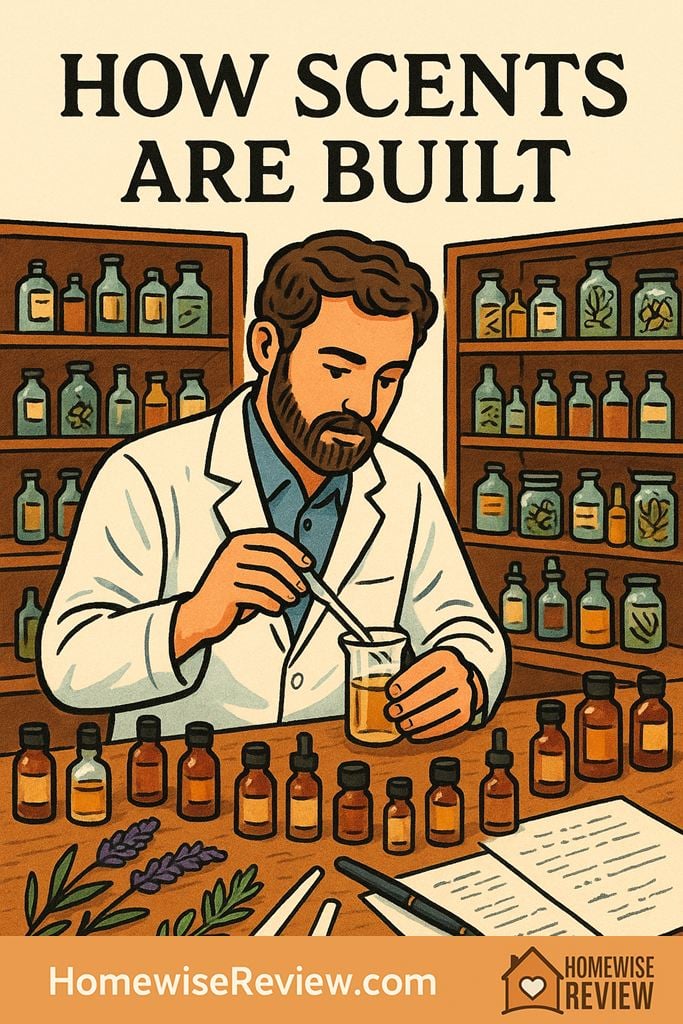
A finished perfume is the result of a creative brief, repeated formula trials, safety and regulatory checks, performance testing, and production controls. The exact sequence varies by brand and fragrance house, and commercial formulas are confidential, but the public standards and creation tools used by major fragrance organizations reveal the decisions that shape what reaches the bottle.
A perfumer does far more than combine a few ingredients that match the notes printed on a box. The job is to turn an idea into a reproducible formula that smells coherent, works in its intended product, complies with applicable rules, and can be manufactured consistently. Understanding that process helps shoppers interpret note lists, reformulations, concentration labels, and claims about artificial intelligence without mistaking marketing shorthand for a literal recipe.
A creative brief defines the problem
Commercial fragrance work usually begins with a brief from a brand or development team. The brief can describe the intended mood, audience, product format, market, price position, performance expectations, and constraints. It is not a formula. It is a set of decisions the fragrance must satisfy.
That distinction matters because the same broad idea can produce very different perfumes. A request for a transparent floral could become a quiet skin scent, a bright daytime fragrance, or a richer evening composition depending on the desired diffusion, sweetness, texture, and price. The perfumer and development team translate those words into an olfactory direction and decide what to test first.
Official material from dsm-firmenich describes fine-fragrance creation as a multidisciplinary process involving perfumers, development managers, marketing and consumer-insight specialists, technical teams, and safety and regulatory experts. That is a better picture than the lone-genius myth: authorship matters, but a commercial launch is also coordinated product development.
The formula is an architecture, not a note list
The notes shown in advertising describe recognizable impressions. They do not disclose every ingredient or its dosage. A “rose” impression, for example, can come from natural extracts, synthetic aroma materials, or an accord built from several materials. Supporting ingredients may control lift, diffusion, texture, persistence, or the transition between stages of wear without receiving a place in the marketing copy.
Perfumers evaluate how the composition changes from the opening through the drydown. Volatile materials become noticeable and fade at different rates, so balance is temporal as well as spatial. A promising opening can still need revision if the heart loses definition or the base overwhelms everything after several hours.
Natural and synthetic materials are both normal tools. Origin alone does not determine quality, safety, complexity, or cost. A shopper who wants to understand a perfume should treat the listed notes as a sensory map and the ingredient list as a regulatory disclosure, not assume either is a complete formula.
Trials turn the first idea into a workable scent
The initial formula is sampled and evaluated, then adjusted. Each revision can change dosage, replace a material, strengthen an accord, reduce an unwanted effect, or bring the scent closer to the brief. Teams may smell trials on blotters and skin because the same formula can develop differently across evaluation conditions.
There is no responsible universal claim for how many revisions a perfume requires. A straightforward project may converge quickly; another may change after brand feedback, technical testing, ingredient availability, or a revised brief. The useful point is that iteration is part of creation, not evidence that the first version failed.
Safety standards and law constrain the palette
Fragrance development is subject to both legal requirements and industry safety standards. The International Fragrance Association explains that its Standards can prohibit an ingredient, restrict its level in a finished consumer product, or impose purity specifications. IFRA also states that following its Standards does not replace compliance with the laws of each market.
This can affect a formula early or force later reformulation. The permitted level of a material can depend on the product category and expected exposure. A perfumer may need to lower a material, replace it, or rebuild the surrounding accord so the intended effect survives the change.
Labeling is a separate issue from formula design. European cosmetics rules require specified fragrance allergens to be named individually above applicable thresholds rather than hidden entirely under the general term “parfum.” A listed allergen does not reveal the whole composition, and an absent marketing note does not prove that a material is absent.
Technical testing checks more than smell
A fragrance that smells good in a fresh lab sample still has to work as a product. Quality teams establish specifications for ingredients and finished mixtures, retain records, and check that materials meet defined requirements. IFRA’s good-operating-practice guidance specifically calls for sampling, testing, batch identification, and quality-control records.
Development teams can also evaluate how a formula behaves with alcohol, colorants, packaging, light, temperature, and time. The relevant tests depend on the product and manufacturer. These checks help identify discoloration, cloudiness, separation, packaging interaction, or an olfactory shift before large-scale production.
Digital tools accelerate trials but do not replace judgment
Major fragrance houses now use computer-assisted creation systems. Givaudan says its Carto platform lets perfumers select materials through a digital interface and uses an instant-sampling robot to produce trials rapidly. The company describes the system as support for experimentation while keeping the perfumer at the center of creation.
That is the practical role of artificial intelligence in the documented example: organizing knowledge, exploring combinations, optimizing parts of formulation, and shortening repetitive sampling work. It does not prove that a machine independently designed every aspect of a perfume, nor does “AI-created” tell a shopper whether the result will suit their taste.
What this process means when choosing perfume
- Use note lists for orientation. They can help identify a fragrance family or likely impressions, but they are not a recipe or a guarantee of how the scent will develop on skin.
- Sample the full drydown. Revisions are judged over time, and your decision should be too. Smell the opening, heart, and later base before buying a full bottle.
- Do not equate natural with automatically safer. Both natural and synthetic fragrance materials can be subject to restrictions or labeling requirements.
- Expect legitimate reformulation. Ingredient rules, supply, technical performance, or commercial constraints can change. Compare the current bottle rather than relying entirely on memories of an older batch.
- Treat concentration names as incomplete guidance. Strength and persistence also depend on formula structure, dosage, application, skin, and environment; the label alone cannot predict performance.
Related fragrance guides
To apply these ideas while shopping, compare restrained compositions in our guide to signature scents for minimalists, learn how positioning affects high-end choices in our luxury perfume guide, or use our travel-size perfume guide to sample with less commitment.
Sources and limitations
This guide draws on the IFRA Code of Practice, IFRA good-operating-practice guidance, the European Commission’s fragrance-allergen labeling overview, dsm-firmenich’s account of fine-fragrance development, and Givaudan’s description of Carto. Brand-specific briefs, formulas, test protocols, and revision histories are proprietary, so this is a documented map of common commercial stages rather than a claim about every launch.