

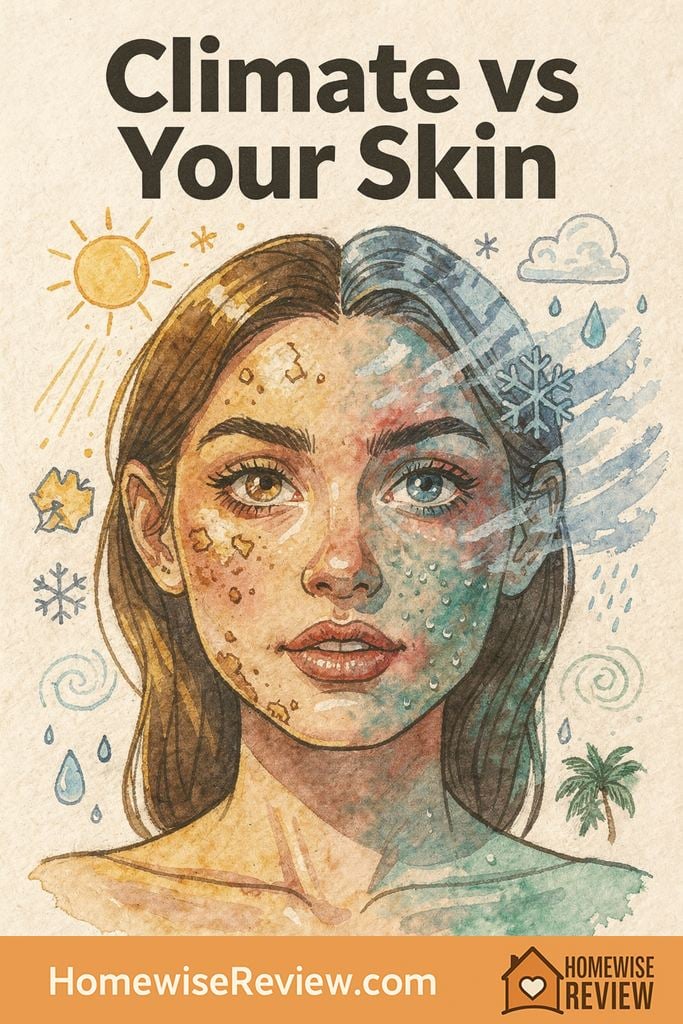
If your skincare works at home but fails on vacation, the culprit is often climate. A few measurable variables, UV index, humidity, temperature, and pollution, predict most of the “before and after” changes people see in texture, tone, and breakouts.
- Up to 90% of visible skin changes commonly attributed to aging are linked to sun exposure (photoaging).
- WHO UV Index guidance recommends sun protection starting at UV Index 3, meaning “high-UV” routines are relevant well beyond beach days.
- EPA guidance commonly cites an ideal indoor humidity band around 30% to 50%, a range that often conflicts with winter heating and drives visible dehydration.
- WHO estimates 99% of people breathe air exceeding air quality guideline levels, making pollution-related skin stress a widespread baseline factor.
Climate changes skin in predictable ways, and the most surprising part is how fast the visible shift can happen when the environment changes, even if your products stay the same. Across major public-health guidance and dermatology research, four levers show up again and again: UV intensity, humidity, heat (and sweat), and airborne pollution.
- Sun exposure dominates visible aging signals: up to 90% of visible skin changes commonly attributed to aging are linked to sun exposure.
- Protection thresholds start lower than many expect: the WHO UV Index guidance recommends sun protection starting at UV Index 3.
- Indoor air can be “skin-dry” air: EPA guidance commonly cites an ideal indoor relative humidity band of about 30% to 50%.
- Pollution exposure is nearly universal: the WHO reports 99% of people breathe air that exceeds their air quality guideline levels.
Below is a data-forward, before-and-after breakdown of what these variables tend to do to the skin barrier, oil balance, pigment behavior, and inflammation, plus the routine tweaks that most directly counter each signal.
Finding 1: Low humidity shows up as “tight, dull, and lined” first
When humidity drops, skin loses water more easily. The barrier can still be intact, but the surface behaves like it is under-supplied: makeup clings to patches, fine lines look sharper, and the face can feel tight within hours. This is why winter, desert climates, and over-heated indoor air so often produce the same look, even in people who do not consider themselves “dry skinned.”
What tends to change before and after a humidity drop:
- Within 24 to 72 hours: rough texture becomes more noticeable, “smile lines” look deeper, and redness can appear around the nose and mouth as the surface dehydrates.
- Within 2 to 4 weeks: the barrier may become more reactive, with stinging from actives that were previously fine, and increased flaking at the corners of the mouth or around the eyebrows.
Routine implication: in low humidity, the most reliable visible improvement comes from shifting the routine from “treatment-forward” to “barrier-forward.” Humectants (like glycerin and hyaluronic acid) help, but the “after” picture usually looks best when humectants are paired with a moisturizer that reduces water loss, especially at night.
Finding 2: High UV creates a distinct “after” profile: uneven tone first, then texture
UV is the climate variable with the cleanest link to visible skin change because it affects pigment activity and collagen structure. Importantly, UV risk is not just “beach weather.” It varies with season, cloud cover, reflective surfaces (snow and water), and altitude, and it is summarized well by the UV Index.
What tends to change before and after an increase in UV exposure:
- Days to 2 weeks: new freckles or darkening of existing spots, blotchier tone, and persistent redness after outdoor time.
- Weeks to months: fine lines and texture become more noticeable, especially around the eyes and upper cheeks, where skin is thinner and sunscreen coverage is often inconsistent.
Routine implication: the single biggest lever is consistency. When UV Index reaches the WHO “protection recommended” zone (3 and up), the best before-and-after results come from daily broad-spectrum sunscreen use plus reapplication strategies that match real life (work commute, school pickup, outdoor workouts). Brightening ingredients can help evenness, but they do not replace the prevention step that changes the trajectory.
Finding 3: Heat and sweat shift breakouts toward the “friction zones”
Hot, humid conditions do not just mean “more oil.” They change where acne shows up and what kind it is. Sweat, occlusion (think masks, hats, helmet straps), and friction can create a very specific before-and-after pattern: more bumps along the hairline, jaw, under the chin, and on the upper lip, even in people who usually break out in the T-zone.
What tends to change before and after a heat jump:
- Within 3 to 7 days: small clogged bumps and inflamed pimples concentrate where sweat sits or gear rubs.
- Within 2 to 4 weeks: post-inflammatory marks can linger longer if UV is also high, creating the common “summer breakout plus spots” cycle.
Routine implication: in heat, visible improvement usually comes from reducing occlusion and optimizing cleansing timing, not from harsh stripping. A gentle cleanse soon after heavy sweating, a lighter moisturizer layer, and a sunscreen that sets comfortably can reduce the friction-and-occlusion feedback loop without triggering rebound irritation.
Finding 4: Pollution is the slow-burn stressor that shows up as tone dullness and sensitivity
Air pollution is harder to “see” day to day, which is exactly why it makes a good climate variable for before-and-after analysis. Epidemiologic research links traffic-related pollution exposure with pigment spot development and signs of extrinsic aging, while mechanistic work points to oxidative stress and inflammation as the bridge between environment and visible change.
What tends to change before and after higher pollution exposure:
- Within 1 to 2 weeks: duller tone, more visible redness in reactive skin, and a “gritty” feeling by late afternoon in some environments.
- Over months: more stubborn unevenness and an increased likelihood that minor irritation becomes a longer flare.
Routine implication: the most defensible anti-pollution routine moves are straightforward: thorough but gentle cleansing, barrier support, and antioxidant support in the morning when tolerated. “Detox” claims are usually less useful than repeatable, low-irritation steps that reduce oxidative load and prevent barrier disruption.
Before and after timelines: what changes first (and what takes a full skin cycle)
A helpful way to interpret climate-driven before and after photos is to separate surface hydration changes from pigment and collagen changes. Hydration and inflammation can swing quickly, while pigment distribution and texture remodeling tend to reveal themselves over weeks to months.
| Time window | Most “visible” climate effects | Most effective routine focus |
|---|---|---|
| 24 to 72 hours | Tightness, flaking, shine changes, redness | Barrier support, reduce over-exfoliation, adjust moisturizer weight |
| 2 to 4 weeks | Breakout patterns stabilize, sensitivity trends become clear | Right-size cleansing, consistent sunscreen, targeted anti-acne or calming steps |
| 8 to 12 weeks | More reliable changes in spots, tone evenness, and texture | Long-game actives (as tolerated) plus strict UV consistency |
Routine switches that match the climate signal (without overhauling everything)
The most consistent “after” improvements usually come from changing one or two variables, not from rebuilding a routine from scratch. The climate signal tells you which dial to turn.
- Humidity low: add a more occlusive night layer, reduce exfoliation frequency, and consider running a humidifier toward the EPA-referenced comfort band (commonly cited around 30% to 50% relative humidity).
- UV high: prioritize broad-spectrum coverage and realistic reapplication. If makeup makes reapplication hard, build a second application method into the day (tinted sunscreen, cushion compacts, or sunscreen sticks that do not skip the hairline and jaw).
- Heat and sweat high: lighten moisturizer, cleanse after sweating, and minimize friction. Treat “gear contact” skin (chin strap, mask line, hat band) like its own zone.
- Pollution high: double cleanse if you wear long-wear sunscreen or makeup, keep the barrier calm, and use an antioxidant step if your skin tolerates it.
Methodology: how this analysis was built
This report synthesizes (1) public-health thresholds that quantify environmental exposure (notably UV Index guidance, indoor humidity guidance, and air-quality guideline context), (2) peer-reviewed dermatology and skin biology findings on barrier function, inflammation, pigmentation, and extrinsic aging, and (3) climate datasets used to characterize typical environmental ranges. The goal is not to assign a single “best routine,” but to map measurable climate variables to the most common, visible before-and-after skin changes and the routine adjustments with the most plausible causal link.
Buying Guides Based on This Data
If the data here points you toward barrier repair, this simple night routine for repair and calm shows how to do it without stacking too many products. If UV is the strongest signal in your environment, see our guide to making sunscreen a daily habit for practical ways to stay consistent when life is busy. If your routine keeps swinging with every seasonal change, these top skincare myths debunked can help you avoid fixes that feel productive but do not move the needle.
Frequently Asked Questions ▾
Why does my skin look worse within two days of traveling?
Fast changes are usually hydration and inflammation, not “new aging.” A jump in humidity, UV, or heat can change surface water loss, redness, and oil balance quickly, which shows up as dullness, tightness, or sudden breakouts.
Is UV Index really a better guide than temperature?
For pigment and texture outcomes, yes. Temperature tells you how hot it feels, while UV Index summarizes the intensity of UV radiation that drives tanning, burning, and longer-term photoaging risk.
Do I need different skincare for winter and summer?
Often you only need a different “emphasis.” Winter commonly calls for more barrier support and less aggressive exfoliation, while summer often benefits from lighter layers, better sweat-timing, and stricter sunscreen consistency.
What is the simplest way to tell if pollution is affecting my skin?
Look for patterns: increased dullness by the end of the day, more persistent sensitivity, and uneven tone that is hard to correct even when hydration and sunscreen are solid. The most useful test is whether gentle cleansing plus barrier support improves the baseline within a few weeks.
As an Amazon Associate, we earn from qualifying purchases made through links on our site.