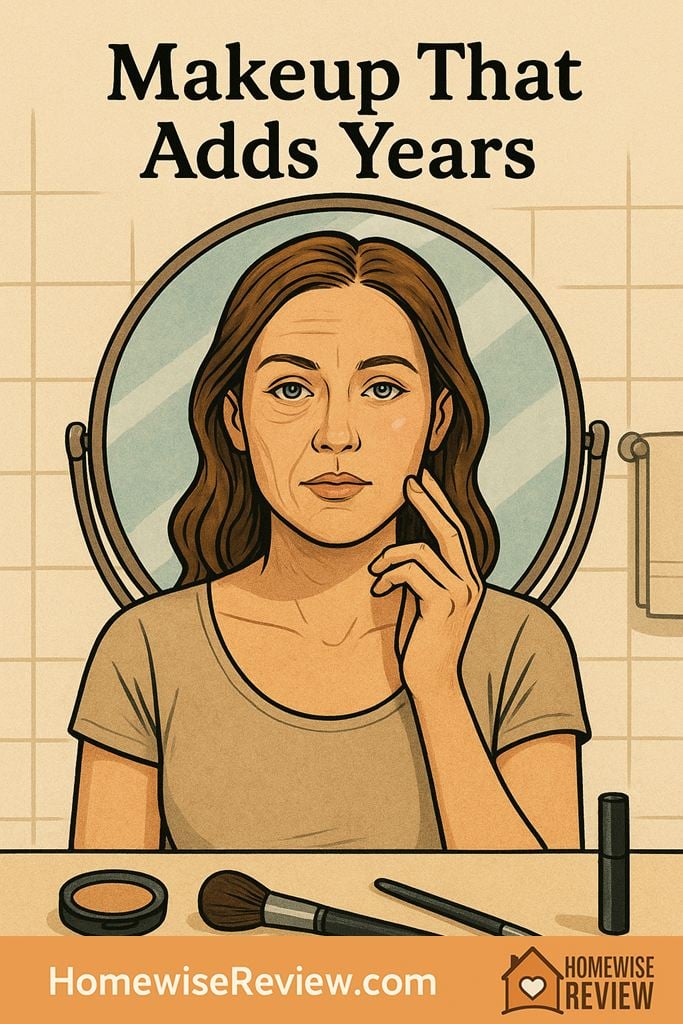
If your makeup seems to look heavier every year, the problem may not be your face. The data point to a few common habits that flatten features, magnify texture, and make skin look older before noon.
- In a 4.5-year randomized trial, daily sunscreen use was linked to 24% less skin aging than discretionary use.
- A menopause review found skin collagen can drop about 30% in the first 5 years after menopause.
- The same review reported ongoing declines in skin thickness after menopause, helping explain why dry, full-coverage base can start looking heavier.
- Face-perception research found that lower facial contrast is a visible cue people use to judge age.
No published poll cleanly proves the exact 90% figure in the headline, but the research behind dermatologist advice is unusually consistent. A randomized sunscreen trial found 24% less skin aging with daily use, menopause research found collagen can fall about 30% in the first five years, and face-perception studies show that lower facial contrast makes people look older.
That adds up to a useful, if slightly annoying, conclusion: makeup usually ages the face less by being the wrong color and more by amplifying dryness, muting natural contrast, and sitting on skin that has changed. The headline sounds like a makeup problem, but much of the evidence points to skin condition and visual cues rather than one bad foundation.
Finding 1: Texture ages the face faster than color mistakes
When skin is drier and collagen levels are lower, foundation stops behaving like a filter and starts behaving like tracing paper. It outlines every flake, pore, and fine line. That is one reason a formula that looked polished at 35 can suddenly look mask-like at 45 or 55.
This is where the menopause data matters. Research reviewing skin changes during menopause found collagen can drop by about 30% in the first five years, with skin thickness declining as well. Dermatologists may debate trends, but they are strikingly aligned on this point: once texture is more visible, a drier, fuller-coverage base often makes the problem easier to see, not harder.
The practical takeaway is simple. Change finish before you change coverage. A satin or skin-like formula with light-reflecting pigments usually reads younger than a fully matte base, especially if you are setting the entire face with powder out of habit.
Finding 2: Flat makeup can read older because the eye uses contrast to judge age
One of the more surprising findings in face-perception research is that people use facial contrast to estimate age. As contrast fades around the brows, lashes, lips, and eyes, faces tend to be judged as older. That helps explain why some technically perfect makeup still looks a little tired.
It also explains why too much beige can backfire. Heavy under-eye concealer, foundation over the lip border, and blush that disappears into the base can flatten the face instead of freshening it. In many cases, the younger-looking move is not more product, but a little more definition where the face naturally loses it first: softer brow structure, mascara at the roots, blush placed a touch higher, and lip color with slightly more life than your base.
This finding matters because it shifts the goal. A lot of people chase absolute coverage when what they really need is selective contrast. If makeup erases every sign of redness but does not put any believable color back into the cheeks or lips, the face can look smoother and older at the same time.
Finding 3: The biggest anti-aging makeup step may not be makeup at all
In a randomized trial that lasted more than four years, participants who used sunscreen daily showed 24% less skin aging than those who used it only when they felt like it. That is a bigger number than most packaging promises, and it helps explain why dermatologists spend so much time talking about sunscreen even when the question starts with concealer or foundation.
Makeup can blur discoloration, but it cannot fully hide the roughness, laxity, and unevenness created by cumulative UV damage. When sunscreen, moisturizer, and gentle exfoliation are inconsistent, people often compensate by adding more base. The result is predictable: heavier coverage, more powder, more settling, and a finish that looks older by midday.
That is why the most useful anti-aging makeup advice is often boring. Protect the skin. Keep the barrier comfortable. Then use less product than you think you need. The data supports that sequence more strongly than any contour trick.
Finding 4: Placement matters more than full-face coverage
Most faces do not age evenly. Redness may sit around the nose, pigment may collect on the cheeks, and shadow may deepen only at the inner corners of the eyes. Covering everything to the same opacity erases natural variation and can make skin look thicker than it is.
Strategic coverage is usually more convincing. A thin layer overall, followed by extra product only where the eye actually catches unevenness, tends to read fresher than a uniform full-coverage mask. That often means around the nose, at the center of the chin, over isolated discoloration, and sparingly at the inner under-eye rather than all the way across the orbital area.
In plain English, most people look younger when some real skin still shows. Full-face perfection is not the same as youthful-looking skin. A little translucency can do more work than a second layer of foundation.
Why matte is not the villain, but dry matte often is
Matte formulas get blamed for aging the face, and sometimes that is fair. On skin that is dry, dehydrated, or textured, they can exaggerate all three. But on oilier skin, or in heat and humidity, a soft-focus matte finish can look cleaner and younger than a shiny base that breaks apart by lunchtime.
The better question is not matte or dewy. It is what kind of light the product leaves on your skin after six hours. Healthy-looking skin usually has variation: less shine in the T-zone, a little bounce on the cheeks, and no crusty build-up around the nose or mouth. That is why spot-powdering tends to age the face less than a blanket of translucent powder.
The habits that most often add years
- Using more coverage as skin gets drier. Coverage neutralizes color, but it also magnifies flakes and fine lines when the base is thirsty.
- Concealing too far under the eye. Carrying bright, opaque product across crepey skin often makes texture more visible.
- Skipping blush or lip color. Removing natural redness without putting controlled color back can make the whole face look flat.
- Powdering the whole face out of habit. Many people only need powder at the sides of the nose, center forehead, and maybe the chin.
- Following old placement rules. The way you applied makeup ten years ago may not flatter the same features today.
What dermatologist-approved younger-looking makeup usually has in common
Not more shimmer. Not trendier colors. Usually it is makeup that respects what the skin is doing now. In practical terms, that means fewer signals the eye reads as age: dryness, heaviness, blurring of contrast, and uneven texture.
The routine itself is almost disappointingly simple. Prep with moisturizer and sunscreen. Let skincare settle. Use less base than you think. Put coverage only where you need it. Add back contrast with brows, lashes, blush, and lip tone. Powder only where shine becomes a distraction. None of that is flashy, but it lines up closely with the evidence.
Methodology
This report reviewed peer-reviewed research on photoaging, menopause-related skin changes, and facial age perception, then compared those findings with common dermatologist guidance on sunscreen, hydration, finish, and product placement. The goal was not to rank brands, but to identify which makeup habits are most consistently associated with an older-looking result and which changes have the strongest evidence behind them.
Buying Guides Based on This Data
If formula quality is the real issue, check out our Amazon beauty buys roundup for budget-friendly picks that avoid the chalky, overfragranced trap. If your base looks worse by noon than it did at breakfast, these overnight beauty products to apply and forget can help support smoother makeup the next day. And if rushed application is part of the problem, the best tech and beauty tools to simplify mornings can cut down on overblending, overpowdering, and other time-crunched mistakes.
Frequently Asked Questions ▾
Does makeup actually age skin, or just make it look older?
Mostly the second. The bigger long-term aging drivers are UV exposure, smoking, inflammation, and sleep loss. Makeup becomes part of the problem when it is drying, irritating, or removed poorly.
What step changes the look fastest?
For immediate improvement, reducing total base and powder usually changes the finish fastest. For long-term prevention, daily sunscreen has the strongest evidence.
Is dewy makeup always better on mature skin?
No. Too much shine can emphasize pores and laxity. A skin-like finish with selective powdering usually looks fresher than either extreme.
As an Amazon Associate, we earn from qualifying purchases made through links on our site.
