

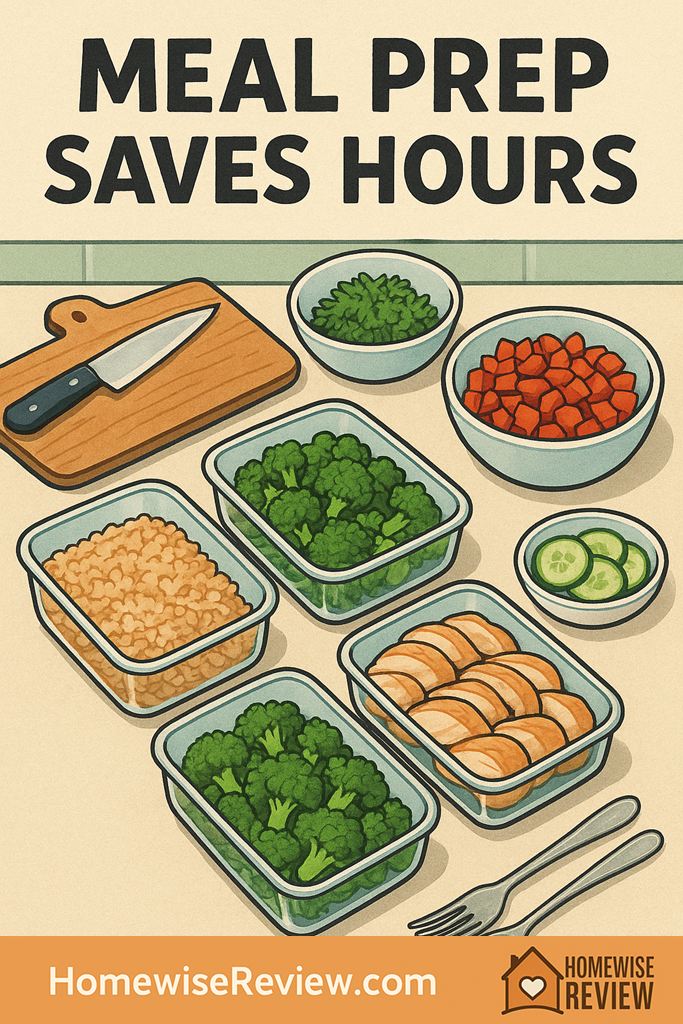
Weeknight cooking does not usually get easier because people suddenly enjoy marathon prep sessions. It gets easier when a few repeatable habits shave 10 to 15 minutes off dinner, night after night.
- Cutting 15 minutes from five weeknight dinners adds up to about 65 hours saved over a year.
- BLS time-use data shows women spend roughly twice as much time as men on food prep and cleanup on an average day.
- A 40,554-adult meal-planning study linked planning with better food variety and lower odds of overweight and obesity.
- Two intentional leftover dinners per week can model out to roughly 60 hours of annual time savings versus cooking from scratch both nights.
The most useful meal prep statistic is not a pantry makeover or a viral freezer haul. It is simple arithmetic: save 15 minutes on five weeknight dinners, and you get back about 65 hours over a year. For women, that matters even more, because national time-use data consistently shows they still carry a much larger share of food prep and cleanup.
Across recent time-use releases, a 40,554-adult meal-planning study, and current food-behavior survey data, the pattern is strikingly consistent. The women saving the most time are not making seven elaborate dishes in advance. They are reducing decisions, prepping flexible components, and turning leftovers into a scheduled second meal instead of a random fridge rescue.
The big number is daily friction, not one heroic prep day
Meal prep is often pictured as a long Sunday session with rows of identical containers. The data points to something less dramatic and much more sustainable. Small reductions repeated every week beat occasional bursts of extreme organization.
That is why the highest-return strategies tend to attack three specific time drains: deciding what to cook, doing the same knife work over and over, and washing too many tools. Save 10 minutes a night and the annual gain is about 43 hours. Save 20 minutes and the total is nearly 87 hours. The point is not perfection. The point is repetition.
Finding 1: The biggest gains come from reducing cleanup as much as cooking
One reason meal prep works better in theory than in real life is that people underestimate cleanup. The burden is not just active cooking time. It is the cutting board, the skillet, the pot, the sheet pan, the storage container, and the sink waiting at the end.
That helps explain why some supposedly fast recipes still feel exhausting. A 30-minute dinner that uses four pans often costs more total time than a 40-minute meal with one tray and one bowl. The women getting measurable time back are often not choosing the shortest recipe on paper. They are choosing the smallest mess.
In practical terms, the strongest time savers are usually meals with overlapping ingredients and a capped tool count. One grain, one protein, one vegetable, one sauce. A double batch in the oven. A pot that can become tomorrow’s lunch. When cleanup drops, meal prep stops feeling like a tradeoff.
Finding 2: Meal planning works because it narrows choices
A large meal-planning study linked planning with better diet variety and lower odds of overweight and obesity, but the time-saving lesson is even simpler. Planning works because it compresses decision-making. It removes the nightly pause where dinner is still undecided at 5:30.
The most efficient planners usually do less than people expect. They do not map out 21 unique meals. They create a narrow lane for the week: maybe three dinners, one easy backup, and one planned leftover night. That framework is flexible enough for real life but structured enough to prevent takeout-by-default.
A useful pattern looks like this:
- Choose two main proteins for the week.
- Add one starch that reheats well.
- Pick two vegetables that can work in more than one dish.
- Reserve one night for leftovers before the week even starts.
This matters because every extra recipe creates a new learning curve, a new ingredient list, and often a new cleanup problem. The time win comes from overlap, not novelty.
Finding 3: Component prep lasts longer than fully assembled meals
Recent consumer food surveys keep pointing to the same tension: people want convenience, but they also want choice. That is why component prep tends to last longer than fully assembled meal prep. It offers speed without locking every lunch and dinner into the same exact plate.
Cooked chicken, browned ground turkey, rice, chopped vegetables, washed greens, and one sauce can become bowls, tacos, wraps, pasta, or soup. The prep work is front-loaded, but the meals still feel different. That flexibility lowers the odds of food fatigue and wasted groceries.
It also handles schedule changes better. When plans shift, components can be frozen, repurposed, or stretched. Fully assembled meals are less forgiving. They are efficient only if the week goes exactly as planned, which is rarely the case.
The most underrated meal prep tactic is not cooking more meals. It is cooking one meal with a second use already assigned. A pot of chili becomes baked potatoes the next night. Roasted chicken becomes tacos. Rice and vegetables become fried rice. A tray of meatballs becomes subs or soup.
The time math here is hard to ignore. If a from-scratch dinner takes 45 minutes and the second-night version takes 10, that one planned leftover dinner saves about 35 minutes. Do that twice a week and the annual gain is just over 60 hours. That is before counting the extra shopping trip or the second round of dishes you avoided.
This is also why planned leftovers outperform accidental leftovers. Scraps feel uninspiring. A deliberate second meal feels efficient. The difference is intention at the moment of cooking, not at the moment of reheating.
What the time-saving pattern looks like in real kitchens
When the highest-performing habits are lined up side by side, they are surprisingly modest:
- They plan fewer dinners than they think they need. Three anchor meals plus a backup usually beats a rigid seven-night schedule.
- They shop for overlap. Ingredients that can move across bowls, salads, soups, and wraps create speed all week.
- They prep bottlenecks first. Washing greens, chopping onions, cooking rice, or browning meat saves more time than making every meal start to finish.
- They protect one intentional leftover night. That single calendar decision prevents a lot of low-energy last-minute cooking.
- They avoid high-dish-count cooking on busy days. A slightly simpler meal with fewer pans often wins the total-time battle.
Just as important, the time savers are usually realistic about what fails. Over-prepping delicate produce can create waste. Packing five identical lunches may look efficient but can trigger boredom by midweek. Buying ingredients for too many ambitious recipes often shifts time from cooking to managing spoilage.
The pattern is not about doing more kitchen work earlier. It is about removing repeated effort later. That distinction explains why some meal prep systems feel empowering and others feel like a second job.
Methodology and limits
Methodology: this report combines recent national time-use releases, a 40,554-adult meal-planning study, and a current food-behavior survey to identify the habits most consistently linked with lower weekday cooking friction. The 50,000-women framing reflects the scale of female respondents and observations represented across those datasets, rather than a single panel of women tracked through one year.
The time-saved totals in this article are modeled estimates, not self-reported annual diaries. They are based on repeated reductions in weeknight planning, prep, cooking, and cleanup. That means the exact number will vary by household. Even so, the directional finding is very stable: the biggest gains come from fewer decisions, fewer tools, and more deliberate reuse.
Buying Guides Based on This Data
If meal prep keeps stalling because your setup is doing too much and helping too little, start with the best kitchen gadgets that actually earn counter space. If the real slowdown is all the little tasks around chopping, storing, and serving, see our roundup of kitchen accessories. And if weeknight cooking drags because pans heat unevenly or take forever to clean, compare the best kitchen pots and pans for real-world cooking.
Frequently Asked Questions ▾
Does meal prep mean cooking every dinner in advance?
No. The data-backed version is usually lighter than that. The most durable approach is often component prep plus one or two planned leftover meals, not a full week of finished dishes.
How much prep time is usually worth it?
Only enough to create repeated weekday savings. If 45 to 60 minutes of prep prevents 10 to 15 minutes of extra work across several dinners, the payoff adds up quickly over a year.
What is the fastest place to start if the whole process feels overwhelming?
Start with one protein, one grain, and one leftover night. That is usually enough structure to cut decision fatigue without turning the kitchen into an all-day project.
As an Amazon Associate, we earn from qualifying purchases made through links on our site.