

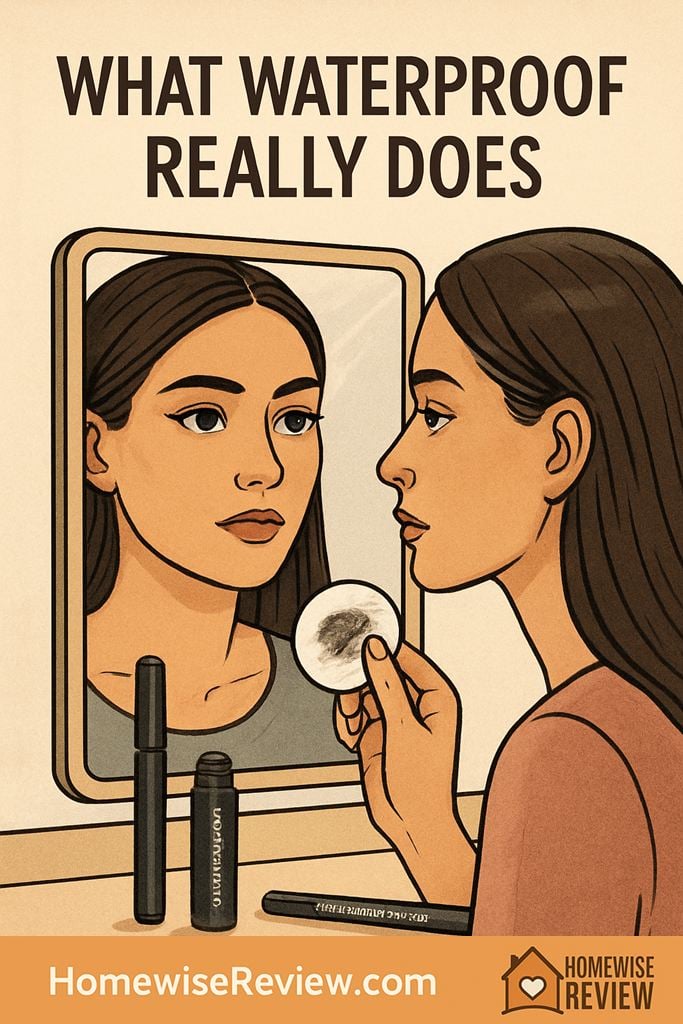
Waterproof makeup is most useful when you can name the failure you need to prevent: mascara transferring to an oily lid, liner breaking down when eyes water, brows fading in humidity, or base makeup rubbing onto clothing. It is not automatically longer-wearing, safer, or better for every part of the face. The stronger hold can also mean less blending time and more effort at removal. This guide explains where waterproof formulas add practical value, how to compare a claim with real wear conditions, and how to remove eye and face products without turning durability into unnecessary rubbing.
Waterproof, water-resistant, and long-wear are different shopping clues
These terms all suggest durability, but they do not tell you exactly what was tested unless the brand supplies the method. A waterproof claim points to resistance to water exposure. Transfer-resistant describes pigment that is less likely to move onto skin, clothing, a phone, or a cup. Smudge-resistant is especially relevant to mascara, liner, and brows. Long-wear focuses on time, which may or may not include water, sweat, oil, or friction.
Read the claim beside the product type and directions. A mascara designed for tears solves a different problem from a foundation designed to resist transfer. If a brand publishes a wear test, look for duration, water or humidity exposure, participant count, application method, and the result actually measured. A bare “24-hour” or “waterproof” label cannot tell you how the product will behave with your skincare, eye shape, skin oil, or climate.
Where waterproof makeup usually earns its place
| Makeup type | Useful when | Main tradeoff | What to test |
|---|---|---|---|
| Mascara | Eyes water, lids are oily, or regular mascara leaves under-eye transfer | More removal effort and a higher temptation to rub or pull lashes | Flaking, curl hold, transfer, comfort, and complete removal |
| Eyeliner | The lash line smudges, wings lose their edge, or humidity breaks down the formula | Fast setting can make correction and soft blending harder | Set time, inner-corner wear, removal, and suitability for the intended eye area |
| Brow product | Brow tails fade from oil, sweat, hats, or touching | Strong films can look stiff or deposit too much color | Brush-through flexibility, skin staining, and clean fading |
| Complexion makeup | Small high-transfer areas break down or an event involves heat and humidity | A full waterproof base can feel dry, set quickly, or resist normal cleansing | Compatibility with skincare, patchiness, transfer, and end-of-day comfort |
| Lip color | Transfer control matters more than gloss or easy reapplication | Some durable films emphasize dryness or wear unevenly with oily food | Comfort, inner-lip wear, meal performance, and removal |
The pattern is selective use. If only mascara transfers, a waterproof base adds work without solving the problem. Start with the smallest area where moisture, oil, movement, or friction causes visible breakdown.
How waterproof formulas resist movement
Formulas vary, so there is no single waterproof ingredient list. In general, durable makeup is designed to leave a film that holds pigment in place after volatile ingredients evaporate or the product sets. Waxes can contribute structure; film-forming ingredients can improve adhesion; powders can change oil absorption and feel. The finished formula, ingredient proportions, applicator, and application thickness matter more than spotting one familiar ingredient.
This explains two common behaviors. First, a product may become harder to move shortly after application, so working time is limited. Second, water alone may not dissolve the set film, while an oil-containing or bi-phase remover can loosen it more efficiently. That is a practical formulation pattern, not a promise that every waterproof product survives every condition.
Choose by failure mode, not by the strongest label
- Identify what moves the product. Tears and rain are water; skin oil is not. Sweat combines water, salts, heat, and movement. A collar or finger adds friction. The correct formula depends on the actual stress.
- Decide how much correction time you need. A fast-setting liner may suit a crisp wing but frustrate someone who prefers a smoky edge. A gripping base may suit thin layers but become patchy if repeatedly blended.
- Check routine compatibility. Rich skincare, silicone-heavy primers, facial oils, and setting products can alter adhesion. Test the whole routine rather than the waterproof item in isolation.
- Plan removal before purchase. If you will not use the remover or contact time the product needs, a less tenacious formula may produce a healthier routine and a better overall experience.
A controlled wear test you can repeat
Apply the waterproof product on one side and your usual formula on the other, using the same preparation, tool, amount, and setting time. Record the start time. Check in the same lighting after two hours and again near the end of your normal day. Look separately for fading, transfer, smudging, flaking, creasing, tightness, and discomfort.
Do not manufacture an unsafe test by spraying products toward the eyes or deliberately submerging your face. Normal conditions (commuting, warm rooms, a workout appropriate for you, or naturally watery eyes) are more relevant. A result from one day is still personal evidence, but a consistent side-by-side method is more informative than comparing two products on different days.
Remove durable eye makeup with time, not force
Follow the product and remover directions. With closed eyes, place an appropriate remover on a soft pad or reusable cloth, hold it against the area long enough to loosen the film, and wipe gently rather than scrubbing back and forth. Repeat with fresh remover if pigment remains. Keep remover out of the eye and stop if irritation develops.
FDA advises washing hands before applying eye cosmetics, keeping applicators clean, never sharing eye makeup, and stopping use immediately if a product causes irritation. If irritation persists, contact a doctor. FDA also warns against adding water or saliva to dried mascara because contamination can introduce microorganisms and dilute preservatives. If you have an eye infection, stop using eye cosmetics and discard the products used around the time of infection.
These precautions matter more with a stubborn formula because aggressive removal can encourage rubbing near a sensitive area. Durability should reduce daytime maintenance, not create nighttime injury risk.
When waterproof makeup is unnecessary
- Your regular formula already lasts through the conditions you encounter.
- You want a soft, blendable look that benefits from gradual fading.
- Your main problem is shade match, texture, or application rather than moisture or transfer.
- You cannot comfortably use the remover required for the formula.
- The product is intended for occasional use, but you are buying it only because the claim sounds stronger.
For complexion makeup, preparation and layer choice can matter more than an all-over waterproof claim. The makeup base builder hub can help isolate whether skincare, primer, foundation, powder, or setting technique is the weak link. For a compact routine, the travel makeup capsule guide focuses on products that earn their space instead of maximizing claim strength.
Safety and labeling boundaries
FDA regulates mascara, eyeliner, foundation, lipstick, blush, and similar products as cosmetics. With the exception of color additives, cosmetic products and ingredients generally do not receive FDA approval before marketing, though products must be safe under labeled or customary use. A waterproof claim is not the same as FDA approval, and it does not override directions, ingredient declarations, or eye-area restrictions.
Use only products intended for the area where you plan to apply them. FDA specifically advises against using a lip liner as eyeliner because contamination and color-additive permissions differ. Keep applicators still near the eye, and never apply or remove eye makeup in a moving vehicle.
Bottom line
Waterproof makeup is a targeted tool. It makes the most sense where water, tears, humidity, oil, or friction causes a specific and repeatable failure. Compare the exact claim with the conditions you face, test one area at a time, and include removal effort in the purchase decision. A selective waterproof mascara, liner, or brow product often delivers more benefit with less cleansing work than making an entire routine as resistant as possible.
Frequently Asked Questions
Is waterproof makeup guaranteed to survive swimming?
No universal result can be assumed from the word alone. Check the manufacturer’s directions and test information, and remember that rubbing, oil, salt water, chlorine, heat, and duration can change wear.
Can I wear waterproof mascara every day?
Daily use is a personal choice, but removal must be gentle and complete. If a formula causes irritation, discomfort, lash pulling, or requires aggressive rubbing, stop and choose an easier-to-remove option.
Does waterproof mean transfer-proof?
No. Water resistance and transfer resistance describe different stresses. Oil and friction can move a product that resists water, so look for test information that matches your actual problem.
Sources and evidence notes
- FDA: Eye Cosmetic Safety: hygiene, contamination, ingredient-label, application, and irritation guidance.
- FDA: Cosmetics Safety Q&A (Eye Cosmetic Safety): mascara, infection, irritation, sharing, and eye-area precautions.
- FDA: Makeup: U.S. cosmetic-regulation and premarket-approval boundaries.