

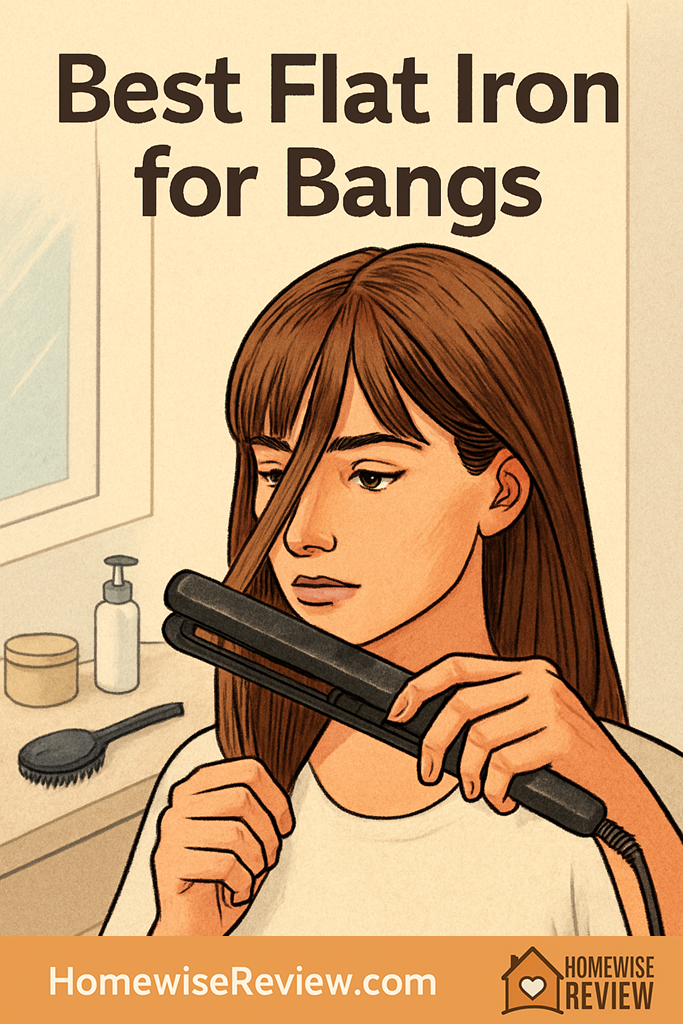
A useful flat iron for bangs needs enough control for a short section of hair without forcing you to hold a hot plate close to the scalp for longer than necessary. Plate width matters, but so do temperature control, tool size, and whether you also want to style the rest of your hair. HomeWise did not conduct a controlled hands-on test of these four tools. The comparison uses current manufacturer specifications and the practical tradeoffs those specifications create. Verify the exact model before buying because product names and dimensions can change.
As an Amazon Associate, we earn from qualifying purchases made through links on our site.
Quick comparison
| Product | Verified specification | Most practical fit | Main limitation |
|---|---|---|---|
| ghd Mini Flat Iron | 0.60-inch plates; fixed 365 F; 30-minute sleep mode; universal voltage | Short bangs and precise root-area sections | No lower temperature option |
| BaBylissPRO Nano Titanium 1/2-inch Mini | 1/2-inch plates; fixed heat up to 430 F; 6-inch body; dual voltage | Compact travel use when the fixed temperature suits the hair and directions | High fixed heat cannot be adjusted |
| ghd Platinum+ Flat Iron | 1-inch plates; fixed 365 F; 30-minute sleep mode; universal voltage | Longer fringe plus full-head styling | Less precise around very short bangs |
| Dyson Corrale | 330, 365, and 410 F; up to 30 minutes cord-free; 1.24 lb; flexing plates | Cordless touch-ups with temperature choice | Heavier and more complex than a mini iron |
How the four options were assessed
- Plate width: Narrow plates can isolate a small fringe section; a standard 1-inch tool covers more hair.
- Temperature choice: Adjustable heat offers more control than a fixed high setting, especially when hair is fine, lightened, or already damaged.
- Handling: A compact body can be easier near short hair, while a heavier cordless tool may be less comfortable for precise wrist movement.
- Secondary use: A standard-width iron is more efficient for the rest of the hair; a mini is a specialized purchase.
- Safety features: Auto shutoff, voltage information, and manufacturer directions matter, but none makes it safe to touch the scalp or use an unsuitable temperature.
ghd Mini Flat Iron: the narrow specialist
ghd’s current U.S. Mini has 0.60-inch ceramic floating plates, not the 0.5-inch measurement previously listed in this article. The manufacturer positions it for short hair, bangs, and bobs. It uses a fixed 365 F temperature, universal voltage, and a sleep mode that switches it off after 30 minutes of inactivity.
- Advantage: The narrow plate can isolate short sections and requires less space to rotate than a 1-inch iron.
- Tradeoff: There is no lower heat setting. That conflicts with the general need to use lower heat on fragile hair, so check your hair condition and the directions rather than assuming the fixed setting is suitable.
- Choose another option if: You need adjustable temperature or want to straighten long, dense hair efficiently with the same tool.
BaBylissPRO Nano Titanium 1/2-inch Mini: compact but fixed hot
The exact BNT3050UC model is a 6-inch mini iron with 1/2-inch Nano Titanium and ceramic plates, dual voltage, and a fixed operating temperature that the manufacturer lists as reaching up to 430 F.
- Advantage: It is physically compact and has the narrowest verified plate size in this comparison.
- Tradeoff: Its high fixed heat gives the user no way to start low. The American Academy of Dermatology recommends low or medium heat for flat irons, so this is not the flexible choice for fine, lightened, brittle, or frequently styled bangs.
- Choose another option if: Temperature adjustment is an important part of managing heat exposure.
ghd Platinum+: one tool for longer fringe and full-head styling
The ghd Platinum+ uses 1-inch floating plates and a fixed 365 F temperature. The manufacturer lists universal voltage, a 30-minute automatic sleep mode, and sensors that monitor plate heat. A 1-inch plate covers more hair than either mini, which can make it the more practical single-tool purchase for curtain bangs, longer face-framing pieces, and full-length styling.
- Advantage: Standard-width plates make the tool useful beyond fringe.
- Tradeoff: The larger plate leaves less room for precise work on very short bangs, and the fixed temperature cannot be reduced.
- Choose another option if: Bangs are the only section you intend to style or you need a lower heat setting.
Dyson Corrale: cordless control with more weight
Dyson lists three settings at 330 F, 365 F, and 410 F, up to 30 minutes of cord-free use, and flexing manganese-copper-alloy plates. The technical specification lists the tool at 1.24 pounds including cable and plug and says exact run time varies with hair type and technique.
- Advantage: It is the only option here that combines cordless use with three stated temperature choices.
- Tradeoff: It is heavier than a typical mini, and a cordless full-size tool is more equipment than most people need only for bangs.
- Choose another option if: Low weight, a narrow plate, or simple storage matters more than cordless operation.
Decision guide by bang length and routine
- Very short or blunt fringe: A narrow mini leaves more room to work, but compare its fixed temperature with your hair’s condition.
- Curtain bangs or long face-framing pieces: A 1-inch tool can smooth and curve a longer section while remaining useful for the rest of the hair.
- Fine, bleached, or damaged bangs: Temperature choice should take priority over a compact body. None of these recommendations replaces the tool’s instructions or professional advice.
- Frequent travel: Confirm voltage, plug adapter needs, battery airline rules, storage lock, and heat-resistant case before choosing on portability alone.
- Occasional touch-ups only: Consider whether a round brush, blow-dry technique, or the flat iron you already own can solve the problem before buying a specialist tool.
A lower-risk technique for shaping bangs
- Use a conventional flat iron only on fully dry, detangled hair.
- Follow the manufacturer’s heat-protectant and temperature directions. When adjustment is available, start lower rather than assuming more heat will create a better bend.
- Separate a thin section that fits within the plates without overlap.
- Keep the plates moving. Do not clamp in one spot or touch the scalp.
- For a soft bend, make a small wrist rotation near the ends instead of repeating the pass at a higher temperature.
- Let the section cool before deciding whether another pass is necessary.
The American Academy of Dermatology advises using flat irons on dry hair at low or medium heat and limiting frequency because excessive heat can damage hair. A fixed-temperature tool removes part of that control, which is a material drawback rather than a minor preference.
Related HomeWise comparisons
For broader use, compare the professional flat iron guide, cordless flat irons, and affordable flat irons. The Dyson Corrale review focuses on that model, while the lower-cost heat-tool guide covers alternatives when bang styling is only one need.